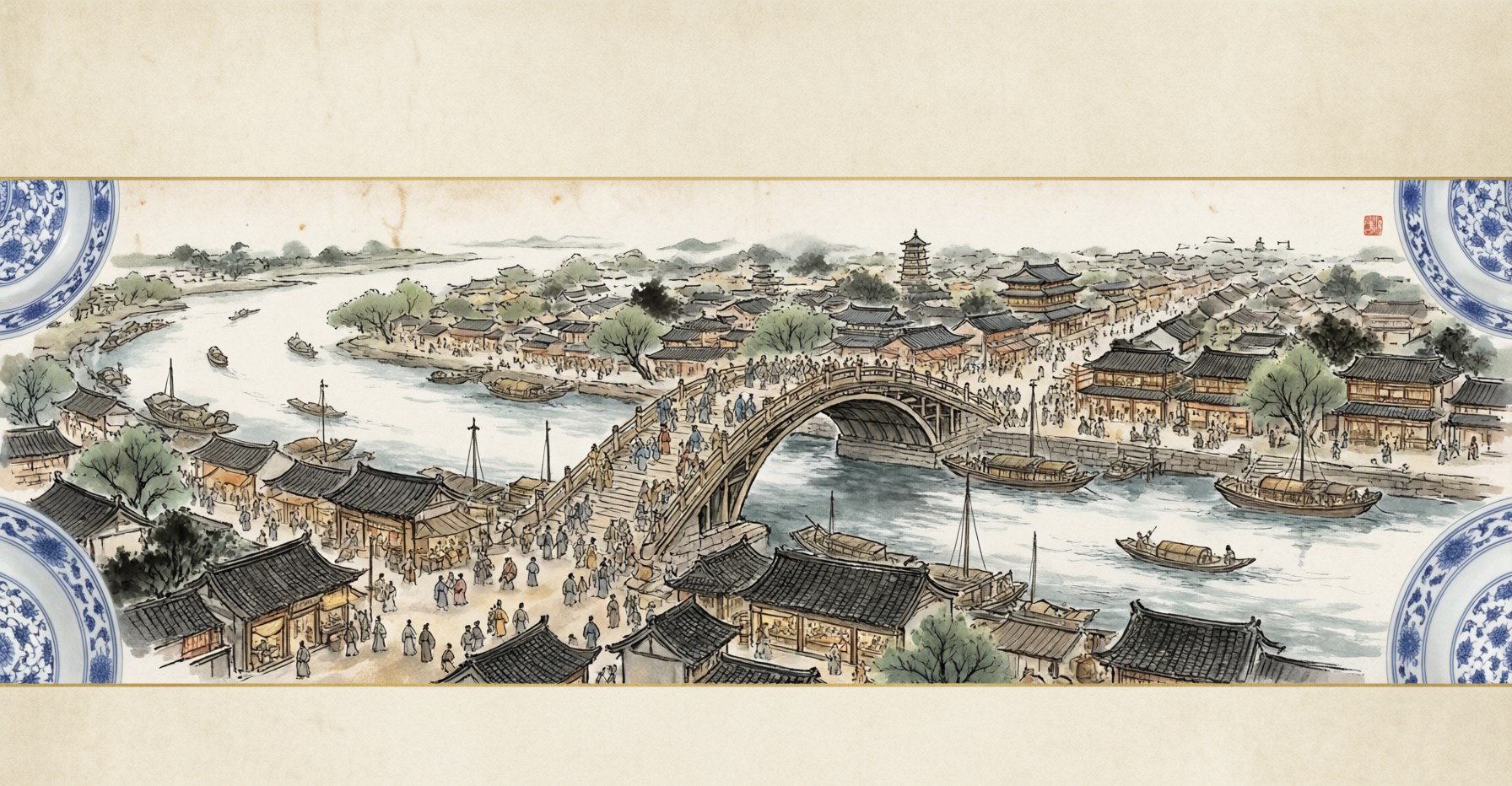
There is a famous painting, a handscroll more than five meters long, that shows a single day in a Song Dynasty city. Along the River During Qingming Festival (清明上河图) unrolls like a novel: a donkey caravan crossing a stone bridge, teahouses crowded with merchants, a fortune-teller's stall, a blacksmith, a vendor of bows and arrows, sailors hauling a barge upstream, a child peering over a railing. There are no emperors in it, no generals, no sages. There are only people buying and selling, eating and arguing, living. It is, in its quiet way, a revolutionary document — the portrait of a civilization that had discovered commerce, the city, and the dignity of ordinary life.
The Song Dynasty (宋朝, Songchao) ruled China for more than three centuries, from 960 to 1279, and it is the dynasty that, more than any other, made China feel modern. It was the age of paper money and printed books, of gunpowder and the compass, of porcelain so refined that the very word for it in English is the name of the country. It produced some of the finest landscape paintings and the most delicate poetry China has ever written, and a philosophy that would govern the Chinese mind for the next seven hundred years. And yet for all its brilliance the Song never fully controlled its own borders. It bought peace with silver and silk, lost half its territory to invaders, and died fighting on the open sea. It is the great paradox of Chinese history: the dynasty that was weakest in war was, in nearly everything else, the strongest.
The Soldier Who Chose Peace
The Song began, ironically, with a general. In the tenth century China had been shattered by half a century of chaos — the Five Dynasties and Ten Kingdoms, a time when armies made and unmade emperors and any strong commander could seize the throne. Zhao Kuangyin (赵匡胤) was one such commander, a gifted officer of the Later Zhou. In 960, on the eve of a campaign, his troops mutinied and draped a yellow robe over his shoulders — the traditional signal of a forced coronation — and he marched back to the capital to take the throne almost without bloodshed. He became Emperor Taizu of Song.
Taizu understood better than anyone how he had come to power, and he was determined that no one would do to him what he had done to his predecessors. The genius of his solution was its restraint. According to a celebrated story — likely embellished by later historians, but true in spirit — he invited his most powerful generals to a banquet, and over wine gently persuaded them to surrender their commands and retire to a life of land, wealth, and leisure. No heads rolled. He simply bought them out. The episode is remembered as "releasing military power over a cup of wine" (杯酒释兵权).
From that moment the Song made a deliberate, fateful choice: civil power would rule over military power. Generals were rotated, kept from forming personal loyalties with their troops, and placed under the authority of civilian officials. The examination system was expanded until the scholar-official (士大夫, shidafu) became the empire's true ruling class — men who had earned their place through years of study rather than birth or battlefield prowess. It made for an extraordinarily refined, literate, and humane government. It also made for a chronically weak army. The Song would spend three centuries paying the price for Taizu's wise and dangerous decision.
Two Capitals, Two Dynasties
Historians divide the Song into two halves, and the division is not merely academic — it is a wound that runs through the dynasty's memory. The Northern Song (北宋, 960–1127) ruled from the great city of Kaifeng, then called Bianjing, on the Yellow River plain. It was a vast, flat, vulnerable capital, rich and exposed, and the Song spent its early decades in uneasy coexistence with the Khitan Liao Dynasty to the north and the Tangut Western Xia to the northwest. When war threatened, the Song preferred to pay. In 1005, after a Liao army pushed deep into Song territory, the two sides agreed to the Chanyuan Treaty, by which the Song sent the Liao an annual gift of silk and silver. It was humiliating to the proud, but it bought more than a century of peace — and peace, for the Song, meant prosperity beyond anything China had yet seen.
The peace ended in catastrophe. In the early twelfth century the Song made the catastrophic miscalculation of allying with the rising Jurchen Jin Dynasty to destroy their old Liao rivals. The Jin did the job, then turned on their ally. In 1127 Jurchen armies stormed Kaifeng, captured the emperor and his retired father, and carried the imperial family and the treasures of the court north into captivity. The event is remembered as the Jingkang Incident (靖康之耻), the "Humiliation of Jingkang," and it has never been forgotten. A surviving prince fled south, regrouped, and reestablished the dynasty at Lin'an — modern Hangzhou — on the shores of the beautiful West Lake. This was the Southern Song (南宋, 1127–1279), a diminished empire that held the rich lands south of the Yangzi but had lost the cradle of Chinese civilization in the north.
For the rest of its life the Southern Song was haunted by the question of recovery. Should it march north and reclaim its lost capital, or accept the new borders and cultivate what it had? The debate consumed its politics and broke its finest hearts.
The World's First Modern Economy
If the Song was weak on the battlefield, it was without rival in the marketplace. The three centuries of Song rule saw an economic transformation so profound that some historians have spoken of a "commercial revolution" — and the comparison, allowing for the difference of scale, is not unfair. For the first time in Chinese history, and arguably in world history, a genuinely urban, market-driven economy came into being.
The old Tang Dynasty cities had been rigidly regulated, their markets confined to walled districts that opened and closed at the sound of a drum. The Song swept all of this away. In Kaifeng, and later in Hangzhou, shops opened onto the street, trade spilled into the night, and the line between residential and commercial life dissolved. Restaurants, theaters, teahouses, and pleasure quarters lined the avenues. Hangzhou, the Southern Song capital, grew into one of the largest cities on earth, a place of canals and bridges that astonished every visitor. It was here, centuries before Europe developed anything comparable, that a true urban culture was born — a culture of entertainment, fashion, gossip, and consumption, immortalized in the Qingming scroll.
"In the great city of Hangzhou there are ten principal markets, and beside them a countless number of others... and all the streets are paved with stone and brick, so that one may ride and travel everywhere without being incommoded by mud." — adapted from Marco Polo's account of the Southern Song capital, Kinsai
The sheer volume of trade outran the supply of metal coin, and necessity drove the Song to one of their most consequential inventions: paper money. The first true banknotes, called jiaozi (交子), appeared in Sichuan around the turn of the eleventh century, originally as receipts issued by merchants and later taken over and regulated by the state. By the Southern Song, government-issued notes circulated widely across the empire. It was an idea so far ahead of its time that Europe would not adopt paper currency on any scale for several more centuries. The Song had discovered that money could be a matter of trust rather than weight — and, in time, they would also discover the dangers of printing too much of it.
The Four Great Inventions Come of Age
China's "Four Great Inventions" (四大发明) — papermaking, printing, gunpowder, and the compass — are often listed as national achievements, but it was under the Song that three of them reached maturity and began to change the world. The Song were not always the original inventors, but they were the ones who turned clever ideas into civilization-changing realities.
Printing is the clearest example. Woodblock printing had existed since the Tang, but around the 1040s a craftsman named Bi Sheng (毕昇) devised movable type — individual clay characters that could be arranged, inked, printed, and rearranged for the next page. The technique was laborious for Chinese, with its thousands of characters, and never fully displaced woodblocks at home; yet the idea traveled westward and, centuries later, helped ignite the European printing revolution. In the Song itself, the explosion of cheap printed books transformed education, spread knowledge, and fed the examination culture that defined the age.
Gunpowder, known to Chinese alchemists since the Tang as a curiosity, became a weapon of war under the Song. Facing cavalry armies they could not match on the open plain, Song engineers turned to fire: fire arrows, fire lances, bombs hurled by catapult, and crude proto-cannons. The Song military manuals describe these devices in detail. It was a defensive, desperate ingenuity — and it set gunpowder on its long road toward reshaping warfare everywhere. The magnetic compass, too, was refined in this era; Song navigators used magnetized needles to find their bearings at sea, opening the way for the great maritime trade that would carry Chinese ships across the Indian Ocean.
The Aesthetic of Restraint
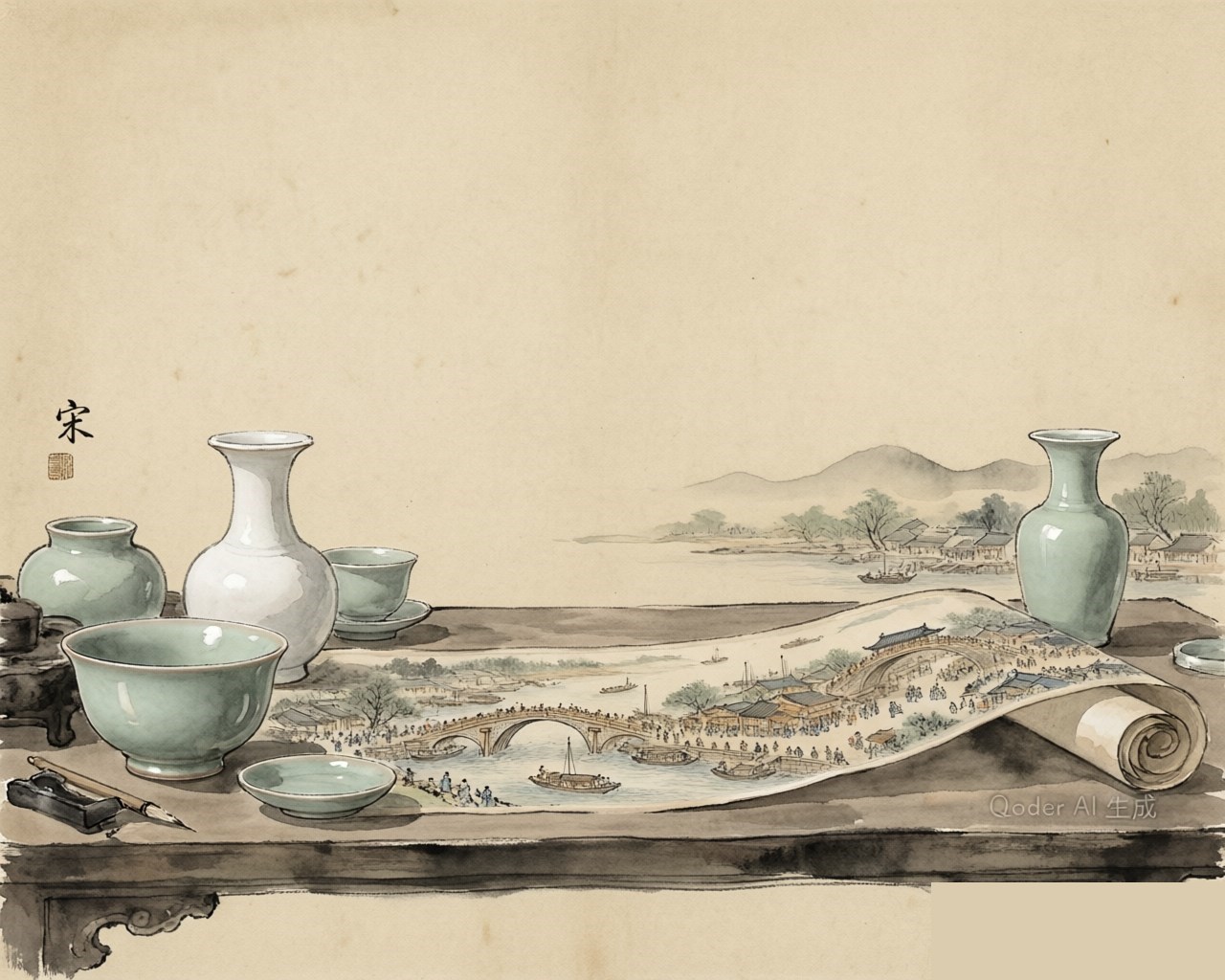
For all its commercial energy, the Song taste in art was the opposite of showy. Where the Tang had loved gold, color, and abundance, the Song prized subtlety, silence, and the beauty of almost-nothing. Nowhere is this clearer than in their ceramics. Song potters pursued a single ideal: the perfect glaze. The most coveted of all are the wares made for the imperial court at Ru (汝窑), produced for only a few decades and surviving today in barely more than a handful of pieces. Ru ware is a pale, misty blue-green — the color, the Chinese say, of "the sky after rain" — its surface faintly crackled, its form utterly plain. There is no painting, no ornament, nothing to distract from the quiet perfection of the shape and the glaze. To hold one is to understand an entire civilization's idea of beauty.
The same restraint governs Song painting. This was the golden age of Chinese landscape (山水画, shanshui), the painting of mountains and water. Song masters such as Fan Kuan and Guo Xi painted vast, towering compositions in which tiny human figures — a traveler, a fisherman, a scholar in a pavilion — are dwarfed by immense cliffs and empty mist. The empty space is the point: it is the Dao, the breath of the world, the reminder that human concerns are small against the scale of nature. Later, under the Southern Song, painters such as Ma Yuan and Xia Gui pared the landscape down still further — a single branch, a lone boat, a corner of mountain dissolving into blank silk. The West sometimes mistakes this for emptiness. It is the opposite: it is fullness distilled.
The age also perfected the ci (词), a lyric poem set to a musical tune, supple and intimate, made for expressing longing, parting, and the small sorrows of the heart. Poets like Su Shi and Li Qingzhao — the latter widely regarded as the greatest woman poet in Chinese history — gave the form its lasting voice. And in philosophy, the great synthesizer Zhu Xi (朱熹) gathered the scattered insights of earlier thinkers into Neo-Confucianism (理学, lixue), a moral metaphysics that read the patterns of the universe into the patterns of the human heart. Zhu Xi's commentaries on the Confucian classics became the orthodox curriculum of the examinations and shaped the educated Chinese mind down to the twentieth century.
Loyalty, Betrayal, and the End at Sea
The Song's cultural triumph could not save it from its military failure, and the dynasty's last century is a long, sad story of pressure from the north. The greatest tragedy of the Southern Song belongs to Yue Fei (岳飞), the general who came closest to recovering the lost north. Yue Fei was a brilliant commander whose disciplined army won victory after victory against the Jurchen Jin. Just as his campaign seemed on the verge of success, the chief minister Qin Hui — long remembered as the archetype of the treacherous official — persuaded the emperor to recall him, and Yue Fei was imprisoned and put to death on charges that even his prosecutors struggled to define. When asked what crime justified the execution, Qin Hui is said to have replied, with chilling vagueness, "perhaps there is" (莫须有). Yue Fei became the supreme symbol of loyalty betrayed, and his memory is honored to this day.
The final blow came from a new and far more terrible enemy: the Mongols. Having conquered the Jin in the north, the Mongol armies turned south, and the Southern Song fought them for decades with a stubbornness that surprised the conquerors. But the end, when it came, was total. In 1279, the last remnants of the Song court — a child emperor and his loyal ministers — were cornered by a Mongol fleet at the Battle of Yamen (崖门), off the southern coast. Rather than surrender, the minister Lu Xiufu is recorded as taking the young emperor in his arms and stepping with him into the sea, while thousands of loyal followers followed them into the water. The Song Dynasty ended not with a treaty or a capitulation but with an act of desperate, heartbreaking fidelity.
The Legacy of the Cultured Empire
The Song left China a different civilization than the one it inherited, and the changes it made proved permanent. It bequeathed to later ages the technologies that would reshape the world — printing, gunpowder, the compass, paper money — and an aesthetic of restraint and refinement that remains, for many, the highest expression of Chinese taste. Its Neo-Confucian philosophy governed education and morality for seven centuries. Its model of the scholar-official, selected by examination rather than birth, became the enduring ideal of Chinese government. And its cities created a commercial, urban culture that never entirely disappeared.
Yet the Song also left a cautionary tale that the Chinese have pondered ever since. A civilization can be the most advanced, the most prosperous, the most cultured on earth — and still be unable to defend itself. The Song's choice to elevate the civil over the military bought it refinement and peace, but it left the dynasty exposed to every horseman on the steppe, and in the end the most sophisticated society in the world was conquered by the most austere. The tension between culture and power, between the life of the mind and the demands of survival, runs through Chinese history from the Song onward.
To love the Song is to love China at its most civilized — its misty mountains, its celadon cups, its printed books and paper notes, its poets sighing over the moon on the West Lake. It is also to grieve for it. No dynasty is more beloved, and none more pitied. The Song proved that a people could reach the heights of art and thought and commerce and still fall — and that what they built, even so, would outlast every army that destroyed them.