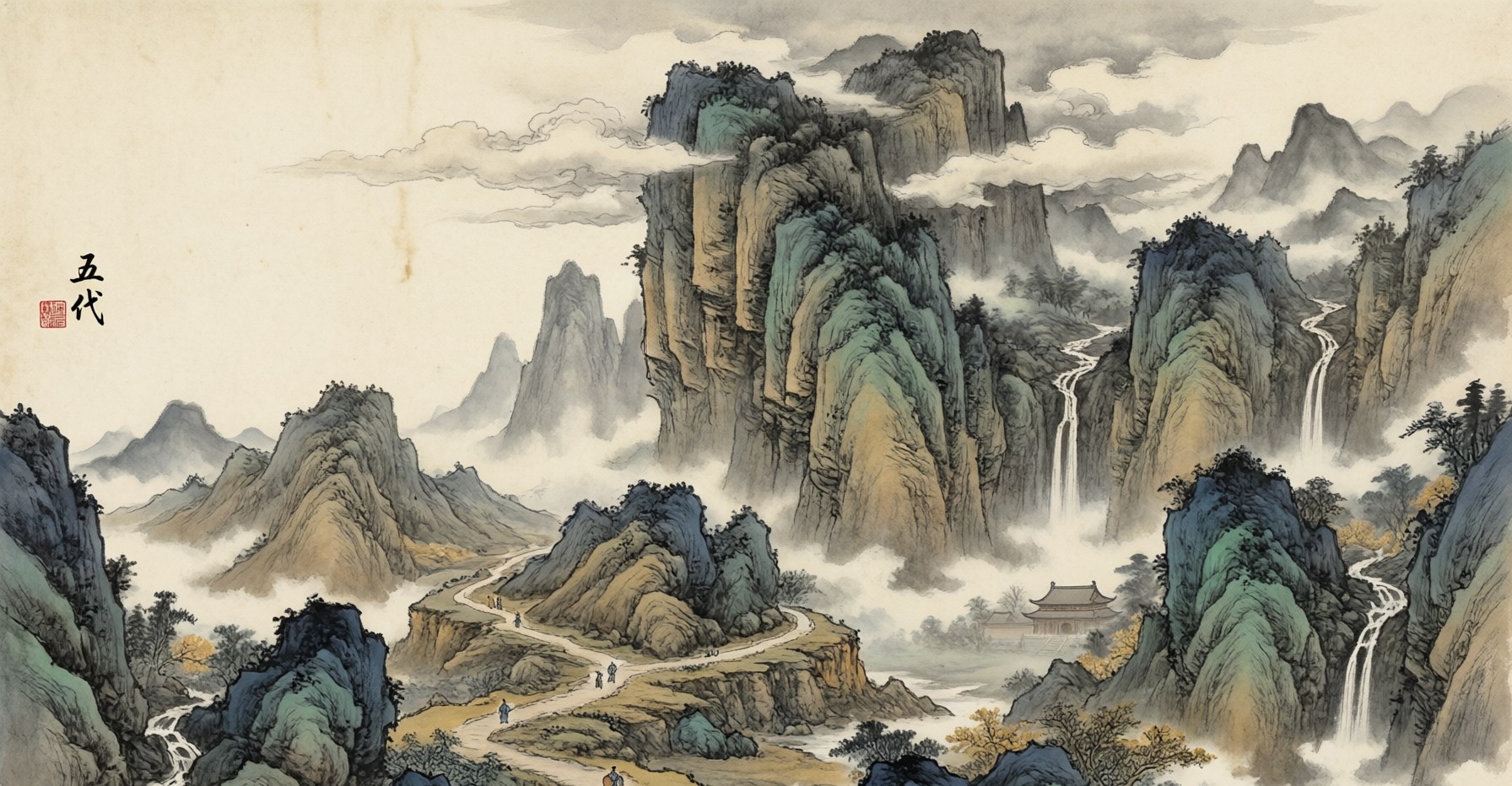
Between the grandeur of the Tang and the refinement of the Song lies a half-century that most people would prefer to skip. The Five Dynasties and Ten Kingdoms period (五代十国, 907–960) is, on the surface, everything the Chinese historical imagination most dislikes: fragmentation, military usurpation, short-lived regimes, and the humiliation of a civilization that had, for three centuries, considered itself the center of the world. Five dynasties rose and fell in the north in barely fifty years. A scattering of kingdoms carved up the south. War was constant, loyalty was optional, and the old Tang capital of Chang'an was reduced to a provincial town. And yet — and this is the paradox that makes the period endlessly fascinating — it was precisely in this age of collapse that Chinese artists invented the visual language that would define their civilization for the next thousand years. The monumental landscape painting tradition, the spread of printed books, the lyric poetry of the ci form — all were born or matured in the crucible of division. Chaos, it turned out, was a better midwife to art than stability.
The Collapse: How the Tang Fell Apart
The Tang Dynasty did not die in a single blow. It bled out over decades. The An Lushan Rebellion of 755 had broken the dynasty's military and political spine, leaving a patchwork of semi-autonomous regional commanders — the jiedushi (节度使) — who collected their own taxes, maintained their own armies, and passed their positions to sons or chosen heirs with only nominal reference to the court. The late Tang emperors were often puppets of palace eunuchs; the provinces were effectively independent. When the great Huang Chao rebellion swept through the south and sacked both Guangzhou and Chang'an in the 870s and 880s, whatever remained of central authority evaporated.
The final act was sordid and swift. The warlord Zhu Wen (朱温), once a lieutenant of Huang Chao who had defected to the Tang side, spent two decades consolidating power in the central plains. In 904 he forced the court to move from Chang'an to Luoyang, and in 907 he compelled the last Tang emperor — a boy of sixteen — to abdicate in his favor. Zhu Wen declared himself founder of the Later Liang Dynasty (后梁), and the Tang was over. No one mourned it as a political entity; the dynasty had been a hollow shell for years. But the cultural world it had built — the poetry, the painting, the cosmopolitan confidence — would prove harder to kill.
Five Dynasties in the North: A Carousel of Power
In the north, the half-century after 907 saw five dynasties succeed one another in rapid, violent rotation, each founded by a military strongman who seized the throne from his predecessor and was in turn overthrown. The Later Liang (后梁, 907–923) gave way to the Later Tang (后唐, 923–936), which fell to the Later Jin (后晋, 936–947), which was replaced by the Later Han (后汉, 947–951), which yielded to the Later Zhou (后周, 951–960). The "Tang" and "Han" in these names were aspirational — attempts to borrow legitimacy from the great dynasties of the past — but the reality was that each regime lasted, on average, little more than a decade.
The pattern was grimly consistent. A general would accumulate military power on the frontier, march on the capital, depose or murder the reigning emperor, and install himself. His own generals would then eye him with the same ambition. Loyalty was a luxury no one could afford; the period's defining political ethic was naked pragmatism. The Later Jin emperor Shi Jingtang famously ceded the strategically vital Sixteen Prefects — a swath of territory around modern Beijing — to the Khitan Liao Dynasty in exchange for military support, a decision that would haunt Chinese defense for two centuries. The north was a place where armies made and unmade emperors, and where the old Confucian ideal of the scholar-official counted for little against the sword.
"In the Five Dynasties, the Son of Heaven was made by strong soldiers and swift horses. What need was there of noble birth?" — An Zhongrong, a Later Tang general, as recorded in the Zizhi Tongjian
Ten Kingdoms in the South: Islands of Stability
While the north churned, the south — shielded by the Yangzi River and its tributaries from the worst of the cavalry wars — fragmented into a constellation of smaller but generally more stable states. Historians conventionally count ten, though the actual number varied over time. Among the most culturally significant were the Southern Tang (南唐, 937–975), centered on Nanjing; Wuyue (吴越, 907–978), based in Hangzhou; and the two Shu kingdoms — Former Shu (前蜀) and Later Shu (后蜀) — in the fertile Sichuan basin.
These southern kingdoms were, in a real sense, the inheritors of Tang civilization. Their courts patronized poets, painters, and musicians; their rulers collected books and sponsored academies; their economies, fed by rice agriculture and river trade, remained prosperous even as the north bled. Wuyue's rulers, the Qian family, were celebrated for their policy of peaceful submission — they developed the Hangzhou region's waterways and eventually surrendered to the Song without a fight, sparing their people further war. The Shu kingdoms, protected by the mountain walls of Sichuan, became refuges for Tang-era artists and scholars who fled the northern chaos. It was in this environment of relative peace and deliberate cultural patronage that the arts of the Tang were preserved, refined, and transformed into something new.
Mountains in Ink: The Birth of Monumental Landscape
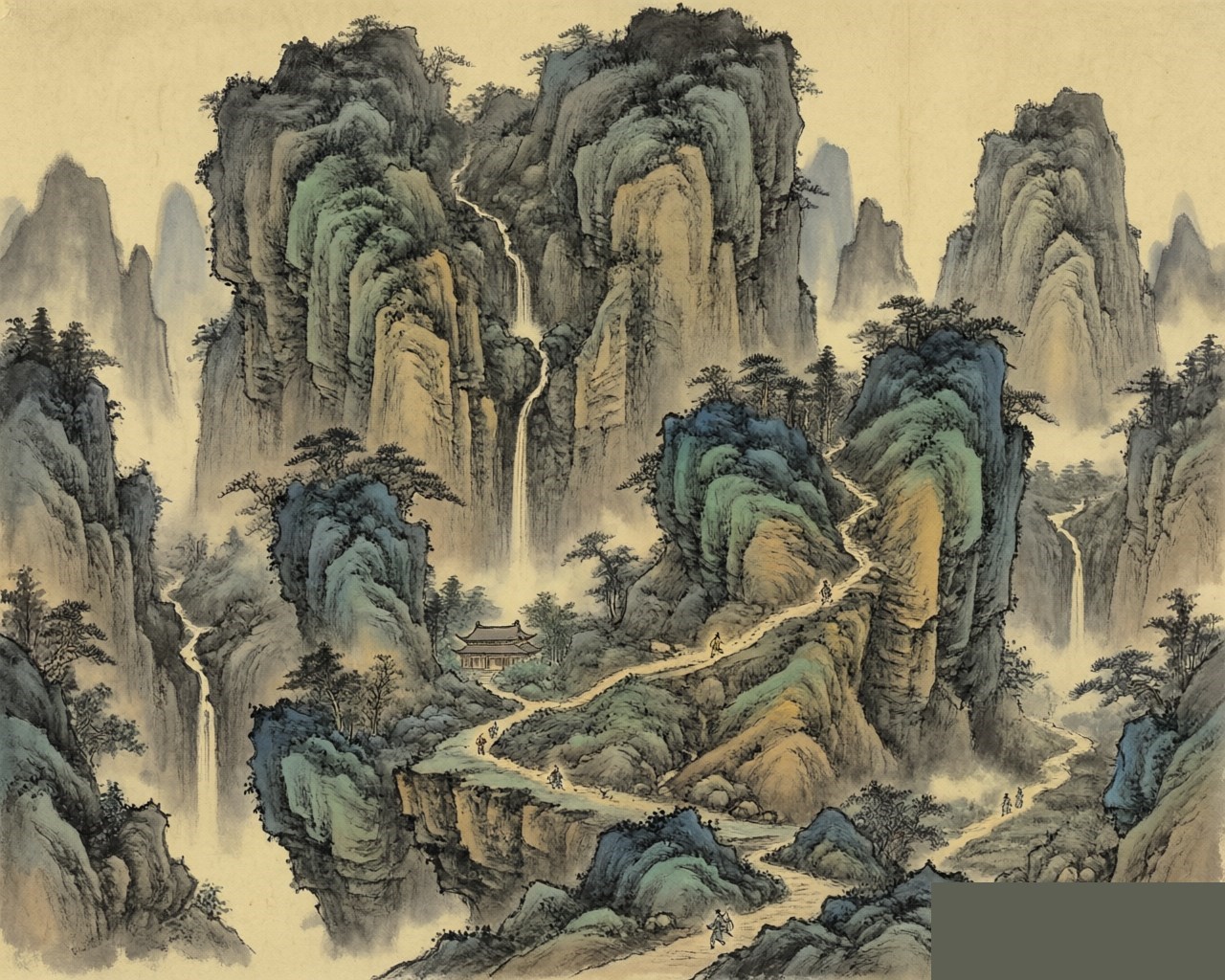
If the Five Dynasties gave China one thing that outlasted all its wars, it was the landscape painting tradition. Before this period, Chinese painting had been dominated by figure painting — portraits, narrative scenes, Buddhist icons. Mountains appeared as decorative backdrops, stylized and subordinate to the human drama in the foreground. In the first half of the tenth century, a group of artists working in the northern mountains and the southern riverlands transformed landscape from backdrop to subject, from ornament to philosophy.
In the north, Jing Hao (荆浩) and his follower Guan Tong (关仝) painted the vast, austere peaks of the Taihang Mountains — towering cliffs rendered in sharp, angular brushstrokes that conveyed the terrible grandeur of stone. Their compositions placed the viewer at the foot of mountains so immense that human figures, when they appeared at all, were reduced to specks. This was not mere scenery; it was a vision of the cosmos in which humanity was small, transient, and properly humble before the enduring forms of nature. In the south, Dong Yuan (董源) and his student Juran (巨然) developed a gentler idiom for the low, misty hills and broad rivers of the Yangzi delta — soft, rounded forms, layered washes of ink, a sense of infinite atmospheric depth. Together, these two traditions — the monumental northern style and the lyrical southern style — established the grammar of Chinese landscape painting (山水画, shan shui hua, literally "mountain-water painting") that every subsequent dynasty would inherit, argue with, and return to.
The reasons for this flowering in an age of chaos are not hard to find. When the human world offers nothing but betrayal and violence, the mountains offer permanence. When courts rise and fall in a decade, the peaks endure for millennia. The landscape painters of the Five Dynasties were not escaping reality; they were asserting a deeper order beneath the political chaos, finding in the forms of nature a stability that history had denied them.
The Printed Word: A Revolution in Knowledge
The Five Dynasties also witnessed a transformation in how knowledge was reproduced and disseminated — one whose consequences would dwarf any single dynasty's rise or fall. Woodblock printing had existed in China since at least the Tang (the Diamond Sutra scroll of 868 is the world's earliest dated printed book), but it was during the Five Dynasties that printing moved from a craft practiced by Buddhist monasteries and private workshops to a tool of state policy. In the Later Tang and Later Zhou, the government undertook the first official printing of the Confucian classics — the massive project known as the Jiuyin jingdian — making the canonical texts available in standardized, affordable editions for the first time.
The implications were enormous. Before printing, books were hand-copied, expensive, and rare; a scholar's library was a mark of aristocratic privilege. After printing, knowledge could be multiplied. The civil-service examinations, already important in the Tang, would in the Song Dynasty become the dominant path to official career — and that transformation was made possible by the printed textbooks and study guides that the Five Dynasties pioneered. In the southern kingdoms, too, printing flourished: the Shu and Southern Tang courts produced printed editions of literary collections, Buddhist scriptures, and even early forms of paper currency. The information revolution that would make Song China the most literate civilization on earth was set in motion here, in the midst of political collapse.
Li Yu: The Poet Who Lost a Kingdom
No figure embodies the Five Dynasties' strange alchemy of loss and beauty more perfectly than Li Yu (李煜, 937–978), the last ruler of the Southern Tang. A man of exquisite artistic sensibility — a poet, calligrapher, painter, and musician — Li Yu was spectacularly unsuited to the business of defending a small kingdom against the rising Song Dynasty. When Song armies took his capital in 975, he surrendered and was carried north to the Song court at Kaifeng, where he lived as a captive, stripped of his throne but permitted to write.
What he wrote in captivity is among the most beloved lyric poetry in the Chinese language. His ci (词) — song lyrics set to existing musical tunes — transformed the form from a vehicle for courtesan's entertainment into a medium of profound personal grief and philosophical reflection. Lines like "Ask me how much sorrow I have — / it is like a river of spring water flowing east" (问君能有几多愁,恰似一江春水向东流) have been memorized and quoted for a thousand years. The Song emperor who held him captive reportedly had him poisoned — legend holds that a cup of wine laced with poison was sent on his birthday — though the details are debated. What is certain is that Li Yu's poetry survived its author by centuries, and that his suffering gave Chinese literature some of its most achingly beautiful expressions of loss. He lost a kingdom; he gave the language a way to speak of sorrow that has never been surpassed.
Zhao Kuangyin, Reunification, and Legacy
The chaos of the Five Dynasties ended, as it had begun, with a general. In 959, the Later Zhou emperor died young, leaving a child on the throne. His most trusted commander, Zhao Kuangyin (赵匡胤), was dispatched north to meet a reported Khitan invasion. At a place called Chen Bridge (陈桥), his troops mutinied — or, as later Song historians preferred to tell it, spontaneously draped a yellow robe over their sleeping general and proclaimed him emperor. Whether the mutiny was staged or genuine is one of Chinese history's enduring questions; Zhao Kuangyin himself insisted on the latter. In any case, he returned to the capital, accepted the child-emperor's abdication with conspicuous gentleness, and in 960 founded the Song Dynasty (宋朝).
Zhao Kuangyin — posthumously Emperor Taizu of Song — spent the next sixteen years reunifying China, conquering or persuading the southern kingdoms one by one. He was notably reluctant to use force where negotiation would serve, and he treated deposed rulers with a courtesy that contrasted sharply with the Five Dynasties' norm of murder. More importantly, he restructured the entire relationship between military and civil power. Remembering that every Five Dynasties regime had been overthrown by its own generals, Taizu famously invited his senior commanders to a banquet and, over wine, persuaded them to surrender their military commands in exchange for wealth, land, and comfortable retirement — the episode known as "releasing military power over a cup of wine" (杯酒释兵权). The Song Dynasty that emerged from this revolution was governed by scholar-officials, not generals; it would never again be easy for a frontier commander to march on the capital. The age of the warlord was over. The age of the literatus had begun.
The Five Dynasties and Ten Kingdoms lasted barely half a century — a brief interregnum between two of China's greatest dynasties. It is tempting to dismiss it as a footnote, a dark corridor between two luminous rooms. But that would be to misunderstand how civilizations work. The Tang gave China its confidence; the Song gave it its refinement. The Five Dynasties gave it something harder to name but equally essential: the knowledge that beauty and meaning can be forged in the midst of collapse, that the destruction of political order does not mean the destruction of culture, and that sometimes the most enduring art is made not in palaces but in mountain retreats, not by emperors but by exiles and refugees and men who have lost everything except their brushes and their grief.
The landscape painters of the Five Dynasties gave Chinese art its highest subject and its deepest philosophy. The printers gave it the means to spread knowledge to millions. The poet-kings of the southern courts preserved the Tang literary heritage and refined it into new forms. And the political trauma of the period — the visceral, generation-deep memory of what happens when military power goes unchecked — gave the Song Dynasty its defining conviction: that civilian government, however inefficient, was preferable to the rule of the sword. Every brushstroke of Song literati painting, every printed examination essay, every quiet garden designed for contemplation rather than display, carries within it the memory of the Five Dynasties — the age that taught China, at terrible cost, what it most valued and what it could not bear to lose again.