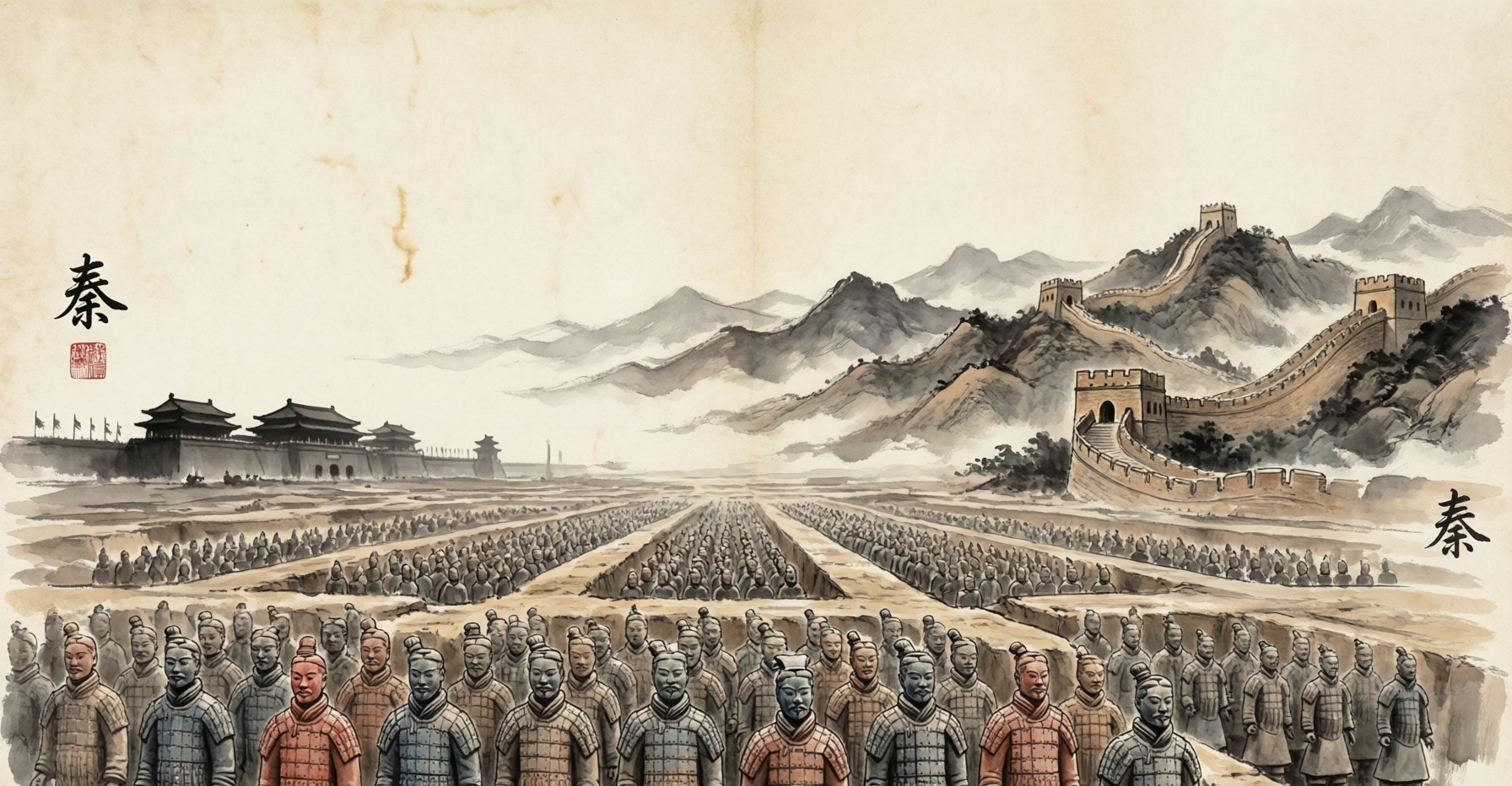
Of all the dynasties in China's long record, none was shorter than the Qin, and none more consequential. It lasted barely fifteen years — a single human lifetime, a rounding error against the four thousand years that surround it. Yet in that brief flare of power it accomplished something that five centuries of war had failed to do: it made China one. The very name by which the world knows the country is, most likely, an echo of "Qin." To understand China as a single, continuous civilization rather than a collection of warring states, you must begin here, with a dynasty that ruled through fear and fell through fear, and that left behind an army of clay soldiers to guard an emperor in the dark.
From Western Backwater to Superpower
The Qin did not begin as conquerors. For centuries they were a semi-frontier state on the western edge of the Chinese world, in what is now Shaanxi, looked down upon by the cultured states of the central plains as half-barbarian, rough, and provincial. Their land bordered the nomadic steppe, and they spent their early history fighting horsemen as much as rival Chinese. It was precisely this marginal position that made them dangerous. Unburdened by the aristocratic traditions that stiffened the older states, the Qin were free to remake themselves from the ground up.
The transformation began in 356 BCE, when Duke Xiao of Qin put his faith in a ruthless reformer named Shang Yang. Shang Yang was an adherent of Legalism (法家, fajia) — a school of thought that held that human beings were driven not by virtue but by self-interest, and that a state grew strong not through moral example but through clear laws, harsh punishments, and rich rewards. Under Shang Yang, Qin society was reorganized into a machine. Noble birth counted for nothing; advancement came only through measurable achievement, above all in war and agriculture. Families were grouped into units of mutual surveillance, so that neighbors spied on neighbors and crime became everyone's business. The aristocracy was stripped of its hereditary privileges and the population registered, taxed, and mobilized with an efficiency the other states could not match.
The result was a state of terrifying discipline. Where the rival kingdoms fought with feudal levies led by hereditary lords, Qin fielded a professional, meritocratic army whose soldiers were said to go into battle bare-chested, carrying severed enemy heads at their belts to claim their rewards. Generation after generation, the Qin expanded eastward, swallowing territory with the patience of a rising tide. By the time a boy named Ying Zheng took the throne of Qin in 246 BCE, at the age of thirteen, his kingdom was already the strongest of the seven Warring States. What remained was only a matter of will.
The First Emperor
Ying Zheng would become the most consequential single ruler in Chinese history. Between 230 and 221 BCE, in a decade of relentless campaigning, his armies conquered the other six Warring States one by one — Han, Zhao, Wei, Chu, Yan, and Qi — until, for the first time, all of the Chinese world answered to a single throne. The age of the Warring States, which had bled the land for more than two hundred years, was over.
Having done what no man had done before, Ying Zheng decided that no existing title could contain him. The old word wang (king) was not enough; it was shared by the rulers he had just destroyed. So he reached back into legend, took the titles of the mythical Three Sovereigns and Five Emperors, and fused them into a new name: Huangdi (皇帝), usually translated as "Emperor." He became Qin Shi Huangdi — the First August Emperor of Qin — and declared that his dynasty would pass to a second emperor, a third, and onward "for ten thousand generations." He also abolished the practice of giving rulers posthumous names, judging it impertinent for sons to sit in judgment on their fathers. He intended the Qin line to outlast time itself.
"The First Emperor unified all under heaven, yet he trusted in punishment and did not trust in virtue. Therefore his dynasty did not last." — Sima Qian, Records of the Grand Historian (Shiji)
The Work of Unification
Conquest was the easy part. The harder task — the one that earned the Qin their place in history — was turning seven separate kingdoms into one country. The First Emperor and his formidable chancellor Li Si set about it with the same ruthless efficiency that had won the wars, and in a few short years they laid foundations that would hold for two millennia.
They abolished the feudal system outright. Instead of enfeoffing relatives and generals as hereditary lords — the arrangement that had slowly torn the old Zhou order apart — they divided the empire into commanderies and counties governed by officials appointed, paid, and dismissed by the center. Power no longer ran through blood; it ran through bureaucracy. This was, in essence, the invention of the Chinese civil state, and every dynasty from the Han to the Qing would govern on the same basic principle.
Then they standardized everything that could be standardized. Before the Qin, each state had used its own script, its own coins, its own weights and measures, even its own axle widths — so that carts from one kingdom could not run smoothly in the ruts of another. The Qin imposed a single unified script (小篆, the "small seal" style), a single currency, a single system of weights and measures, and a single axle width for carts. They built a vast network of roads and canals radiating out from the capital at Xianyang, binding the empire together physically as the new script bound it together culturally. The unification of writing was perhaps the most fateful act of all: it meant that people who spoke mutually unintelligible dialects could read the same texts and share the same written civilization. It is no exaggeration to say that the cultural unity of China was forged in this moment.
The Great Wall and the Burning of Books
Two Qin projects have lodged in the world's imagination more than any others, and both reveal the dynasty's character — its grandeur and its brutality in the same breath.
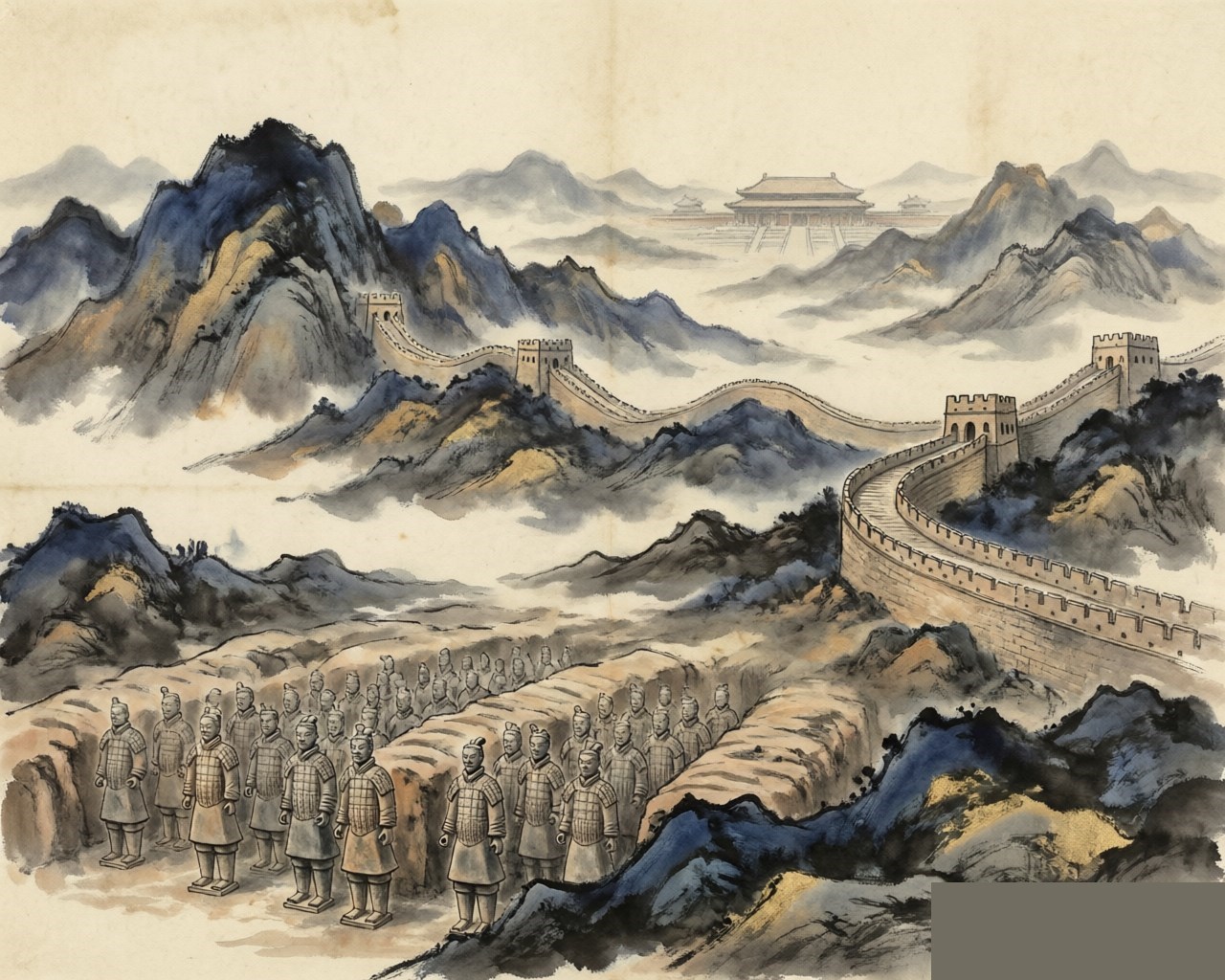
To the north, nomadic confederations — above all the Xiongnu — pressed against the frontier. Earlier states had each built their own border walls; the First Emperor ordered them linked and extended into a single continuous barrier, the first Great Wall (长城, Changcheng). Hundreds of thousands of conscripted laborers were sent to build it, and untold thousands died in the work. The wall was less a fortification than a statement: here civilization ended, and the steppe began. It drew a line that Chinese rulers would keep redrawing for two thousand years.
The other great project was an assault not on barbarians but on ideas. In 213 BCE, on Li Si's advice, the First Emperor ordered the burning of books. Histories of the conquered states, the poems of the Shijing, and the philosophical writings of the Hundred Schools — above all the Confucian classics, which praised the old feudal order the Qin had destroyed — were to be surrendered and destroyed. Only practical manuals on medicine, agriculture, and divination were spared. A year later, tradition holds that hundreds of scholars who defied the decree were buried alive. The "burning of books and burying of scholars" (焚书坑儒) became, for all later ages, the supreme symbol of tyranny's war on the life of the mind. It also ensured that the Qin would be remembered, above all, as villains.
An Emperor in the Dark
For all his power, the First Emperor was haunted by one enemy he could not conquer: death. He became obsessed with finding the elixir of immortality, dispatching expeditions to seek mythical islands of the blessed and swallowing alchemical potions that probably contained mercury — the very substance, ironically, that would help preserve his tomb. He died in 210 BCE, far from home on one of his endless inspection tours, aged about forty-nine.
What he left beneath the earth is almost beyond belief. Discovered by accident in 1974 by farmers digging a well near modern Xi'an, the mausoleum of the First Emperor is one of the great archaeological wonders of the world. Its outer army — the terracotta warriors — stands in battle formation across vast underground pits: thousands of life-sized soldiers, each with an individual face, arranged with their horses and chariots and bronze weapons, oriented eastward toward the lands he conquered. They were meant to guard him in death as his armies had in life. The inner tomb mound itself, a pyramid of rammed earth, has never been fully excavated; ancient sources describe rivers of mercury flowing through a model of the empire, and modern soil tests have found mercury levels high enough to suggest the stories may be true. The emperor who unified the world took a copy of it with him into the dark.
The Fall: Fifteen Years and Then Nothing
The First Emperor's grand plan — a dynasty of ten thousand generations — collapsed almost the moment he was buried. His death was concealed by his entourage long enough for a eunuch and a compliant minister to forge a will, install a weak younger son on the throne, and force the capable heir to kill himself. The second emperor proved a puppet and a fool, and the court descended into paranoia and murder.
The empire, stretched to breaking by decades of forced labor and harsh law, snapped. In 209 BCE, a group of conscripts caught in the rain and facing execution for lateness — under Qin law, the penalty was death regardless of the cause — decided they had nothing left to lose and revolted. Rebellions erupted across the land, led by men of no noble birth, including a peasant named Liu Bang and a brilliant young general named Xiang Yu. Within three years the Qin capital had fallen, the imperial palace had been burned, and the last Qin ruler had surrendered. The dynasty that was to last ten thousand generations had lasted fifteen years.
The Qin Paradox: Tyranny That Built a Civilization
The Qin present a paradox that runs through much of Chinese history: the things later ages most condemned were also the things that most endured. The Legalist cruelty, the burning of books, the forced labor that built the wall and the tomb — these became the textbook examples of how not to rule. The Han Dynasty that rose from the Qin's ashes explicitly defined itself against them, replacing naked Legalism with a gentler blend that made room for Confucian virtue. And yet the Han kept nearly everything the Qin had built: the commandery system, the unified script, the standardized weights and measures, the roads, the bureaucracy, the very idea of a single united empire governed from a center.
This is the Qin's true legacy. They were the dynasty that imagined China as a unity and then, by sheer force of will, made it real. The structure they imposed was so sound that it survived their own extinction and became the permanent shape of Chinese civilization. Every educated Chinese person since has lived inside institutions the Qin invented, writing in a script the Qin standardized, within borders the Qin first dared to draw. The dynasty died; the idea it built did not. In the end the First Emperor got something like the immortality he craved — not for his bloodline, but for his blueprint.
To stand today before the silent ranks of the terracotta army is to stand before the birth of China itself — a civilization that chose, at its founding, unity over division, order over freedom, and the long view over the merciful one. Whether that bargain was worth its cost is a question the Chinese have been debating ever since.