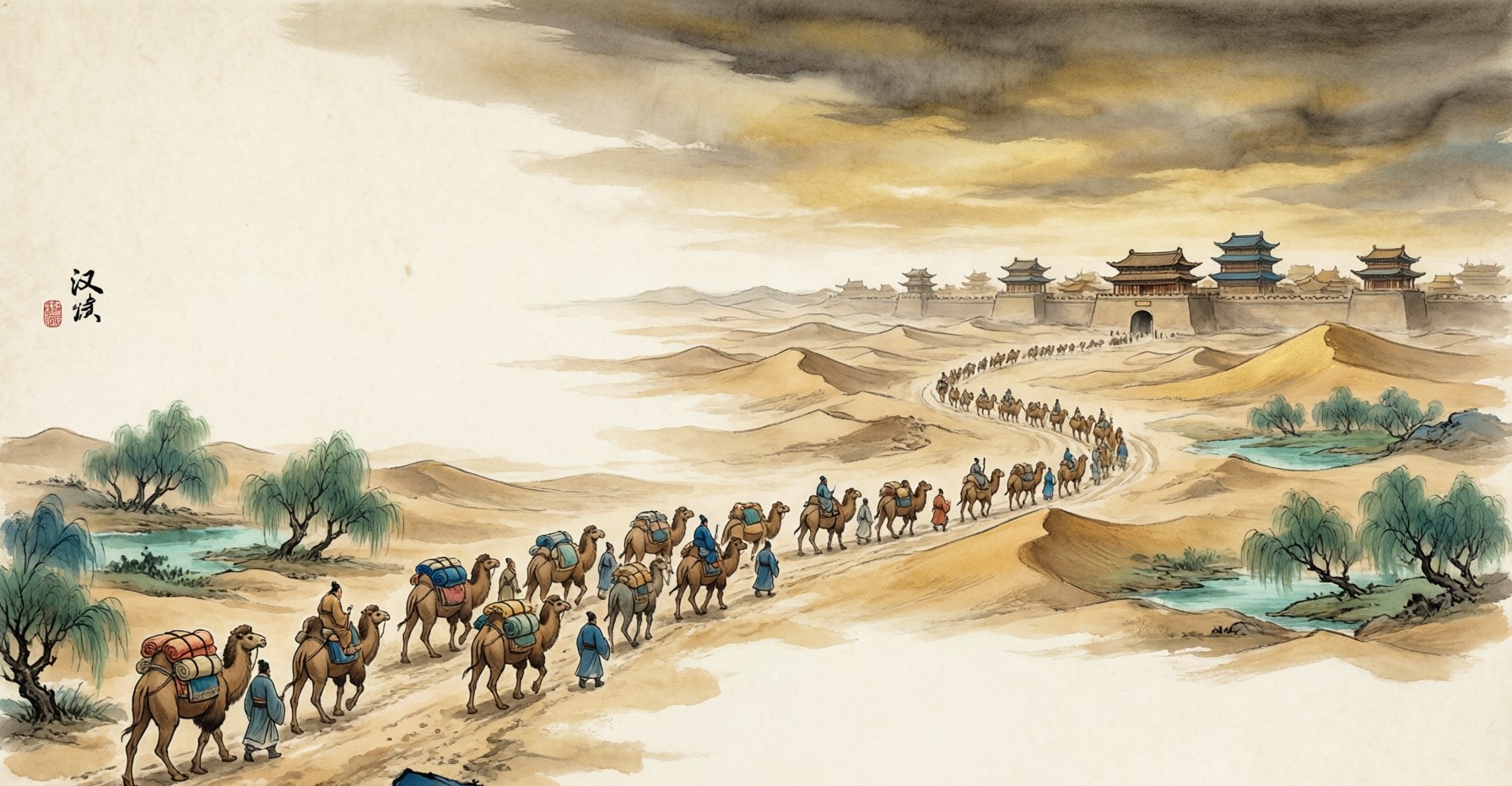
Ask a Chinese person today what they are, and the answer, more often than not, will be a single syllable: Han. The Han people (汉族, Han zu) are the largest ethnic group on earth. The Chinese written language is called the Han script. The dynasty that earned this extraordinary honor — the one whose name became a people's name for all time — ruled for four centuries, from 206 BCE to 220 CE, and in that long span it did something rarer than conquest: it made an empire feel like a civilization. Where the Qin had built the body of China in fifteen years of iron, the Han gave it a soul. It opened the roads to the West, raised Confucianism to the dignity of a state creed, invented the paper on which all later learning would be written, and produced the histories and poems that educated Chinese readers still cherish. If the Qin made China one, the Han made China Chinese.
A Commoner on the Throne
The Han began, improbably, with a man of no birth at all. Liu Bang (刘邦) was a peasant from the state of Chu, a minor local official of no distinction, who found himself swept up in the rebellions that tore the Qin apart after the First Emperor's death. The fall of the Qin had unleashed a furious contest for the prize it left behind, and for a few years it seemed certain that the brilliant, aristocratic general Xiang Yu would claim it. But Xiang Yu had the manners of a conqueror and none of a ruler; he alienated his allies and underestimated his rivals. Liu Bang, by contrast, had a gift that proved worth more than any army: he knew how to listen, how to delegate, and how to win the loyalty of men more talented than himself. He would later say, in essence, that he had won the empire because he had the wisdom to use three extraordinary men — his strategist, his administrator, and his general — better than they could use themselves.
After years of struggle known as the Chu–Han Contention, Liu Bang defeated Xiang Yu and, in 202 BCE, proclaimed himself emperor. He is remembered as Emperor Gaozu of Han, the "high ancestor" — the first commoner in Chinese history to rise to the throne. His origins mattered. The Han never forgot that they had been born from the people's suffering under the Qin, and they governed accordingly: with lighter taxes, gentler laws, and a deliberate humility that let the exhausted land recover. The early Han emperors practiced a kind of restrained, almost Daoist restraint, interfering as little as possible so that the country could heal. It was a wise beginning, and it bought the dynasty the time it needed to grow strong.
"I rose from among the common people with a sword three feet long, and by it I took the empire. Was this not the work of men?" — attributed to Emperor Gaozu of Han, Liu Bang
Two Halves and a Brief Usurpation
The Han's four centuries are conventionally divided in two, and the dividing line is one of the strangest episodes in Chinese history. The first half, the Western Han (206 BCE–9 CE), ruled from the great capital of Chang'an — modern Xi'an — and built the empire's foundations. Then, in the year 9 CE, a court minister named Wang Mang (王莽) did the unthinkable: he deposed the Han heir and seized the throne for himself, founding a short-lived dynasty of his own, the Xin (新, "New").
Wang Mang is one of history's great curiosities — a moralist who believed he could remake the world by reaching back to an idealized antiquity. He nationalized land, abolished slavery, reformed the currency again and again, and tried to govern by the letter of the ancient Confucian classics. It was, in effect, an attempt to legislate a golden age into existence, and it failed catastrophically. His reforms threw the economy into chaos, his currency changes ruined the people, and a devastating flood of the Yellow River — which the Chinese read, as ever, as a sign that the Mandate of Heaven had turned — brought famine and revolt. Within fifteen years Wang Mang was dead, killed in the capture of his capital, and the Han were restored.
The restored dynasty, the Eastern Han (25–220 CE), moved its capital east to Luoyang and ruled for nearly two more centuries. Though it would never quite recover the vigor of its first half, the Eastern Han presided over some of the dynasty's greatest cultural achievements. Historians speak of the Western and Eastern Han together as a single golden age, and it is to that age, taken whole, that China owes its name.
Emperor Wu and the Confucian State
If one ruler embodies the Han at its zenith, it is Emperor Wu (汉武帝, the "Martial Emperor of Han"), who reigned for more than half a century around the turn of the first century BCE. Under him the cautious, recovering empire of his forebears became an assertive, expanding power. He pushed the frontiers outward in every direction, brought new regions under imperial control, and transformed the Han from a Chinese kingdom into something approaching a world empire. He was also restless, superstitious, and extravagant — a man of immense energy and considerable flaws, whom later historians have judged with the mixture of admiration and unease that great and costly rulers always provoke.
But Emperor Wu's most enduring act was not military but intellectual. On the advice of the scholar Dong Zhongshu, he elevated Confucianism to the position of state orthodoxy — the official philosophy of the empire. This was a quiet revolution with endless consequences. The harsh Legalism of the Qin was set aside as the dynasty's public creed; in its place, the court proclaimed the Confucian vision of virtuous rule, of right relationships, of government by moral example. Confucian classics became the core of education, and a knowledge of them became the gateway to official life. In practice the Han governed with a shrewd blend — Confucian ideals on the surface, Legalist machinery underneath — but the public commitment to Confucianism shaped the Chinese state for the next two thousand years. The empire had found not only its institutions but its conscience.
The Silk Road: China Meets the World
The Han did not look inward only. Under Emperor Wu, the empire reached out across the deserts and mountains of Central Asia and, in doing so, changed the history of the world. The agent of this opening was an envoy named Zhang Qian (张骞), who in the late second century BCE was sent west on a diplomatic mission to seek allies against the nomadic Xiongnu. He was captured, held for years, escaped, and pressed on — and though his original mission failed, he returned with something far more valuable: knowledge of the lands and peoples of the West, and of the goods they longed to trade.
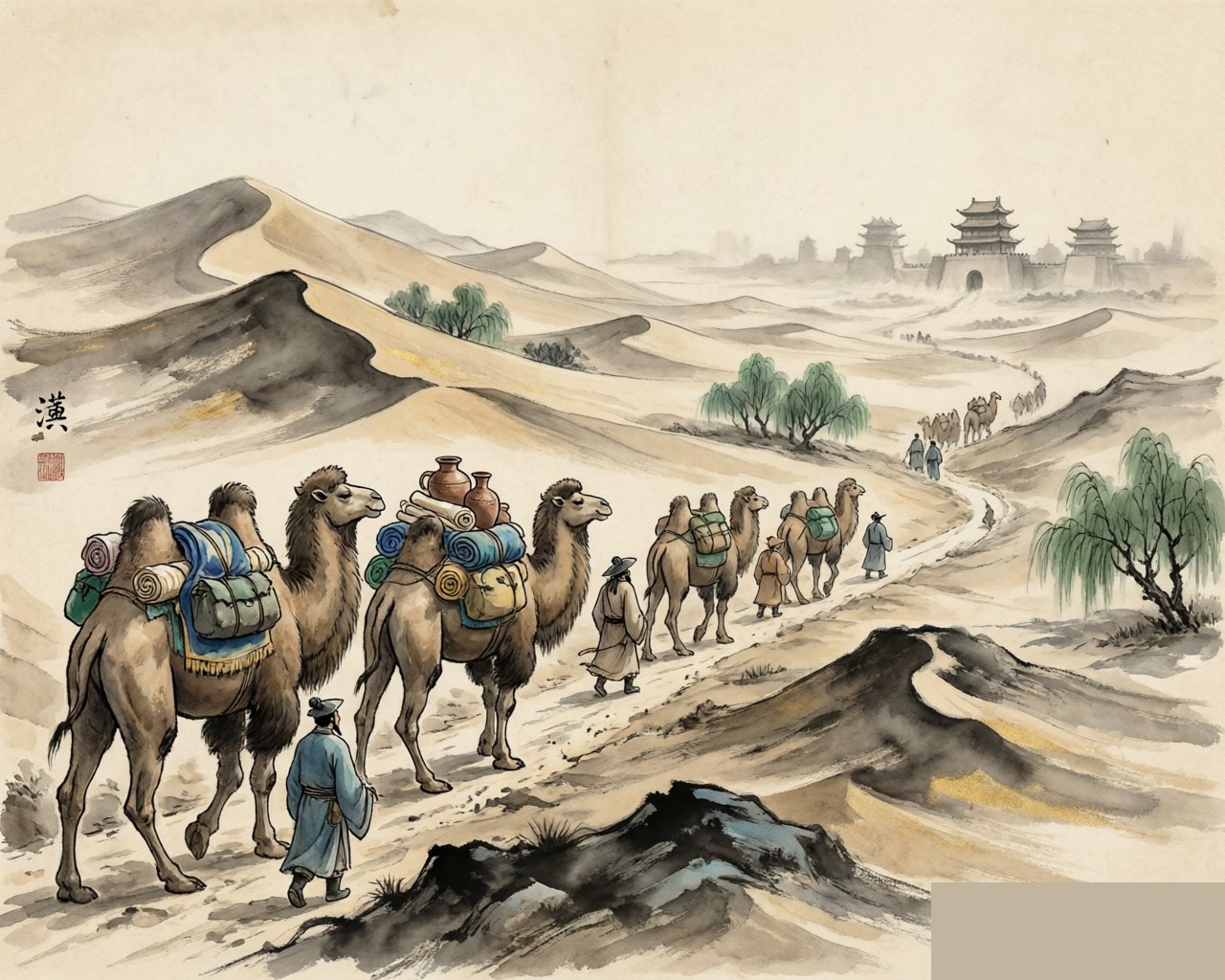
From Zhang Qian's journeys grew the great network of trade routes later called the Silk Road (丝绸之路, Sichou zhi Lu) — a name coined by modern scholars, but a fitting one for the roads along which Chinese silk flowed westward and Central Asian horses, glassware, grapes, and ideas flowed east. For the first time, China was linked, however loosely, to the civilizations of Central Asia, Persia, and eventually Rome. Han silk has been found in Roman contexts; Roman glass has been unearthed in China. The Silk Road was never a single road but a web of routes, and it carried far more than goods: religions, technologies, crops, and diseases all traveled its length. It made the Han cosmopolitan, and it made China a participant in a wider world. The image of the camel caravan threading the desert dunes remains, to this day, one of the most romantic in all of Chinese memory.
Invention, History, and the Examined Life
The Han was as inventive as it was expansive, and several of its achievements reshaped human civilization. Foremost among them is paper. Writing had once been scratched onto bone, cast onto bronze, or brushed onto cumbersome strips of bamboo and silk. Around the year 105 CE, a court eunuch named Cai Lun (蔡伦) is credited with refining the craft of papermaking from plant fibers, bark, rags, and old fishing nets, producing a material that was cheap, light, and easy to write on. Papermaking had older roots, and Cai Lun's exact role is debated, but tradition honors him as the man who gave the world its most important medium. Without Han paper, there is no later printing, no spread of learning as we know it. It is, quite simply, one of the great gifts of China to humanity.
The Han genius for observation reached equally far in science. Zhang Heng (张衡), a polymath of the Eastern Han, made advances in astronomy and, around 132 CE, devised an ingenious bronze instrument — often called the first seismograph — designed to detect the direction of distant earthquakes. Its exact mechanism is reconstructed rather than fully known, but its existence testifies to a civilization taking the systematic measure of the natural world. Han astronomers charted the heavens with care, refined the calendar, and developed sophisticated models of celestial motion.
Above all the achievements of the age, however, stands a single book: the Shiji, the Records of the Grand Historian, by Sima Qian (司马迁). Sima Qian set out to write the history of the world from its legendary beginnings to his own day, and he succeeded in creating not just a chronicle but a work of literature and moral philosophy. He invented a form — the biographical-thematic history — that every later Chinese dynasty would imitate. And he paid a terrible price for it: when he defended a disgraced general and offended Emperor Wu, he was sentenced to the humiliating punishment of castration. He chose to endure it rather than die, so that he might finish his book. The Shiji is, in this sense, written in suffering as much as in scholarship, and it remains one of the supreme works of Chinese prose.
"I would count it no disgrace to die, had I but left my name to posterity. ... I have therefore set down what I have seen and heard, so that it may not be lost." — Sima Qian, in his letter explaining why he endured to complete the Records of the Grand Historian
The Steppe, the Court, and the Seeds of Decline
For all its brilliance, the Han was never free of enemies, and the greatest were the Xiongnu (匈奴) — the powerful nomadic confederation of the northern steppe that had also tormented the Qin. The early Han, still weak, had been forced to buy peace with gifts and even marriage alliances after a humiliating early defeat. Emperor Wu reversed this, launching vast cavalry campaigns that drove the Xiongnu back and secured the northern frontier at enormous cost in men and money. The struggle between settled China and the steppe nomads — a rhythm that would repeat for two thousand years — was already fully formed in the Han.
The dynasty's end came not from the steppe but from within. The later Eastern Han grew weak as emperors came to the throne as children and real power fell into the hands of eunuchs, regents, and rival court factions. The great families of the provinces grew rich and independent; the peasants grew poor and desperate. In 184 CE, a massive uprising known as the Yellow Turban Rebellion — named for the yellow cloths its followers wore, and inspired by a Daoist millenarian faith — erupted across the empire. The court could not suppress it alone and was forced to grant military power to regional commanders. Those commanders never gave it back. The dynasty fractured into the hands of warlords, and in 220 CE the last Han emperor was deposed. The empire broke into the three rival kingdoms — Wei, Shu, and Wu — whose struggles would fill the next chapter of Chinese history and inspire its most beloved novel. The golden age was over; the age of heroes and villains had begun.
The Name That Outlasted the Throne
It is the fate of most dynasties to be remembered as a chapter and then forgotten. The Han achieved something almost unique: they became an identity. When Chinese people today call themselves Han, when they speak of Han characters or Han clothing or Han tradition, they are reaching back across two millennia to this dynasty and claiming it as their own. No other Chinese dynasty has left so deep a mark on the very name of the people. The Han gave China not merely a government but a sense of itself — a shared script, a shared canon of classics, a shared moral vocabulary, a shared memory of a golden age worth remembering.
Consider what endured. The Confucian state the Han proclaimed would govern China, in one form or another, until the twentieth century. The civil service ideal — the notion that officials should be chosen for learning and merit rather than birth alone — took root in the Han through systems of recommendation and examination, and would flower, centuries later, into the great imperial examination system. The Silk Road the Han opened would link East and West for more than a thousand years. The paper the Han refined would carry the thoughts of every civilization that followed. The histories the Han wrote set the pattern by which China would remember its own past. Even the capital cities — Chang'an and Luoyang — would remain among the greatest cities of the medieval world.
The Qin taught China that it could be one; the Han taught China what it meant to be one, and made that meaning so attractive that it has never been wholly lost. Through every later age of division and war, the memory of the Han held out the promise of unity, prosperity, and civilization worth defending. To be Chinese, in some deep sense, has always meant to remember the Han — the dynasty that gave a people its name, and a civilization its confidence. Four centuries is a long time to rule. But to live on, two thousand years later, in the very word a billion people use to say who they are — that is a kind of immortality no emperor could have planned.