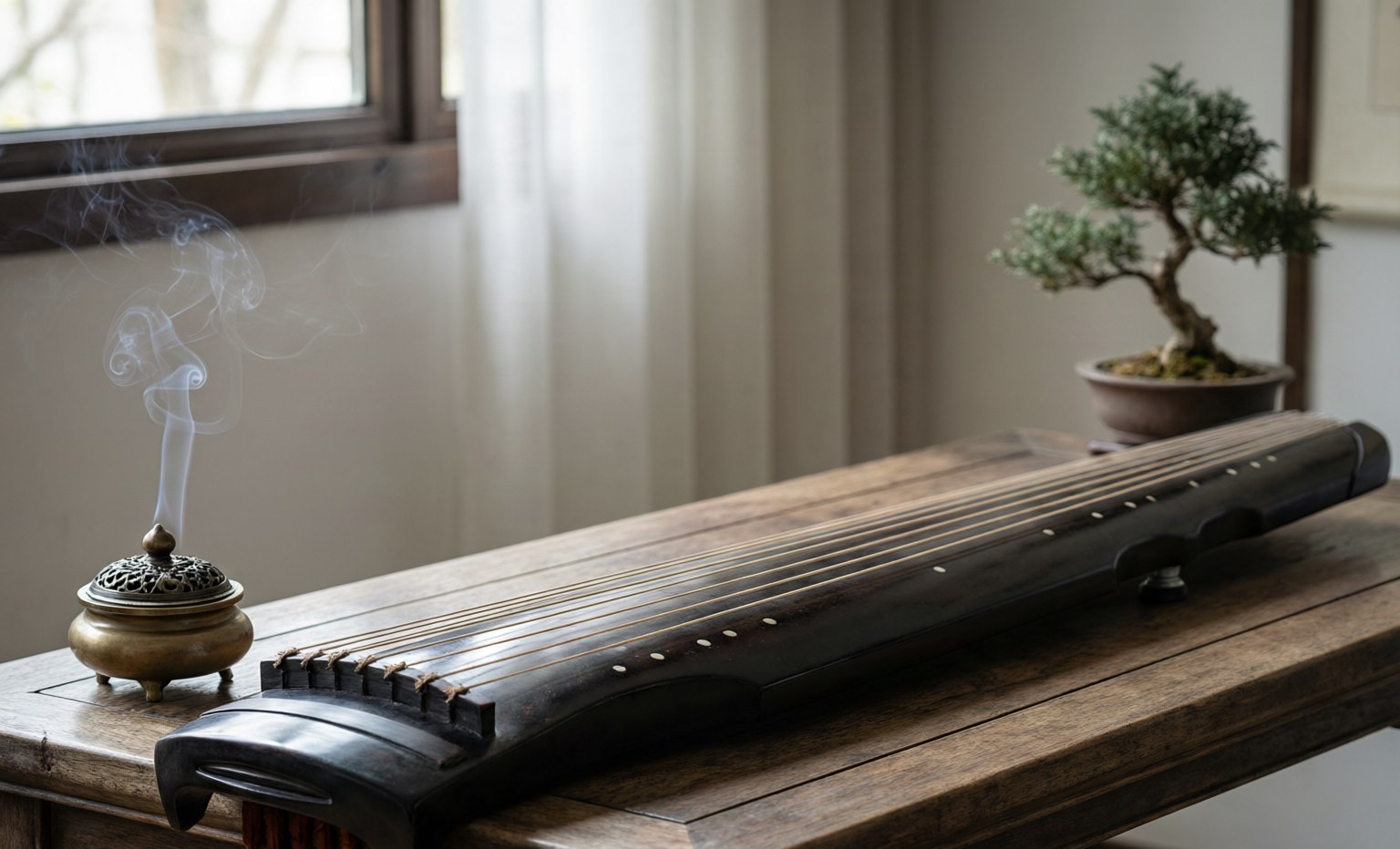
Of all the sounds China has given the world, none is quieter, and none is more revered. The guqin (古琴, gǔqín) — literally "the ancient instrument" — is a long, narrow zither of lacquered wood and seven silk strings, so soft-spoken that it was historically played not for an audience but for oneself, or for a single trusted friend, or for the mountains, or for no one at all. For three thousand years it has been the instrument of Confucius and the literati, the companion of poets and hermits, the one object a scholar would carry into exile and set down beside him in a mountain hut. To understand the guqin is to understand something essential about the Chinese ideal of cultivation: that the highest art is not performance but discipline, not expression but restraint, and that the most important listener is the one inside your own chest.
The Oldest Voice in the Room
The guqin's origins dissolve into legend. Tradition credits its invention to the sage-kings of remote antiquity — Fuxi (伏羲), Shennong (神农), or the Yellow Emperor — placing its birth somewhere in the third millennium BCE. Archaeology is more cautious but still impressed: fragments and depictions of long plucked zithers appear by the late Zhou dynasty, and the instrument was already ancient when Confucius (孔子, 551–479 BCE) is said to have studied it under the master Xiang (师襄). The Book of Songs (诗经) mentions the qin alongside the se zither as the sound of civilized domestic harmony: "Wife and children in loving union, like the playing of qin and se." By the time of the Han dynasty (206 BCE–220 CE), the guqin had settled into something close to its modern form and had acquired the full weight of Confucian moral philosophy.
It was, from the beginning, an instrument with a job to do — and that job was not entertainment. The qin was one of the four arts a true gentleman was expected to master (琴棋书画, qin qi shu hua): the zither, the board game of weiqi, calligraphy, and painting. Notice the order. The qin came first. It was understood as a technology of self-cultivation, a way of ordering the mind and aligning the emotions with the cosmic pattern. To play badly was a minor embarrassment; to play with a vulgar heart was a moral failure. The old manuals are full of prohibitions: do not play in the presence of the uncultivated, do not play while drunk, do not play facing an execution ground. The instrument demanded a clean room, a calm heart, and ideally the company of wind, pines, and moonlight.
A Body Made of Heaven and Earth
Pick up a guqin and you are holding a cosmology. The standard instrument is roughly 130 centimeters long — three chi, six cun, five fen, a measurement traditionally said to represent the 365 days of the year. Its upper board is arched to symbolize heaven (天, tian); its lower board is flat to symbolize earth (地, di). The whole is hollowed into a resonating chamber, so that the player literally holds heaven above and earth below, with the breath of sound moving between them.
The top is most often made of paulownia wood (桐木, tongmu), light and resonant; the bottom of catalpa or Chinese lacquer tree, denser and grounding. The surface is coated in many layers of raw lacquer (大漆, daqī) mixed with deer-horn ash, a finish that can take months to build and that ages into the prized cracked pattern called "snake-skin" or "tortoise-shell" crazing. Old instruments — genuinely old ones, centuries old — are treasured above all, because the lacquer and wood continue to mellow with time, and a fine antique qin is said to sound like nothing a new instrument can imitate. Thirteen round markers of mother-of-pearl, gold, or jade are inlaid along the surface: these are the hui (徽), harmonic nodes that tell the player where to touch the string to produce pure overtones.
The seven strings were once five. Legend holds that King Wen (文王) added a sixth string in grief for his dead son, and King Wu (武王) added a seventh to rouse his soldiers before the conquest of the Shang — so that the seven strings carry within them both sorrow and martial resolve. For most of its history the strings were twisted silk (丝弦, sīxián), which produce a soft, faint, faintly buzzing tone with a quick decay. In the twentieth century many players adopted steel strings wrapped in nylon, which are louder and more stable but which purists argue betray the instrument's intimate, inward character. The debate is not really about volume. It is about whether the qin is a concert instrument or a private one — a question the tradition answered long ago.
Three Voices in One Instrument
The guqin's technique is built on a distinction found in almost no other instrument: it produces three kinds of sound, each with its own name and its own philosophical meaning. The first is sanyin (散音), the "scattered" or open sound — the string plucked while vibrating freely, deep and resonant, said to represent the human realm. The second is fanyin (泛音), the "floating" or harmonic sound — the string lightly touched at a hui node and released as it is plucked, producing a clear, bell-like overtone that seems to hang in the air; these represent heaven. The third is anyin (按音), the "pressed" or stopped sound — the string pressed firmly against the board and slid, producing the sliding, vocal, microtonal glides that are the qin's most recognizable voice; these represent earth.
A single piece moves constantly between these three textures, so that playing the qin is, in the traditional telling, a continual negotiation between heaven, earth, and humanity. The left hand does far more than stop notes: it slides, vibrates, bends, and ornaments, and much of the music lives not in the plucked attack but in the whisper of the finger traveling along the string after the note has sounded. The right hand employs a small vocabulary of named strokes — tuo, mo, tiao, gou, da, pi — each a different direction and finger. The result is an art of extraordinary subtlety, where a single note can be colored a dozen ways and where silence between notes carries as much meaning as the notes themselves.
High Mountains and Flowing Water
No story is more central to the qin than the friendship of Boya (伯牙) and Zhong Ziqi (钟子期), which gave the Chinese language its most beautiful word for a true friend. Boya was a master player of the Spring and Autumn period. When he played with the image of towering peaks in his mind, the woodcutter Zhong Ziqi, listening, exclaimed: "How lofty! Like Mount Tai (泰山)." When Boya turned his thoughts to rushing torrents, Ziqi cried: "How vast! Like the rivers and the sea." Whatever Boya held in his heart, Ziqi heard it perfectly. When Ziqi died, Boya went to his grave, played one final piece, cut the strings of his qin, and never played again — for there was no one left in the world who could truly hear him.
"The lofty mountains rise; the flowing waters run on. To meet one who understands the sound is to meet one who knows the heart."
— The legend of Boya and Zhong Ziqi, from which the phrase zhīyīn (知音, "the one who knows the tone") came to mean "soul friend"
The piece associated with the legend, Gaoshan Liushui (高山流水, "High Mountains and Flowing Water"), became one of the most celebrated works in the repertoire — and in 1977 a recording of it, played on the guqin by Guan Pinghu, was placed aboard the Voyager Golden Record and launched into interstellar space as a representative sound of human civilization. Of all the music humanity chose to send to the stars, one of the messages was the quietest instrument on earth.
A Repertoire of Solitude and Protest
The surviving qin repertoire is vast and strange: more than three thousand pieces are catalogued in the old handbooks (qinpu, 琴谱), though only a few hundred are played today, and many exist in dozens of competing versions passed down through different schools. The titles alone reveal the world the music inhabits: Plum Blossom Melody (梅花三弄, Meihua Sannong), a meditation on the plum tree that blooms defiantly in winter; Wild Geese Descending on the Sandbank (平沙落雁, Pingsha Luoyan), a serene picture of geese settling at dusk; Dialogue Between the Fisherman and the Woodcutter (渔樵问答), a philosophical exchange between two men who have turned their backs on official life.
Some pieces carry explicit political weight. Guangling San (广陵散), one of the most famous and turbulent works in the canon, is said to depict the assassination of a tyrant; its story is inseparable from the death of the poet-musician Ji Kang (嵇康) in 262 CE. Condemned to execution by the regime of the Sima clan, Ji Kang was granted one final request. He asked for his qin, sat in the execution ground, and played Guangling San once through. When he finished, he said only: "This piece dies with me today." He was killed. The piece, in fact, survived — but the legend fixed forever the association of the qin with integrity maintained to the point of death.
Notation That Hides the Music
The qin is written in a script unlike any other musical notation on earth. Jianzipu (减字谱, "reduced-character notation"), refined in the Tang dynasty, does not record pitch or rhythm at all. Instead, each symbol is a compressed composite of Chinese characters describing a physical action: which finger, which string, which hui position, which direction of stroke, which ornament. The score tells you what to do with your hands; it does not tell you what the result will sound like. The player must therefore reconstruct the music — a process called dapu (打谱, "beating out the score") — drawing on tradition, taste, and personal judgment to decide tempo, phrasing, and emphasis.
This is not a deficiency but a philosophy. Two masters playing from the same page of jianzipu will produce recognizably different performances, and both are "correct." The notation preserves the skeleton of the piece across centuries while leaving its living breath to be reinvented by each generation. It is, in a sense, the musical equivalent of classical Chinese poetry: a compressed set of instructions that blooms differently in every mind that receives it.
The Sound the Literati Carried Into Exile
The qin's symbolism is so dense that the instrument is almost less an object than an argument about how to live. Its music was called yayue (雅乐) in spirit — refined, elegant, the opposite of the vulgar and the loud. Confucius played it; the poet Tao Yuanming (陶渊明) kept an unstrung qin in his house and would mime playing it when he was moved, saying he understood the music within and had no need of the sound. To own a qin, even to be unable to play it well, was to declare allegiance to a whole civilization of values: restraint, sincerity, loyalty to one's own conscience over the world's applause.
"The qin restrains the licentious heart and returns it to the true. It is not for the pleasure of others but for the cultivation of the self."
— A paraphrase of the Confucian view of music found in the Book of Rites (礼记, Lǐjì) and the qin manuals that followed it
This is why the qin appears so often in paintings of scholars in mountain retreats: a robed figure seated on a rock, the long instrument across his knees, a servant boy carrying wine, pines overhead and mist in the valley below. The image is a portrait of an ideal — the cultivated man who has withdrawn from a corrupt world and keeps faith with himself through art. The qin was the prop that made the portrait intelligible. Without it, the man is merely alone; with it, he is in communion.
Three Thousand Years, Still Sounding
The twentieth century nearly ended the qin. Wars, revolution, and the Cultural Revolution scattered the players and silenced the music; by some counts fewer than a hundred true masters remained at the nadir. Yet the instrument survived, as it had survived every previous upheaval. In 2003, UNESCO proclaimed the guqin and its music a Masterpiece of the Oral and Intangible Heritage of Humanity, recognizing it as one of the oldest continuously cultivated musical traditions on earth. Conservatories in Beijing, Shanghai, and beyond now teach it to a new generation; qin societies have reformed; antique instruments fetch extraordinary sums; and recordings circulate online to listeners the old masters could never have imagined.
And still, the heart of the tradition is unchanged. A student today sits as Confucius is said to have sat, lays the long lacquered body across the knees, and learns to make a single open string ring, then to hush it, then to let the silence do its work. The guqin will not fill a concert hall. It was never meant to. It asks only for a quiet room, a settled mind, and — if you are fortunate — one person across from you who hears not just the tone but the heart within it. After three thousand years, that is still enough. That, the tradition insists, was always the whole point.