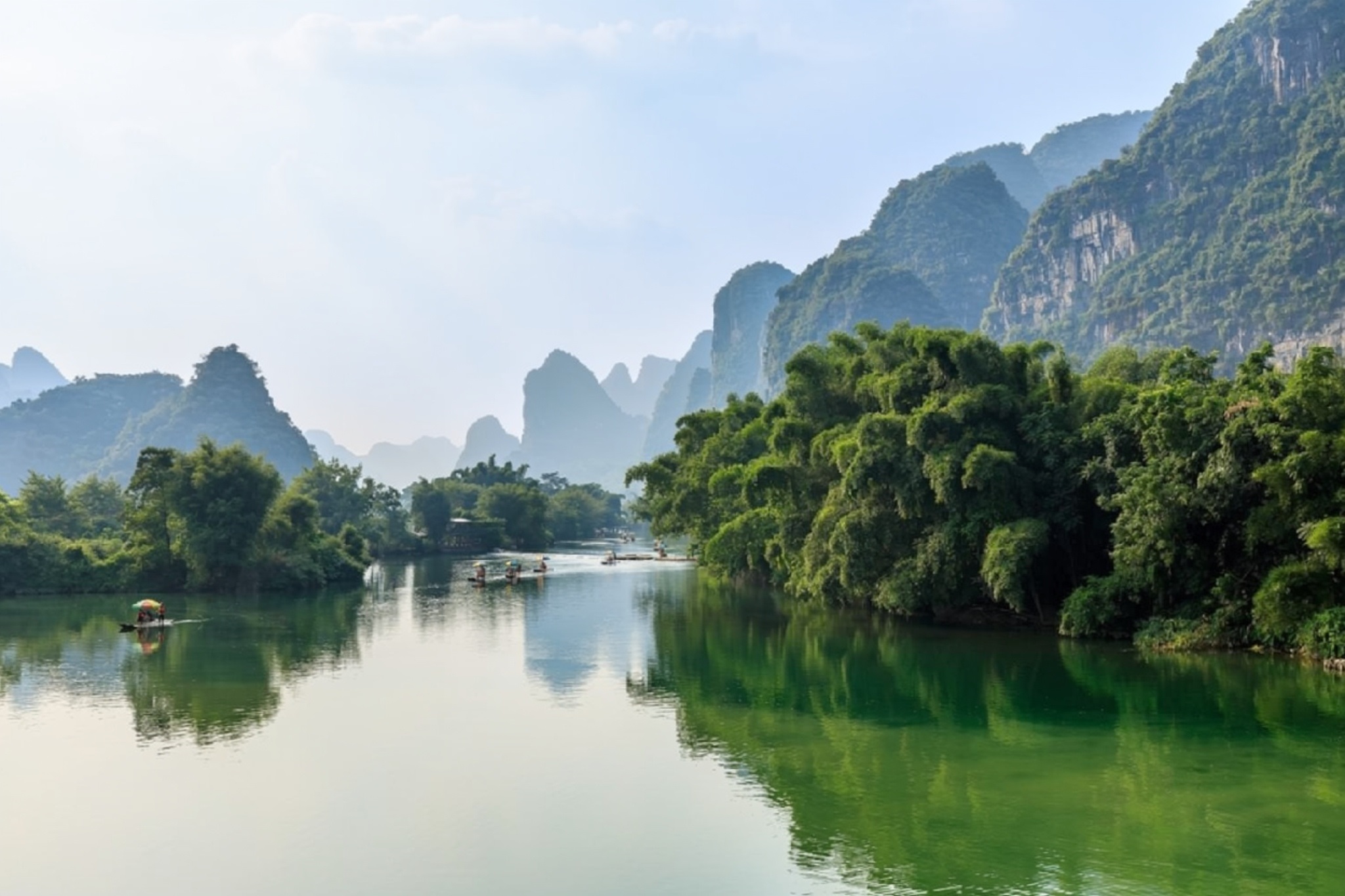
There is a place in southern China where the earth refused to lie flat. Where, instead of rolling gently into the horizon, the land erupted upward in thousands of limestone pillars, cones, and towers — as though the ground itself had been seized by a poetic impulse and could not help but reach for the sky. This is Guilin, and for over a thousand years, it has served as China's most enduring metaphor for the relationship between humanity and the natural world.
The famous declaration Guilin shanshui jia tianxia — "Guilin's mountains and waters are the finest under heaven" — is not mere tourism slogan. Carved into a cliff face at the city's Solitary Beauty Peak during the Southern Song Dynasty, these seven characters represent a verdict rendered by centuries of painters, poets, and pilgrims who traveled here and found themselves unable to describe what they saw in any language but superlative.
Written in Stone and Water: The Making of Karst
To understand Guilin, one must first understand time — specifically, three hundred million years of it. In the Devonian and Carboniferous periods, this region lay beneath a warm, shallow sea. Marine organisms deposited layer upon layer of calcium carbonate, building a limestone seabed of extraordinary thickness. When tectonic forces eventually lifted this seabed above the waterline, the real artistry began.
Rainfall in subtropical Guangxi is abundant and slightly acidic, enriched with carbon dioxide from decaying vegetation. Over millions of years, this weak carbonic acid dissolved the limestone along fractures and joints, carving the rock into the fantastical shapes visible today. What remains are the cores of ancient massifs — the hardest, most resistant pillars — standing in dramatic isolation above alluvial plains. Geologists call this "fenglin" (peak forest) and "fengcong" (peak cluster) topography. The Chinese simply call it shanshui — mountain-water — because in the Chinese aesthetic tradition, these two elements are never separate.
The karst landscape of Guilin represents one of the most extensive and visually spectacular examples on Earth. Over twenty thousand individual peaks dot the region, ranging from modest hundred-meter hills to towering spires that pierce low-hanging clouds. Between them, the Li River and its tributaries thread silver ribbons through rice paddies, bamboo groves, and villages where water buffalo stand motionless in flooded fields, their reflections perfect in the still water.
The Li River: A Scroll Unfolding
The eighty-three-kilometer stretch of the Li River between Guilin and Yangshuo is not merely a waterway. It is, in the Chinese conception, a living handscroll — a shanshui hua juan — that unspools before the traveler in continuous, ever-changing composition. The traditional journey by boat from Guilin southward to Yangshuo takes approximately four hours, and the Chinese have long insisted that this journey should be experienced as one experiences a painting: not rushing toward the destination, but surrendering to the rhythm of revelation.
The river bends constantly, and with each bend, a new arrangement of peaks presents itself. Nine Horses Fresco Hill displays a cliff face whose mineral striations suggest galloping horses. Yellow Cloth Shoal offers the reflection that appears on the twenty-yuan note — a composition so perfectly balanced that it seems designed rather than discovered. Crown Cave reveals subterranean chambers where stalactites have grown for millennia in absolute darkness, indifferent to the eyes that now admire them.
"The river is like a green silk ribbon, the mountains like jade hairpins."
— Han Yu (韩愈), Tang Dynasty poet, describing the Guilin landscape
Han Yu never actually visited Guilin. He wrote these lines from imagination, based on descriptions from friends. Yet his metaphor — silk and jade, the feminine and the precious — captured something essential about the landscape's character. These are not the brutal, masculine peaks of the western ranges. They are elegant, suggestive, half-concealed in mist. They invite contemplation rather than conquest.
The Guilin School: Painting What Cannot Be Painted
The relationship between Guilin and Chinese painting is not one of mere subject matter. It is, more profoundly, a relationship of mutual creation. The conventions of Chinese landscape painting — the emphasis on empty space, the suggestion of depth through layered mist, the treatment of mountains as living presences rather than geological objects — were developed in part to capture landscapes like this one. And in turn, visitors to Guilin have always seen it through the lens of painting. They do not merely look at the mountains; they recognize them, as one recognizes a face from a beloved portrait.
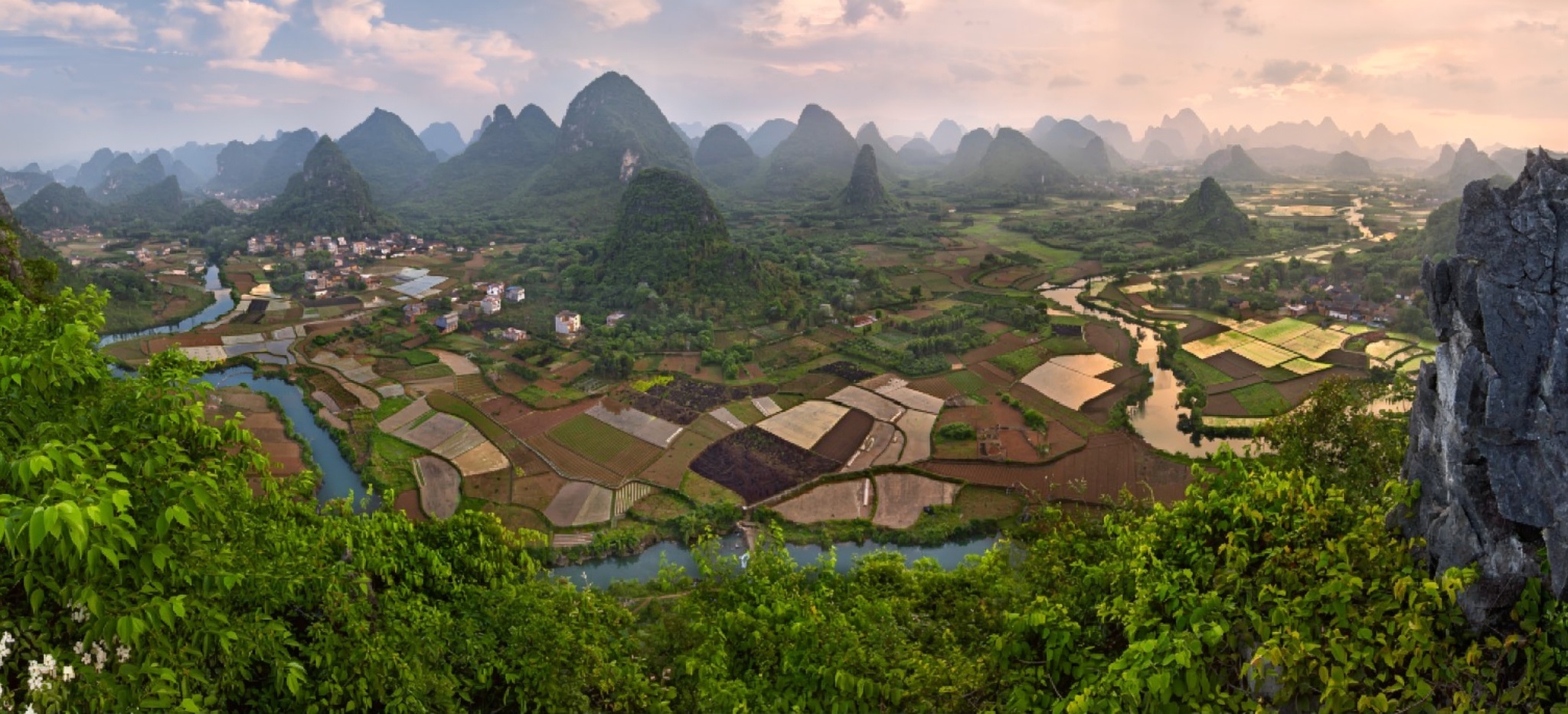
The so-called "Guilin School" of painting, which flourished particularly during the Ming and Qing dynasties, developed specific techniques for rendering karst topography. Unlike the textured, wrinkled brushstrokes (cunfa) used for the granite peaks of northern China, Guilin painters employed smooth, wet washes to suggest the rounded, water-worn surfaces of limestone. They left large areas of paper bare to represent the mist that perpetually wreathes the peaks. They emphasized verticality — the dramatic contrast between the flat river plain and the sudden upward thrust of the peaks.
The painter Shitao, born in Guilin in 1642, carried these landscapes in his memory throughout a life of wandering. His revolutionary approach to ink painting — spontaneous, individualistic, rejecting rigid academic convention — drew directly on the Guilin landscape's own refusal to conform to orderly composition. "The mountains and I meet spiritually," he wrote, "and then we separate, leaving no trace." The landscape had taught him that form and emptiness are not opposites but partners.
Yangshuo and the Countryside Beyond
If Guilin city is the landscape's formal portrait, then Yangshuo — sixty-five kilometers to the south — is its informal sketch, loose and alive. Here the peaks are lower, the valleys wider, and the human presence more intimate. Farmers work rice paddies between the hills. Women wash clothes at river stones. Children ride water buffalo home at dusk along paths that have not changed in centuries.
The Yulong River, a tributary of the Li, offers a gentler experience than its parent waterway. Bamboo rafts — simple constructions of lashed poles, poled by local men in conical hats — drift beneath ancient stone bridges. The famous Moon Hill, visible from the road between Yangshuo and Puyi, presents a natural arch that appears to change shape as one approaches, cycling from crescent to half-moon to full circle. It is geology performing a magic trick, and the locals have built an entire mythology around it.
West Street in Yangshuo's old town has become a meeting point of cultures — backpackers and calligraphers, rock climbers and tai chi practitioners, all drawn by the same gravitational pull that brought Tang Dynasty poets southward a millennium ago. Yet step beyond the commercial bustle, and the old rhythms persist. Morning mist still rises from the river. Fishermen still cast circular nets that open like flowers above the water.
Cormorant Fishing: A Living Fossil
Perhaps no image more perfectly encapsulates Guilin's cultural resonance than the cormorant fisherman. At dusk, when the light turns amber and the peaks become silhouettes, men push their narrow bamboo rafts onto the Li River with a dozen cormorants perched along the gunwales. A ring tied loosely around each bird's throat prevents it from swallowing large fish, while allowing it to eat smaller ones. The fisherman calls, the birds dive, and in the gathering darkness, a single gas lantern on the bow casts a circle of gold on black water.
This practice dates back over thirteen hundred years in the Guilin region. It was once a primary means of subsistence for riverside communities. Today, it persists largely as cultural performance — the fishermen know their audience as well as their birds. Yet to dismiss it as mere spectacle would be to misunderstand something essential about Chinese culture's relationship to tradition. The cormorant fisherman is not performing history. He is continuing it. The technique, the equipment, the relationship between man and bird — these are unbroken threads connecting the present to the Tang Dynasty and beyond.
"I have traveled ten thousand li and read ten thousand books, yet the mountains of Guilin still make me feel I have seen nothing."
— Attributed to Xu Xiake (徐霞客), Ming Dynasty geographer and travel writer
Seasons and the Art of Timing
Guilin's landscape is not a fixed image but a performance that changes with the seasons and the hour. Spring brings the "plum rains" — weeks of soft, persistent drizzle that wraps the peaks in gauze and turns the Li River to jade. The mountains appear and disappear like thoughts half-formed. This is the season painters prefer, for it reveals the landscape's essential quality: suggestion rather than statement.
Summer is lush and green, the rice paddies flooded mirrors reflecting infinite sky. Autumn brings clarity — the air dries, the mist thins, and the peaks stand sharp against hard blue distances. Winter is quiet, occasionally cold, and the tourist crowds thin to a contemplative few. Each season offers a different Guilin, and the Chinese connoisseur returns repeatedly, collecting variations as one collects poems on a single theme.
The finest hours are dawn and dusk, when the angle of light transforms limestone into something luminous and the long shadows between peaks create a second, inverted landscape of darkness. It is at these moments that one understands why the Chinese placed mountains at the center of their spiritual geography — not as obstacles to be overcome, but as presences to be communed with. In Guilin, the mountains do not tower over humanity. They gather around it, intimate as family, patient as old friends, speaking in a language older than words.
To visit Guilin is not to see a landscape. It is to enter a painting that has been in progress for three hundred million years — and to understand, finally, why the Chinese never stopped painting it.