If tea is the quiet philosopher of Chinese civilization, then wine is its passionate poet. Where tea clarifies the mind and stills the spirit, wine loosens the tongue, ignites the imagination, and dissolves the boundaries between the self and the infinite. For over four thousand years, the Chinese have raised their cups to heaven, to friendship, to sorrow, and to the moon — and in doing so, they have produced one of the most extraordinary drinking cultures the world has ever known.
Du Kang and the Myth of First Fermentation
The origin of Chinese wine is wrapped in legend. The most enduring myth credits Du Kang (杜康), a figure of the Xia Dynasty (c. 2070–1600 BCE), with the accidental discovery of fermented grain. As the story goes, Du Kang stored cooked millet in a hollow tree; weeks later, returning to find it transformed into a fragrant, intoxicating liquid, he tasted it and felt the world tilt into warmth and wonder. He shared his discovery with the people, and thus jiu (酒) — the character that encompasses all fermented and distilled drinks in Chinese — was born.
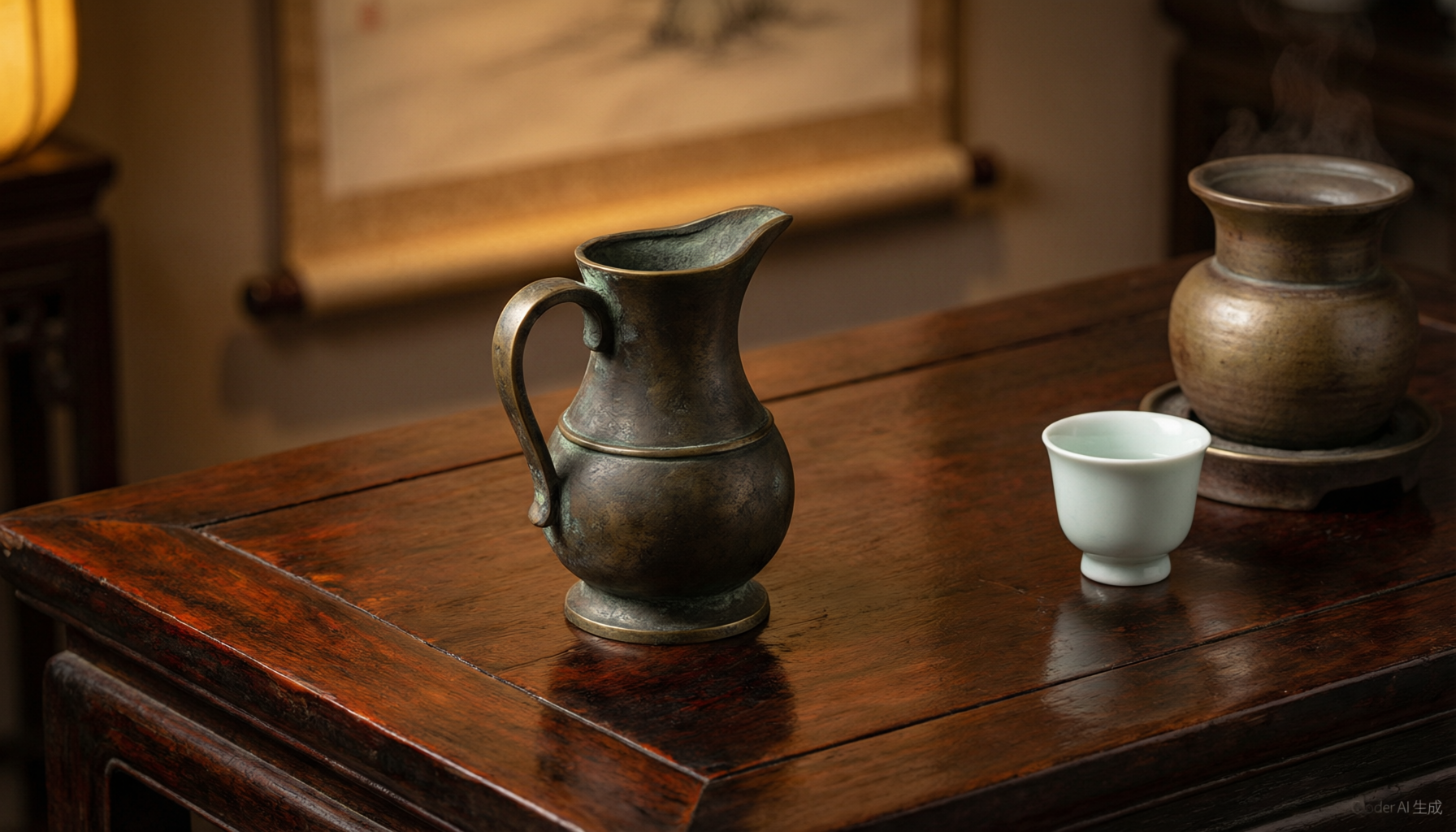
The archaeological record supports an even older origin. Residue analysis of pottery jars from Jiahu in Henan province has revealed traces of a fermented beverage made from rice, honey, and fruit dating to approximately 7000 BCE — making China one of the earliest sites of intentional alcohol production on Earth. By the Shang Dynasty (1600–1046 BCE), bronze wine vessels of extraordinary sophistication — the jue, the gu, the zun — were central to ritual sacrifice and ancestral worship, proving that wine was never merely recreational; it was sacred.
"What is the use of a life without wine? Raise the cup and ask the blue sky — how long has the moon existed?"
— Li Bai, "Drinking Alone Under the Moon," Tang Dynasty
Huangjiu and Baijiu: The Two Great Rivers
Chinese alcoholic beverages flow along two great rivers: huangjiu (黄酒, "yellow wine") and baijiu (白酒, "white spirit"). Huangjiu is the elder — a fermented grain wine, typically made from glutinous rice or millet, with an alcohol content of fourteen to twenty percent. Its color ranges from pale amber to deep mahogany, and its flavor is complex: sweet, savory, slightly nutty, with a long umami finish. The most celebrated huangjiu comes from Shaoxing in Zhejiang province, where jars are buried underground at a child's birth and unearthed decades later for weddings — the famous "daughter's wine" (女儿红).
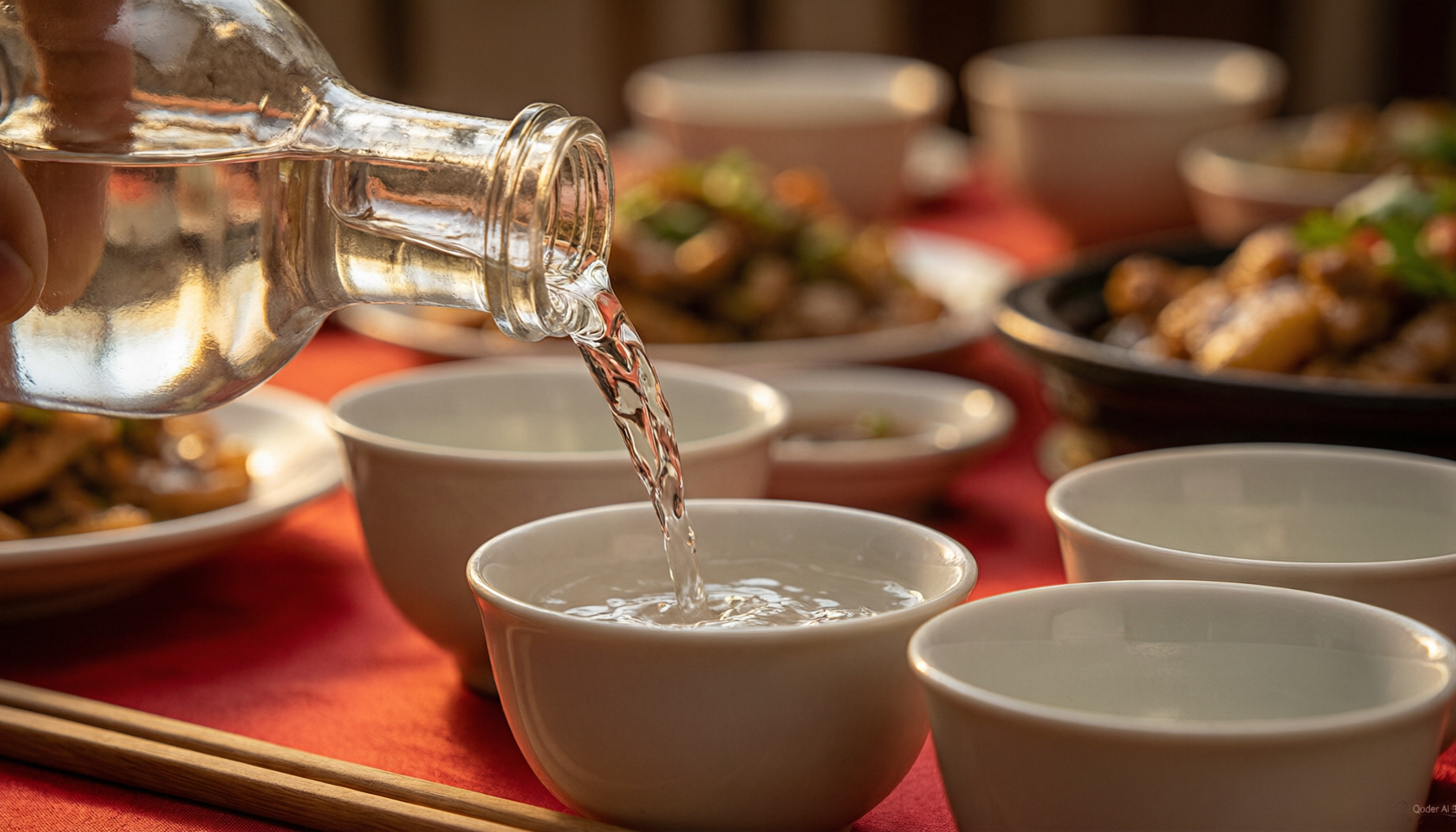
Baijiu, by contrast, is a distilled spirit, typically forty to sixty percent alcohol, clear as water but explosive in character. Distilled from sorghum, rice, wheat, or corn, and fermented in mud pits or stone cellars using a unique starter culture called qu (曲), baijiu is categorized by aroma profile: sauce aroma (酱香), rich and savory like fine soy; strong aroma (浓香), fruity and pungent; light aroma (清香), clean and floral; and rice aroma (米香), delicate and sweet. Moutai (茅台), the sauce-aroma king from Guizhou, has become China's national spirit — served at state banquets and gifted like liquid gold.
The Poetry of the Cup: Wine and Literature
No civilization has married wine and poetry as completely as China. The Shijing (Book of Songs), compiled in the sixth century BCE, already contains verses celebrating harvest wine and communal drinking. But it was the Tang Dynasty (618–907 CE) that produced the golden age of wine poetry. Li Bai (李白), the "Poet Immortal," wrote over three hundred poems in which wine appears — not as mere indulgence but as a gateway to transcendence, a companion in solitude, and a solvent for the sorrows of an imperfect world.
His contemporary Du Fu (杜甫) drank with equal devotion but wrote of wine's bittersweetness — the cup shared with a friend who may soon be exiled, the warmth that briefly holds back the cold of political failure. Wang Wei (王维) raised his cup in farewell at the Wei City tavern, knowing that west of the Yang Pass there would be no old friends. These poems are not drinking songs; they are existential meditations in which the cup becomes a lens focused on impermanence, loyalty, and the terrible beauty of the passing moment.
"I raise my cup to invite the bright moon; with my shadow, we become three."
— Li Bai, "Drinking Alone Under the Moon"
Rituals of the Table: Drinking as Social Architecture
Chinese drinking culture is governed by an elaborate grammar of ritual. At a formal banquet, seating follows strict hierarchy — the guest of honor faces the door, the host sits opposite, and all toasts flow outward from this axis. The host initiates the first toast, often three cups in succession, and no one drinks until the eldest or most senior person raises their glass. To pour for another is an act of respect; to pour for oneself before others is a breach of li (礼), propriety.
The toast itself — ganbei (干杯, "dry the cup") — carries weight far beyond its words. To clink glasses with a superior, one lowers the rim of one's own cup below theirs, a gesture of humility encoded in millimeters. Refusing a toast can wound; accepting one with both hands and a slight bow can heal. In business culture, the banquet table is where contracts are truly sealed — not in the boardroom, but over the fourth round of Moutai, when formality softens and genuine trust becomes possible.
Wine and Philosophy: The Dao of Intoxication
The Chinese philosophical tradition holds an ambivalent, richly nuanced view of wine. Confucius himself was said to drink without limit but never to lose his composure — a model of disciplined enjoyment. The Analerta record his principle: "In wine, there is no fixed limit, but one must not reach the point of confusion." This is the Confucian ideal: pleasure within bounds, freedom within form.
The Daoists took a different path. For Zhuangzi, intoxication was a metaphor for the dissolution of artificial boundaries — the drunk man who falls from a cart and is unharmed because his spirit is undivided, because fear and calculation have been washed away. The "Drunken Immortals" of Daoist hagiography — figures like Liu Ling (刘伶) of the Seven Sages of the Bamboo Grove — embraced wine as a tool of liberation from social convention, drinking not to forget the world but to remember their true nature beneath its weight.
"Heaven and earth are drunk, and all things are one."
— Attributed to Liu Ling, "In Praise of the Virtue of Wine"
Medicinal Wine: The Cup as Pharmacy
In Chinese medicine, wine is not merely pleasure — it is therapy. Medicinal wines (药酒) have been prepared for millennia by steeping herbs, roots, and animal products in huangjiu or baijiu, creating tinctures believed to warm the kidneys, invigorate blood circulation, dispel wind-dampness, and strengthen the sinews. Goji berry wine, ginseng wine, and snake wine remain common in households across southern China, particularly among the elderly, who take a small cup before bed as both comfort and prescription.
The Huangdi Neijing (Yellow Emperor's Classic of Internal Medicine), compiled around the second century BCE, explicitly discusses wine's role in moving qi and blood through the meridians. This medicinal framing distinguishes Chinese wine culture from the purely hedonistic or sacramental models found elsewhere: here, the cup serves the body as well as the spirit, and moderation is not merely polite but therapeutic.
The Modern Table: Tradition Meets Transformation
Today, Chinese wine culture exists in creative tension between ancient ritual and modern life. Baijiu remains the undisputed king of the banquet table, and brands like Moutai, Wuliangye, and Luzhou Laojiao command prices that rival fine Bordeaux. Yet a new generation is rediscovering huangjiu, craft cocktails infused with osmanthus and Sichuan pepper, and even Chinese grape wine from the vineyards of Ningxia and Xinjiang — regions where viticulture stretches back over two thousand years along the Silk Road.
What endures is not any single beverage but the deeper grammar of the Chinese cup: the insistence that drinking is never merely consumption. It is communion — with friends, with ancestors, with the moon, with the poem that will not come until the third cup. It is ritual — the lowered rim, the poured glass, the toast that says what words alone cannot. And it is philosophy — the ancient, ongoing conversation between the Confucian who drinks with grace and the Daoist who drinks with abandon, both raising their cups to the same indifferent, beautiful sky.