On the seventh night of the seventh lunar month, when summer heat still lingers in the lowlands and the first cool breath of autumn stirs in the upper air, the Chinese sky becomes a stage for the oldest love story ever told beneath it. Two stars — Vega, brilliant and blue-white in the constellation Lyra, and Altair, steady and golden in Aquila — hang on opposite banks of the pale river of the Milky Way. And on this single night, according to a legend more than two thousand years old, they are permitted to meet. The Qixi Festival (七夕节, Qīxī Jié) — literally "the Night of Sevens" — is China's festival of love, longing, and the extraordinary power of devotion to bridge even celestial distances.
The Legend of Niulang and Zhinu: Love Across the Silver River
The story begins in the mortal world, where a young cowherd named Niulang (牛郎, "Cow Boy") lived in poverty, tending his family's single aging ox. He was kind, honest, and utterly unremarkable — until the ox spoke. The ox, it transpired, was a fallen celestial being, and it told Niulang that on a certain evening, seven heavenly maidens would descend to bathe in a lake on earth. Among them would be Zhinu (织女, "Weaver Girl"), the seventh daughter of the Jade Emperor, whose task in heaven was to weave the clouds themselves — the rosy dawns, the violet dusks, the silver linings of storm fronts. Without her, the sky would be bare.
Niulang followed the ox's counsel. He saw Zhinu, and she saw him, and the recognition was instantaneous — as though the loom of fate had been threading their lives together since before either was born. They married. They had two children. For several years, Zhinu wove no clouds; she wove a life instead, mending clothes, cooking rice, chasing toddlers through the yard. The sky above grew dull and colorless, but neither lover noticed.
The Queen Mother of the West (西王母), guardian of celestial order, noticed. Furious that a heavenly maiden had abandoned her cosmic duty for a mortal man, she descended with thunder and tore Zhinu from her children's arms. She dragged the weaver back to heaven and, with a single stroke of her silver hairpin, slashed a great river across the sky — the Silver River (银河, Yínhé), what the West calls the Milky Way — separating the lovers forever.
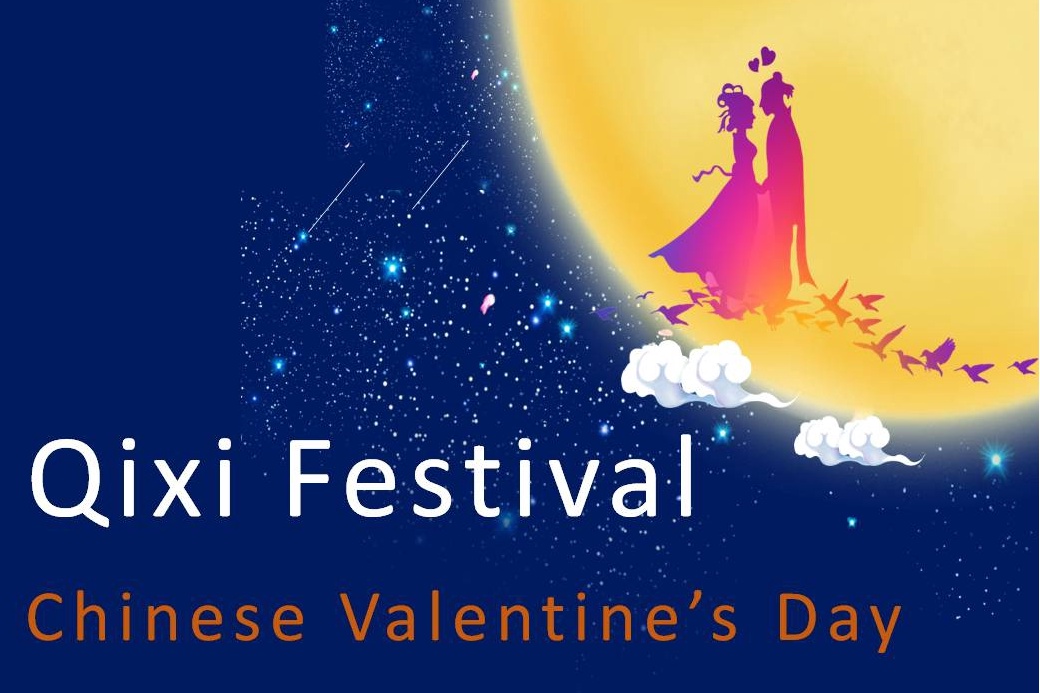
Niulang, carrying his two children in baskets on a shoulder pole, pursued her into the sky. The old ox, dying, offered its hide as a cloak that would let him fly. He reached the river's edge — and could cross no further. The children wept. Zhinu wept. And the magpies of the world, moved beyond endurance, rose in their millions and flew to the Silver River, locking wing to wing, feather to feather, until they formed a living bridge — the Queqiao (鹊桥, "Magpie Bridge") — across which the lovers could walk to meet. The Queen Mother, grudgingly, relented. Once a year, on the seventh night of the seventh month, Niulang and Zhinu may cross. The rest of the year, they gaze at each other across the stars.
Written in the Stars: The Astronomical Heart of Qixi
The legend is not mere fantasy; it is a mythological reading of the actual night sky. Vega (织女星, Zhinu xing) is the fifth-brightest star visible from Earth, blazing at magnitude 0.03 in the northern summer sky. Altair (牛郎星, Niulang xing) shines at magnitude 0.77 in Aquila. Between them, the dense star-fields of the Milky Way form an unmistakable pale band — the Silver River of the story. On clear nights in early August (when the seventh lunar month typically falls), the two stars stand nearly overhead in northern China, close enough to appear almost within arm's reach, yet separated by that luminous gulf.
Ancient Chinese astronomers catalogued both stars as early as the Zhou Dynasty. The Shijing (Book of Songs), compiled around the sixth century BCE, contains a poem that personifies the Weaver Girl as a woman too sorrowful to finish her weaving and the Cowherd as a man who cannot cross the river to reach her. This is the earliest literary record of the Qixi legend — making the festival's roots at least 2,600 years old. By the Han Dynasty (206 BCE–220 CE), the story had crystallized into its familiar form, and the seventh of the seventh month was already marked as a day of romantic significance.
Qiqiao: The Ancient Customs of Skill and Devotion
Before Qixi became a lovers' holiday, it was a women's holiday — specifically, a festival of feminine skill and aspiration. The central custom was called qiqiao (乞巧, "begging for skill"): young women gathered in courtyards on Qixi night to pray to Zhinu for dexterity in weaving, embroidery, and needlework. In an era when a woman's mastery of textile arts determined her marriageability and her family's prosperity, this was no trivial prayer. It was a petition for livelihood.
The rituals were elaborate and varied by region. The most widespread was threading needles under moonlight: young women competed to thread a seven-holed needle (七孔针) by the light of the moon, and the first to succeed was said to have received Zhinu's blessing. Others floated a needle on the surface of a bowl of water and read the pattern of its shadow on the bottom — a straight shadow meant average skill, a curved or flower-shaped shadow meant exceptional talent. In some provinces, women kept spiders in small boxes and examined the density of the webs they spun overnight; a thick, intricate web foretold great skill in the coming year.
Fruit offerings were arranged on tables set in the open air: melons, peaches, grapes, and dates, accompanied by incense and flowers. Women would carve the rind of a melon into the shape of a flower — a "melon flower" (瓜花) — as an offering to the Weaver Girl. In Guangdong, elaborate "Qixi tables" (七夕案) displayed miniature figurines, paper crafts, and agricultural models, turning the courtyard into a temporary museum of feminine artistry.
Qiaoguo and the Flavors of the Seventh Night
No Chinese festival exists without its signature food, and Qixi's is qiaoguo (巧果, "skill fruits") — small, deep-fried pastries made from flour, sugar, oil, and sometimes honey, shaped into flowers, birds, fruits, and geometric patterns. Their name is a pun: "qiao" means both "skill" and "clever," so eating them was thought to ingest cleverness itself. In northern China, women shaped the dough with carved wooden molds, producing intricate designs that were as much sculpture as snack. In the Jiangnan region, qiaoguo were thinner, crispier, and often twisted into spiral shapes resembling the threads of a loom.
Other regional Qixi foods include qiaosou (巧酥), a flaky pastry filled with sugar and nuts; "Weaver Girl's noodles" (织女面), thin hand-pulled noodles symbolizing the threads of the loom; and in some areas, a ritual meal of seven different fruits or seven-ingredient congee, echoing the sacred number of the festival. The emphasis throughout is on delicacy, intricacy, and the transformation of raw materials into something beautiful — the same values Zhinu embodies.
The Poetry of the Magpie Bridge
Qixi has inspired some of the most exquisite love poetry in the Chinese canon. The Song Dynasty poet Qin Guan (秦观) composed what is arguably the definitive Qixi lyric, set to the tune "Queqiao Xian" (鹊桥仙, "Immortal at the Magpie Bridge"):
"纤云弄巧,飞星传恨,银汉迢迢暗度。金风玉露一相逢,便胜却人间无数。
— Qin Guan (秦观), "Queqiao Xian" (鹊桥仙), c. 1090 CE
柔情似水,佳期如梦,忍顾鹊桥归路。两情若是久长时,又岂在朝朝暮暮。"
In translation: "Delicate clouds weave clever shapes; shooting stars carry messages of sorrow. Across the vast Silver River, they cross in secret. One meeting in the golden wind and jade dew surpasses countless meetings in the mortal world. Tender feeling flows like water; the appointed tryst passes like a dream. How can they bear to look back at the magpie bridge, the road of parting? Yet if their love is truly lasting, must they be together every morning and every evening?"
The final couplet — "两情若是久长时,又岂在朝朝暮暮" — has become one of the most quoted lines in Chinese literature. It transforms the tragedy of separation into a philosophy of love: true devotion does not require constant proximity. It is a consolation, a defiance, and a quiet revolution against the assumption that love must be measured in hours spent together. For over nine centuries, lovers parted by distance — by war, by exile, by the simple geography of a vast country — have whispered these words to each other across letters, telegrams, and now text messages.
From Ancient Courtyards to Modern Boulevards: Qixi Today
In contemporary China, Qixi has been rebranded as Chinese Valentine's Day (中国情人节). Since the 1990s, commercial culture has layered roses, chocolates, and restaurant reservations over the ancient substrate of the festival. Shopping malls run "Qixi promotions." Florists report their second-busiest day of the year. Social media fills with couple photographs and declarations of love. Young urbanites who might never thread a needle by moonlight or examine a spider's web will nonetheless exchange gifts on the seventh of the seventh month, sensing — perhaps without knowing why — that the date carries a weight beyond marketing.
Yet the comparison with Western Valentine's Day, while convenient, obscures as much as it reveals. February 14th celebrates romantic love in its active, present-tense mode: I love you, here, now, and I will prove it with flowers. Qixi, rooted in a story of separation, celebrates love in its enduring, patient, almost geological mode: I love you across distance, across time, across the indifference of the cosmos, and I will wait. The Western saint was martyred for performing marriages; the Chinese lovers were punished for having one. The emotional register is different — less exuberant, more elegiac, shot through with the particular Chinese aesthetic pleasure of beautiful sadness (哀而不伤, "sorrowful but not wounded").
In recent years, a quiet counter-movement has sought to recover the older, richer Qixi — the women's festival of skill and aspiration. Cultural centers host qiqiao workshops. Museums display Han Dynasty weaving tools. Television specials dramatize the Niulang-Zhinu legend for children. The festival, it seems, is large enough to hold both meanings: a night for lovers, yes, but also a night for anyone who has ever looked up at the sky and asked the universe for the skill to make something beautiful.
Two Thousand Years of Looking Up
The Qixi Festival endures because its central image — two points of light, separated by an uncrossable distance, meeting once a year through the collective effort of small, ordinary creatures — speaks to something universal. Every long-distance relationship, every family divided by migration, every friendship maintained across years of silence recognizes itself in Niulang and Zhinu. The magpies are us: the friends who drive to the airport, the grandparents who video-call across time zones, the strangers who hold a door or translate a letter or simply say, "I remember you."
On the seventh night of the seventh month, step outside. Find Vega, blazing almost directly overhead. Find Altair, a little to the south and east. See the pale smear of the Milky Way between them. And know that for over two millennia, people have stood in this same posture, in this same season, telling their children the same story: love is patient, love is stubborn, and once a year, the birds build a bridge. Look up. They are crossing now.