There is a morning in early April when the rain falls softly on the hills outside every Chinese city — a fine, persistent drizzle that blurs the boundary between earth and sky, that makes the willows weep a little harder and the new grass glow an impossible green. On this morning, millions of families walk uphill together, carrying baskets of food, bundles of incense, paper money, and fresh flowers. They are going to visit the dead. They are going to clean the graves, lay out offerings, bow their heads, and speak quietly to those who can no longer answer. And then — and this is the part that surprises Western observers — they will fly kites, swing on swings, picnic in the fields, and celebrate the sheer, reckless beauty of being alive in spring.
This is Qingming (清明), the "Clear and Bright" festival, observed on April 4, 5, or 6 each year according to the solar calendar — precisely fifteen days after the spring equinox. It is one of the twenty-four solar terms (节气) in the traditional Chinese agricultural calendar, the only one that is also a major national festival. Its dual nature — mourning and merriment, death and renewal, duty and delight — makes it perhaps the most philosophically rich of all Chinese celebrations. To observe Qingming is to hold two truths simultaneously: that we are bound to those who came before us by obligations of love and memory, and that the living world, in its springtime glory, demands our joyful participation.
Origins: Twenty-Five Centuries of Remembrance
The roots of Qingming stretch back over twenty-five hundred years to the Zhou Dynasty (1046–256 BCE), when emperors and nobles performed elaborate spring sacrifices to their ancestors, praying for good harvests and the continued favor of the dead. The common people, too, had their own simpler rites of spring remembrance. But Qingming as a unified popular festival crystallized later, during the Tang Dynasty (618–907 CE), when Emperor Xuanzong formally decreed that tomb-sweeping rituals should be observed on this day, giving imperial sanction to what had been scattered folk practices.
The festival's development is inseparable from its merger with an older observance: the Cold Food Festival (寒食节, Hánshí Jié), which fell one or two days before Qingming. During Cold Food, no fires were lit and only cold, pre-prepared foods were eaten — a custom rooted in one of Chinese history's most poignant legends.
The Legend of Jie Zitui: Loyalty unto Death
In the seventh century BCE, during the chaotic Spring and Autumn period, Prince Chong'er of the state of Jin was driven into exile by a palace coup. For nineteen years he wandered between rival states, accompanied by a small band of loyal followers. Among them was Jie Zitui (介子推), a man of such devotion that when the prince, starving in the wilderness, expressed a desperate craving for meat, Jie Zitui quietly cut a piece of flesh from his own thigh, cooked it into a soup, and served it to his lord without a word of complaint.
When Chong'er finally returned to claim his throne as Duke Wen of Jin, he rewarded all who had aided him — but in the chaos of restoration, Jie Zitui was overlooked. The humble follower, who had never sought recognition, retreated with his elderly mother into the Mian Mountains. When Duke Wen remembered his debt and sent messengers to summon Jie Zitui back, the loyal servant refused to come. Desperate to force him out, Duke Wen ordered the mountain set on fire on three sides, leaving one path clear for escape. But Jie Zitui would not move. He and his mother were found dead beneath a scorched willow tree, and in a hollow of the trunk, a poem written in blood: "I cut my flesh to serve my lord, hoping only that he would be wise. If he asks why I died beneath the willow, let him remember the fallen and reform his rule."
Grief-stricken, Duke Wen declared three days of mourning during which no fires could be lit — the origin of the Cold Food Festival. Over centuries, Cold Food and Qingming merged into a single observance, and the themes of loyalty, sacrifice, and remembrance became woven into the festival's fabric.
Customs of Qingming: Between Grief and Green
The central ritual of Qingming is tomb sweeping (扫墓, sǎomù). Families travel to ancestral graves — sometimes across great distances, making the holiday one of China's major travel periods — to clean the burial site, pull weeds, repair any damage from the winter, and lay out offerings. The traditional offering includes food the deceased enjoyed in life, cups of wine or tea, bundles of incense whose smoke carries prayers upward, and joss paper (纸钱) — "spirit money" burned so that the dead will have currency in the afterlife. In modern times, fresh flowers, particularly white and yellow chrysanthemums, have joined or replaced some traditional offerings.
After the solemn work of sweeping and offering, the mood shifts. Qingming is equally a festival of spring, and its customs celebrate the season's vitality. The spring outing (踏青, tàqīng) — literally "treading on the green" — sends families into the countryside to walk among new growth, breathe fresh air, and revel in the world's renewal. Kite flying is traditional, and in some regions, small lanterns are attached to kites and flown at night, creating constellations of drifting lights. When the kite is released — its string cut so it sails away — it carries misfortune with it.
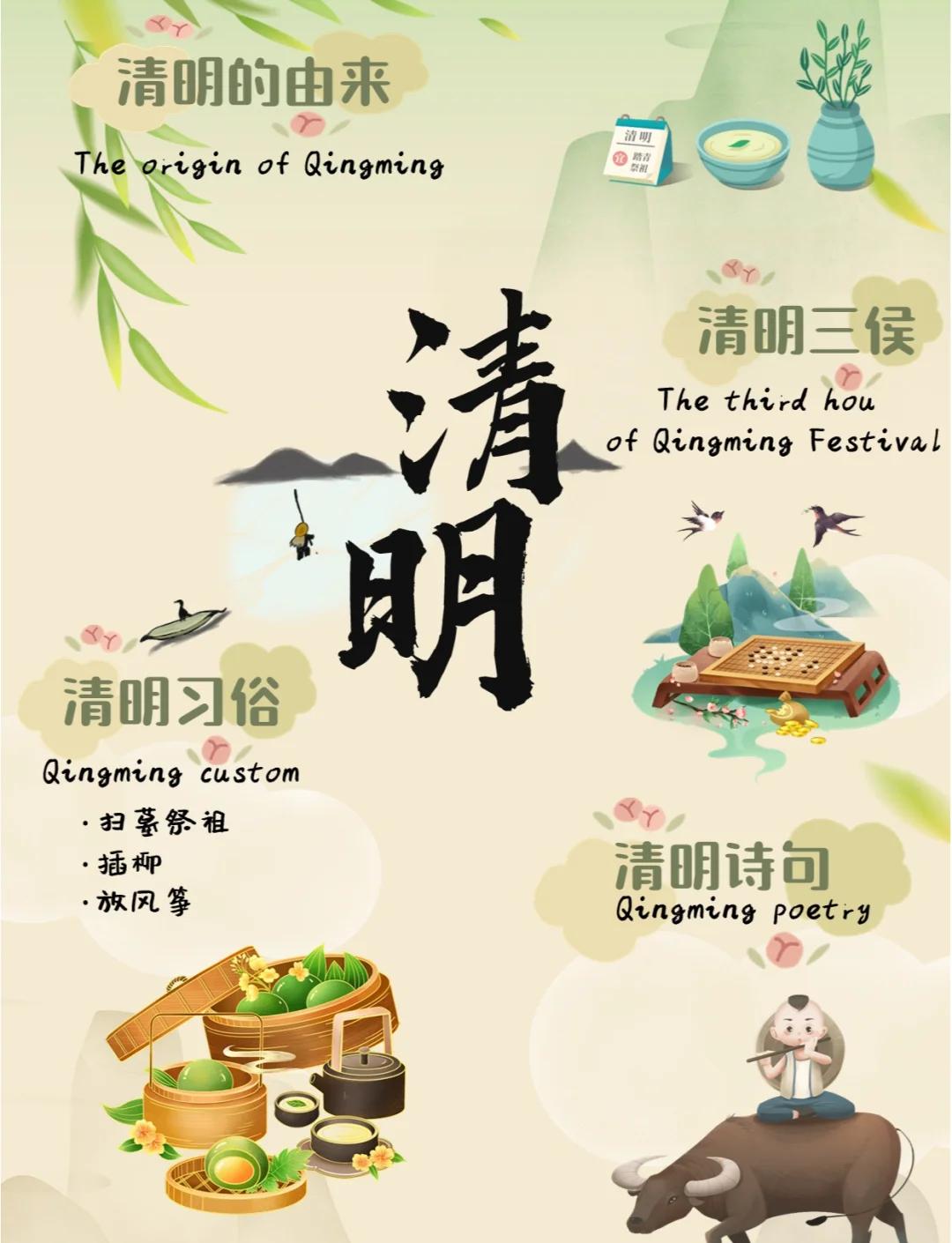
Willow branches play a special role. People insert willow sprigs into their gates or wear them in their hair, a custom linked both to the legend of Jie Zitui (who died beneath a willow) and to the willow's symbolic power to ward off evil spirits. Children play on swings — an ancient Qingming tradition particularly associated with young women in the imperial court, who would swing high above the palace walls, their silk ribbons streaming, while poets watched and composed verses. The image of a girl on a swing, laughing beneath the spring blossoms, is one of Chinese painting's most beloved motifs.
Foods of Qingming: The Taste of Spring
The Cold Food heritage left Qingming with a distinctive culinary tradition: foods that can be prepared ahead and eaten without reheating. The most iconic is qīngtuán (青团), "green rice balls" — glutinous rice dough colored and flavored with the juice of mugwort or barley grass, wrapped around sweet red bean paste or savory fillings, and steamed until glossy and fragrant. Their vivid green color is the color of Qingming itself, of new leaves and wet grass, and biting into one is like tasting spring concentrated into a single, chewy sweetness.
Regional variations abound. In Jiangnan, families eat qingtuan and cold noodles. In Fujian, runbing (润饼) — thin crepes wrapped around shredded vegetables and meats — are traditional. In parts of Shandong, cold eggs and scallion pancakes appear on the table. The common thread is freshness: spring vegetables, new tea, the first tender shoots of the season. Qingming food is light, green, and seasonal — a culinary expression of the festival's embrace of the living world even as it honors the dead.
Qingming in Poetry: Rain, Memory, and the Road
No Chinese festival has inspired more poetry than Qingming, and no Qingming poem is more beloved than the Tang Dynasty poet Du Mu's (杜牧) seven-character quatrain:
"清明时节雨纷纷,路上行人欲断魂。
借问酒家何处有?牧童遥指杏花村。"
"At Qingming, the rain falls thick and ceaseless;
the traveler on the road feels his spirit breaking.
He asks: where can I find a tavern to rest?
A cowherd boy points far off — to Apricot Blossom Village."
— Du Mu (杜牧), Tang Dynasty
The poem's genius lies in its restraint. The rain is endless, the grief is overwhelming ("欲断魂" — the spirit about to shatter), and yet the poem does not end in despair. It ends with a gesture: a child pointing toward a distant village where wine and warmth await. Grief is real, but so is the road forward. So is the small kindness of a stranger. So is the apricot blossom — spring's most delicate flower — blooming at journey's end. In four lines, Du Mu captured the entire emotional architecture of Qingming: sorrow, yes, but also continuation, also beauty, also the quiet promise that life goes on.
Countless other poets have added their voices. Bai Juyi wrote of Qingming picnics where "the grass grows thick and the butterflies dance." Wang Wei painted the quiet of empty mountains where "the osmanthus flowers fall and the night is still." The festival's literary tradition is a conversation across centuries, each generation adding its own grief and its own gratitude to the accumulating record of human feeling.
Modern Qingming: Digital Memorials and National Holiday
Since 2008, Qingming has been a national public holiday in China, granting citizens a three-day weekend to travel home and perform their ancestral duties. The holiday generates enormous travel volume — highways clog, trains fill, and cemetery roads jam with cars — a testament to the obligation's enduring power even in an era of rapid urbanization and modernization.
Yet modernity has also transformed observance. "Online memorial halls" (网上纪念馆) allow those who cannot travel — the diaspora, the elderly, the geographically displaced — to create digital pages for deceased relatives, upload photographs, light virtual incense, and leave messages. Some cemeteries now offer "proxy sweeping" services, where staff perform the rituals on a family's behalf while livestreaming the ceremony. Environmental concerns have led many cities to encourage "green burials" — tree burials, sea burials — and to replace paper-money burning with flower offerings, reducing the smoke and fire risk that once made Qingming a hazardous day for forested hillsides.
These adaptations might seem to dilute tradition, but they also demonstrate its resilience. The essential act — pausing in the midst of busy life to remember, to honor, to acknowledge one's place in a chain of generations — remains unchanged whether performed at a physical grave or a digital altar. The medium shifts; the meaning holds.
The Philosophy of Qingming: Filial Piety and the Circle of Life
At its deepest level, Qingming is an expression of xiào (孝), filial piety — the Confucian virtue that places reverence for parents and ancestors at the foundation of all moral life. In the Confucian vision, one's obligation to family does not end at death. The dead remain members of the family, deserving of care, respect, and remembrance. To neglect their graves is not merely a social failing but a moral one — a severing of the thread that connects past to present, that gives individual life its meaning as part of something larger than itself.
But Qingming is not only Confucian. Its springtime joy — the kites, the swings, the picnics, the willow branches — speaks a Daoist language of harmony with natural cycles. Death is not an aberration but a phase, like winter giving way to spring. The dead return to the earth; the earth puts forth new life; the living celebrate that life while honoring its source. This acceptance, this refusal to separate mourning from celebration, gives Qingming its distinctive emotional texture: bittersweet, tender, and ultimately affirming. One weeps at the grave and then looks up to see the sky clearing, the rain thinning, the first swallows returning. And one understands that this, too, is what the dead would wish.
The ChinaMaxxing philosophy finds in Qingming a model for how to live with full attention to both loss and beauty. The festival asks us to do the hardest and most human thing: to remember honestly, to grieve without shame, and then to turn our faces toward the living world and walk forward into the green, bright spring.