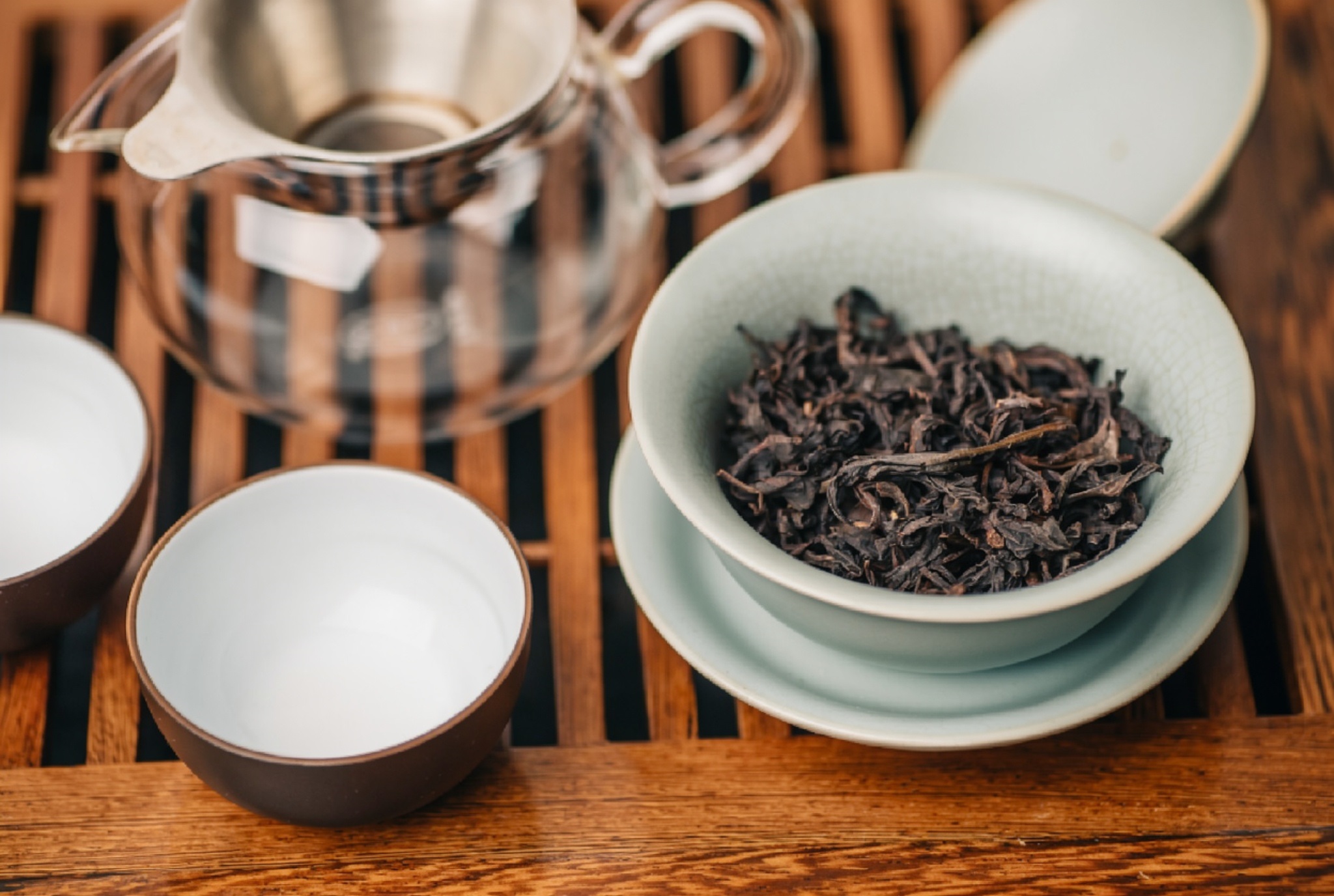
In the West, the life of the mind has traditionally been associated with abstraction — the philosopher in his tower, the scientist at his blackboard, the theologian bent over scripture. In China, the cultivated life took a different form. It was sensuous, embodied, and domestic. The ideal scholar did not merely think; he arranged flowers, brewed tea, burned incense, and hung paintings on his walls. These four pursuits — 点茶 (diǎn chá, whisking tea), 插花 (chā huā, arranging flowers), 焚香 (fén xiāng, burning incense), and 挂画 (guà huà, displaying paintings) — were not hobbies or decorations. They were disciplines of attention, practices through which a person refined their perception, calibrated their spirit, and made their daily environment a work of art.
Dian Cha: The Art of Whisking Tea
While the gongfu method dominates modern Chinese tea culture, the Song Dynasty (960–1279) practiced a more elaborate art: dian cha, the whisking of powdered tea into a frothy, jade-green emulsion. Tea cakes were roasted, ground to a fine powder with a stone mill, sifted through silk, and then whisked in a wide bowl with hot water using a split bamboo whisk. The goal was a thick, persistent foam — "biting the bowl" (咬盏), as connoisseurs called it — that clung to the sides of the vessel like snow on a cliff.
Emperor Huizong himself authored the Daguan Chalun (Treatise on Tea, 1107 CE), prescribing the precise color of the ideal froth (pure white), the correct viscosity, and the seven stages of pouring. Tea competitions (doucha) became social events, with participants judged on the whiteness and longevity of their foam. The aesthetic was one of controlled exuberance: vigorous whisking producing serene stillness, effort dissolving into apparent effortlessness.
Though dian cha eventually gave way to the Ming Dynasty's simpler steeped-leaf method, its spirit endures in the Japanese matcha tradition — which preserves Song techniques almost unchanged — and in the contemporary revival of powdered tea appreciation among Chinese tea enthusiasts seeking to reconnect with a lost refinement.
Cha Hua: Flowers Arranged by the Scholar's Hand
Chinese flower arrangement (插花) is among the oldest in the world, with depictions of arranged blossoms appearing in Tang Dynasty murals and the practice reaching full artistic maturity during the Song. Unlike the symmetrical, abundant style of European floristry, the Chinese approach is governed by principles drawn from landscape painting and calligraphy: asymmetry, negative space, rhythmic line, and the expression of seasonal truth.
A scholar's arrangement might contain a single branch of plum blossom, its gnarled wood speaking of winter endurance, accompanied by two stems of narcissus at an angle that suggests wind. Or a tall vase holding three lotus pods at different heights — one in full bloom, one half-open, one still in bud — representing the Buddhist trinity of past, present, and future. The container matters as much as the flowers: a rough ceramic jar for wild chrysanthemums, a slender celadon vase for a single camellia.
"In arranging flowers, one must understand the nature of the branch. Follow its inclination, respect its curvature. Do not force what wishes to lean left to stand upright."
— Yuan Hongdao, Shi Qu (History of the Vase), 1599
The Ming Dynasty literatus Yuan Hongdao codified these principles in his Shi Qu, arguing that flower arrangement was not decoration but a form of moral cultivation. To arrange a branch well, one must first observe it deeply — attend to its particular character, its history written in every twist and scar. The arranger's ego must recede; the flower's nature must lead. This is Daoist aesthetics applied to the domestic sphere: wu wei, non-forcing, as a creative principle.
Fen Xiang: The Appreciation of Incense
If tea engages taste and flowers engage sight, incense (香, xiāng) engages the most ancient and elusive sense: smell. Chinese incense culture stretches back at least three thousand years, with bronze censers from the Zhou Dynasty surviving in museum collections. By the Song Dynasty, incense appreciation had become a refined art with its own vocabulary, connoisseurship, and spiritual dimensions.
The two great materials are agarwood (沉香, chénxiāng) and sandalwood (檀香, tánxiāng). Agarwood — the dark, resin-saturated heartwood produced when the Aquilaria tree is wounded and infected by a particular mold — is among the most expensive natural substances on earth, prized for its complex, layered fragrance that shifts from sweet to cool to smoky as it burns. Sandalwood offers a warmer, creamier, more immediately soothing profile. Both are used in Buddhist and Daoist ritual, in traditional medicine, and in the quiet domestic practice of scenting a room for contemplation.
The Song Dynasty incense ceremony (香道, xiāng dào) involved heating small chips of agarwood over a bed of ash in which a charcoal pellet was buried — not burning the wood directly, but coaxing its fragrance through gentle, indirect heat. Participants would pass the censer hand to hand, cupping it beneath their noses, closing their eyes, and describing the scent's evolution in poetic language. The practice was explicitly meditative: a training in sustained, non-grasping attention to a phenomenon that exists only in the present moment and cannot be held.
Gua Hua: The Art of Displaying Paintings
The fourth art — hanging paintings (挂画) — transforms the domestic interior into a gallery of the spirit. In the scholar's studio (书房, shūfáng), a single scroll painting was hung on the wall, selected to match the season, the occasion, or the host's mood. A landscape of misty peaks in summer; a branch of red plum against snow in winter; a calligraphic couplet by a revered master for a gathering of friends.
The practice demanded discernment. One did not cover walls with multiple paintings — that was vulgar accumulation. A single work, properly chosen and properly lit, created a focal point for contemplation and conversation. Guests would be invited to admire the painting, to read its colophons and seals, to discuss the artist's brushwork and the poem inscribed in the margin. The painting was not decoration but a presence, a silent participant in the gathering.
Alongside paintings, scholars displayed curated objects on their desks and shelves: a weathered scholar's rock (供石) from Lake Tai, its holes and erosion patterns suggesting miniature mountains; an ancient bronze vessel repurposed as a brush holder; a piece of carved bamboo or jade. Each object was chosen for its patina, its history, its quiet eloquence. Together, painting and objects composed an environment that educated the eye and stilled the mind.
Cultivating Mindfulness Through Aesthetic Practice
What unites the four arts is not their subject matter but their function. Each is a practice of slowing down, of attending fully to sensory experience, of making small decisions with care and intention. To whisk tea is to focus entirely on the texture of foam. To arrange a branch is to see it as it truly is. To burn incense is to sit still and follow a scent into silence. To hang a painting is to choose, from all of art, the one image that answers this particular day.
The Song Dynasty literatus Wu Zimu described the ideal scholar's day as moving fluidly between these practices: tea in the morning, flowers arranged before noon, incense lit for afternoon reading, a new painting unrolled for evening contemplation. The day was not divided into work and leisure but woven into a continuous fabric of aesthetic attention. Life itself was the artwork.
"Burning incense, brewing tea, arranging flowers, hanging paintings — these four arts of leisure are the daily sustenance of the refined person. Without them, the heart grows coarse and the days grow gray."
— Wu Zimu, Mengliang Lu (Record of the Millet Dream), 1274
In our age of infinite distraction, the four arts offer a radical proposition: that a life well lived is not measured by output or achievement but by the quality of one's attention. That beauty is not a luxury but a necessity. That the small, quiet acts of care — the way you pour water, the angle of a stem, the curl of smoke rising from a censer — are not peripheral to existence but central to it. The scholars of old knew this. The question, for us, is whether we will remember.