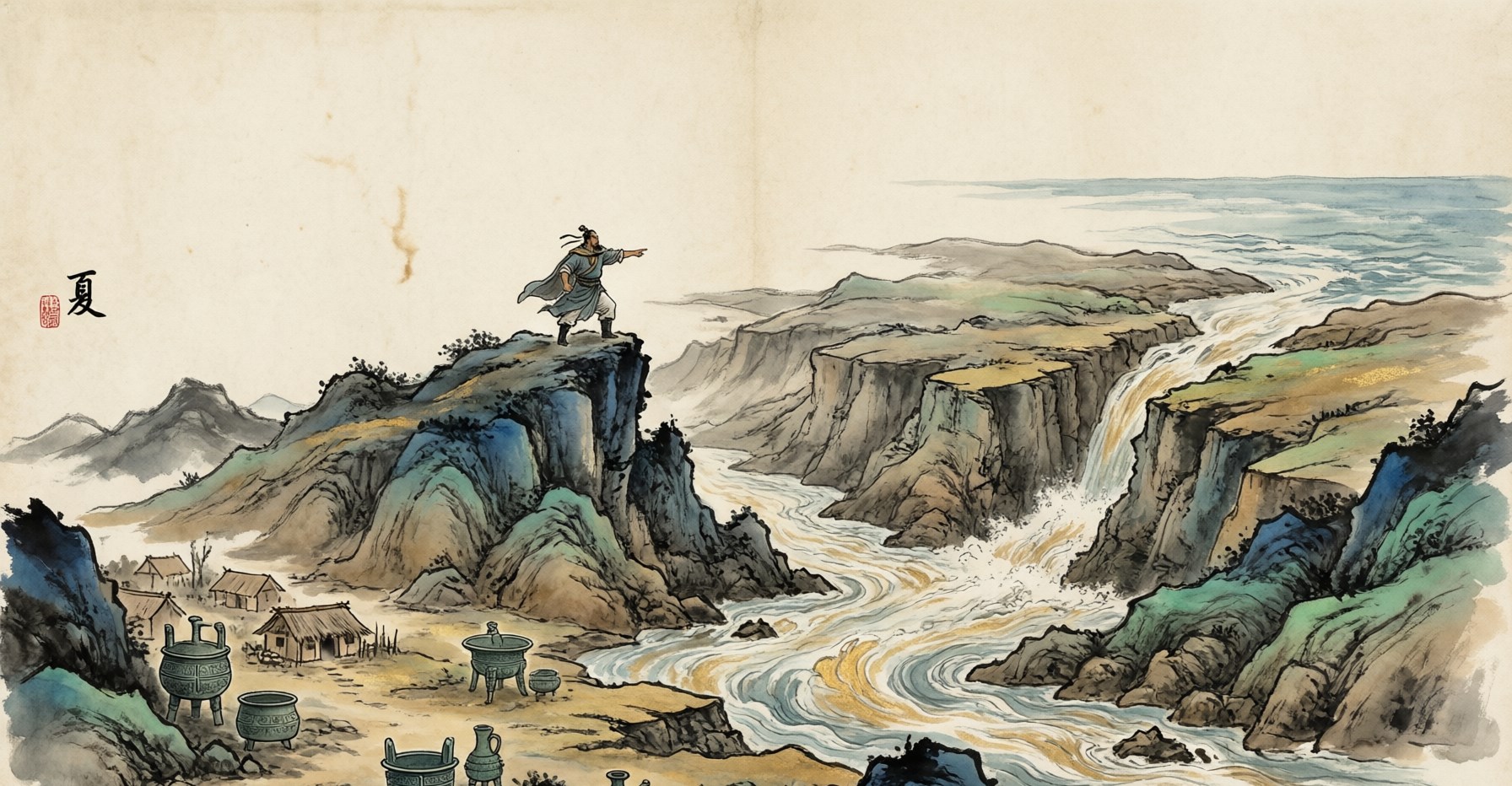
Every civilization needs a beginning, and China's begins in water. Before the first emperors, before the first written word that we can still read, before the bronze and the silk and the walled cities, the old stories say there was a flood — a deluge so vast it drowned the plains and swallowed the hills, and a man who spent thirteen years teaching the rivers how to behave. His name was Yu, and the Chinese have called him "the Great" for four thousand years. From his labor, tradition holds, the first dynasty was born: the Xia (夏). It is the threshold of Chinese history, the place where memory hardens into record and myth leans toward fact. To stand at the beginning of anything so old is to stand in a fog. Yet the Xia matter, because everything that came after — the dynasties, the mandate of heaven, the very idea that China is one continuous story — traces its line back to the man who tamed the waters and to the dynasty he is said to have founded.
The Flood and the Man Who Tamed It
The Xia story opens not with a king but with a catastrophe. In the age of the legendary sage-kings Yao and Shun, the tales tell us, the world was drowning. The Yellow River and its tributaries had burst their banks, the lowlands were marsh, and the people lived in trees and on the high ground, starving and afraid. The emperor Yao charged a man named Gun with controlling the waters. For nine years Gun tried the obvious method — dams, dikes, and barriers, meeting force with force — and for nine years he failed. The floods only rose higher. In the end he was put to death for his failure, and the task passed to his son, Yu.
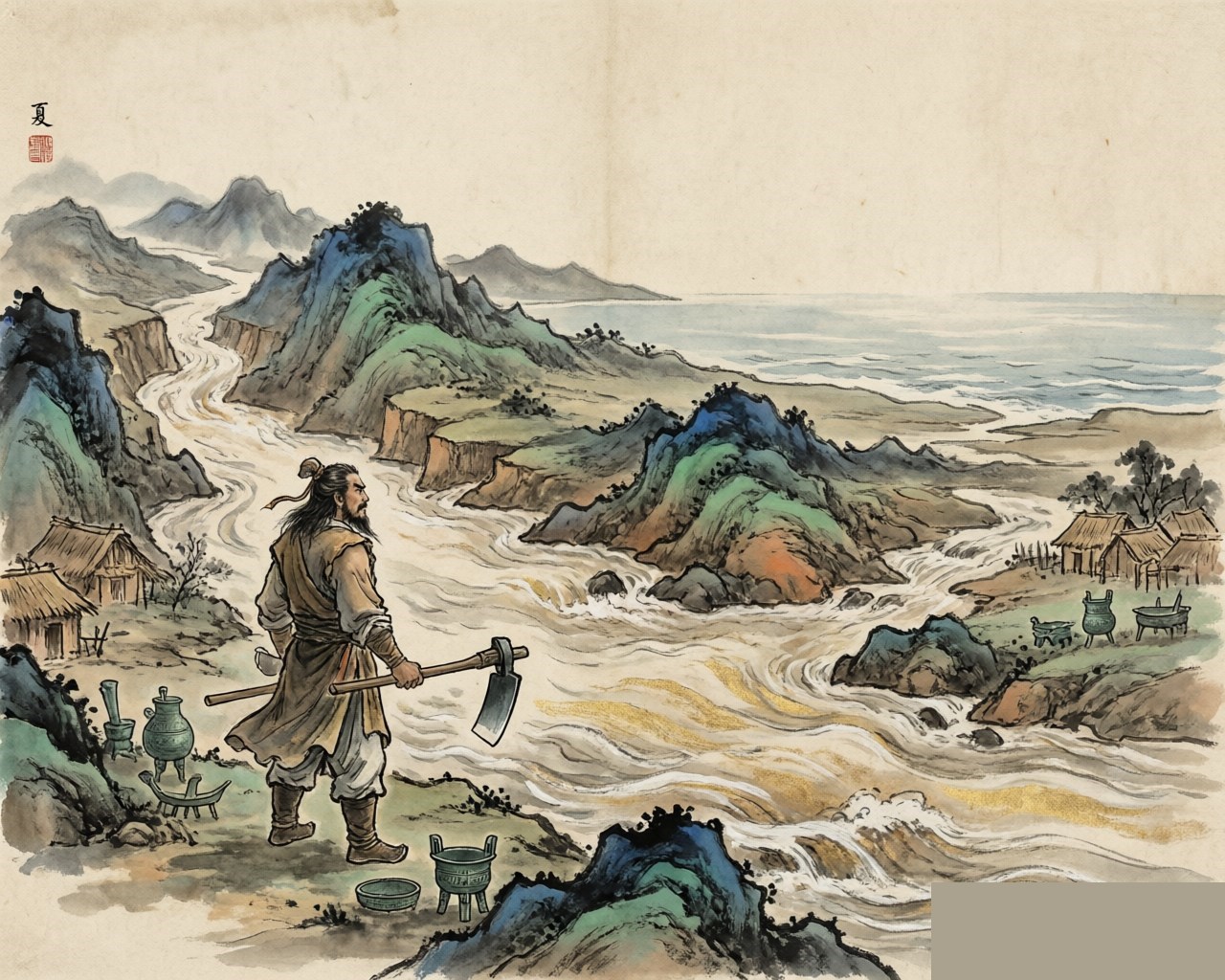
Yu understood something his father had not: you cannot defeat water by opposing it. Where Gun had blocked, Yu would channel. He surveyed the land, read the lie of the slopes, and cut channels to lead the rivers gently toward the sea. He dredged the beds, opened the marshes, and gave the waters somewhere to go. It was, in the telling, a labor of almost supernatural endurance. The classics say he worked for thirteen years, that his hands grew calloused and his legs hairless from wading, and that he passed the door of his own home three times without ever going in — once when his wife had just given birth, the baby crying within earshot — because the flood was not yet tamed and there was no time to rest. "Three times he passed his door and did not enter" (三过家门而不入) became, for all later ages, the proverb for selfless devotion to public duty.
It is worth pausing over the meaning of this story. In a land shaped by the Yellow River — "China's Sorrow," the river that has flooded and shifted course more often than any other great waterway on earth — the hero is not a warrior but an engineer. The founding virtue of Chinese civilization, as the Xia legend frames it, is not conquest but stewardship: the patient, humble, public-spirited work of bringing order out of chaos. Yu did not slay a dragon or seize a throne by the sword. He dug ditches, and he did not go home. Few national origin stories are so quietly admirable.
"Yu tamed the floods and the people were able to live on the level ground. He worked for thirteen years and three times passed his own door without entering." — after Sima Qian, Records of the Grand Historian (Shiji)
From Sage-Kings to Sons: The Birth of Hereditary Rule
Yu's reward was the throne itself. The old legend of the sage-kings describes a remarkable system of succession called "abdication" (禅让, shanrang): a ruler, rather than passing power to his son, was supposed to seek out the most virtuous man in the realm and yield the throne to him. So, the story goes, Yao had passed the throne to the humble Shun, and Shun in turn passed it to Yu, the man who had saved the world from water. It was government by merit, the Confucian dream of power earned rather than inherited.
And then the dream ended — or, depending on your source, was quietly betrayed. When Yu grew old, the throne was meant to pass, by the old custom, to a worthy successor. The traditional account says it was offered to Yu's chosen minister, but that the people and the lords rallied instead to Yu's own son, Qi. Other, less flattering versions in the old texts say that Qi simply seized power by force. Either way, the result was the same: for the first time, a throne passed from father to son. The age of abdication was over; the age of hereditary dynasty had begun. The Xia would be ruled by Yu's descendants for generations, and every dynasty after them — Shang, Zhou, Qin, Han, down to the Qing four thousand years later — would inherit the same principle. The family, not the worthiest stranger, would hold the throne.
This is why the Xia occupy such a charged place in Chinese thought. They are remembered as the moment innocence was lost — the moment the ideal of rule by virtue gave way to the reality of rule by blood. And yet the Chinese never quite condemned the change. Hereditary succession brought stability, and stability, in a land perpetually threatened by flood and famine and war, was no small gift. The Xia legend holds both feelings at once: nostalgia for the sage-kings, and acceptance that the world had moved on.
A Dynasty Written by Others
Here we must be honest, because honesty is what the Xia demand. The Xia left no writings of their own. There is no Xia inscription, no Xia archive, no document in a Xia hand. Everything we "know" of them was written down centuries, even a millennium, after they were supposed to have fallen. The fullest account comes from Sima Qian, the great Han historian, who in the Shiji (Records of the Grand Historian) laid out a list of seventeen Xia rulers with their deeds — a list composed around 100 BCE, roughly two thousand years after the dynasty it describes. Earlier texts such as the Shujing (Book of Documents) and the Bamboo Annals add further traditions, some of them contradictory.
For most of the twentieth century, this put the Xia in an awkward position. Western-trained historians, demanding contemporary evidence, often treated them as pure legend — a founding myth invented by later dynasties to justify their own rule. The Chinese tradition, by contrast, had never doubted them; for two thousand years the Xia were simply the first chapter of the national story. The truth, as so often, lies somewhere in the uneasy middle. The Xia as Sima Qian describes them — with their named kings and tidy chronology — may be partly reconstruction, partly memory, and partly invention. But the broad outline — that a powerful early state flourished in the central plains before the Shang, founded by a culture hero associated with water control — is exactly the kind of thing archaeology has begun to confirm.
Erlitou: When the Legend Touches the Earth
In 1959, Chinese archaeologists began excavating a site called Erlitou (二里头), near the modern city of Yanshi in Henan province — right in the heartland where the old texts place the Xia. What they found transformed the debate. Erlitou was no village. Flourishing roughly between 1900 and 1500 BCE, it was the largest and most advanced settlement of its era in East Asia: a planned center covering several square kilometers, with rammed-earth palace foundations laid out on a formal axis, elite tombs, workshops casting bronze and working turquoise, and the earliest known bronze ritual vessels in China. Here, unmistakably, was a complex, stratified, state-level society — precisely the kind of polity the legends attribute to the Xia.
The catch is one of proof. Erlitou has yielded no writing that names its rulers, so we cannot say with certainty that its people called themselves "Xia," or that the kings buried there are the kings Sima Qian listed. Many scholars in China identify Erlitou with the Xia, or at least with its late phase; many scholars elsewhere prefer the cautious phrase "the Erlitou culture" and treat the dynastic label as unproven. It is a genuine and unresolved debate, and anyone who tells you the question is settled is telling you less than the truth. What is beyond dispute is that something remarkable stood on that ground four thousand years ago — a society already building palaces and casting bronze, already organizing labor on a grand scale, already laying the cultural foundations on which the Shang and Zhou would build. Whether or not we call it Xia, the civilization the legends point toward was real.
The Last Tyrant and the First Mandate
How the Xia ended is, in the telling, how every bad dynasty ends. The traditional histories agree that the line ran strong for a time and then decayed, until it produced its final and worst ruler: Jie (桀). Jie is remembered as the archetype of the tyrant — cruel, decadent, and deaf to remonstrance. The stories pile up: he is said to have built lakes of wine, to have kept a thousand concubines, to have delighted in the suffering of his people, and to have boasted that he was the sun in the sky, which would set only when he chose. The people, the texts say, cursed him and longed for deliverance, crying out that they would gladly perish with him if only the sun would fall.
Deliverance came in the person of Tang, the virtuous lord of a rising state called Shang. Tang is remembered as Jie's mirror opposite — humane, modest, attentive to the suffering of the common people. In a decisive battle traditionally placed at a place called Mingtiao, Tang's forces defeated the Xia, and Jie fled into exile and obscurity. The first dynasty was no more; the Shang had begun. The date, if one must be given, is conventionally placed around 1600 BCE, though the chronology of these earliest centuries remains approximate and contested.
The overthrow of Jie by Tang mattered far beyond the change of one ruling house. It planted, in embryo, the single most powerful idea in Chinese political thought: the Mandate of Heaven (天命, tianming). The notion, which the later Zhou would develop into a full philosophy, holds that heaven grants the right to rule not to a bloodline forever but to a virtuous ruler — and withdraws it from a wicked one. A dynasty that governs well keeps the mandate; a dynasty that produces a Jie forfeits it, and its fall is not treason but justice. The fall of the Xia became, for all later ages, the proof-text for this belief: the first example of heaven changing its mind. Every rebel and reformer in Chinese history would invoke the precedent of Tang overthrowing Jie to argue that a corrupt ruler had lost the right to reign.
The Long Shadow of the First Dynasty
What, then, did the Xia leave behind, if they left no words and perhaps no certain name? More than one might think. They left the template of the Chinese origin story: a civilization founded not on conquest but on the mastery of nature, on public works and patient labor and the subordination of private comfort to the common good. They left the cautionary tale of Jie, the first in a long gallery of tyrants whose vices would justify their overthrow. And they left, in the transition from the sage-kings to hereditary rule, the central tension of Chinese political philosophy — the dream of government by merit forever in dialogue with the reality of government by inheritance.
There is something fitting about the Xia's ambiguity. A civilization as old as China's cannot begin in the full light of documented fact; it must begin in twilight, where the archaeologist's trowel and the poet's memory meet. The Xia live in that twilight — half in the earth at Erlitou, half in the pages of Sima Qian, half in the story every Chinese child still hears about the man who passed his own door three times and did not go in. They are the threshold. To cross it is to leave legend behind and enter, with the Shang, the age of bronze and bone and the first words we can still read. But the threshold itself belongs to Yu, and to the waters, and to the long Chinese habit of looking back to a golden age of selfless kings — and of measuring every ruler since against them.