The Jin Dynasty is, in many ways, the most paradoxical in the long Chinese record. As a political story it is close to an unmitigated disaster: a dynasty that reunified a divided empire only to tear itself apart in one of the most destructive civil wars in Chinese history, lose the entire northern half of the country to foreign conquest, and limp on for another century as a diminished, exiled court in the south. By the usual measures — territory, stability, military glory — the Jin is a cautionary tale. And yet this same broken dynasty presided over one of the supreme flowerings of Chinese civilization. It produced the greatest calligrapher who ever lived, a golden age of poetry, a philosophy of refined withdrawal, and an ideal of the cultivated gentleman-artist that Chinese culture has never abandoned. The Jin lost the north. But in losing it, they discovered something about art that China has treasured ever since.
The Patient Rise of the Sima
The Jin was the creation of a single family, the Sima (司马), and no dynasty in Chinese history owes more to the long game. The family's rise began not with a founder but with a survivor: Sima Yi (司马懿), the brilliant and infinitely cautious strategist who served the warlord Cao Cao and his heirs during the Three Kingdoms era. In the popular romance he is remembered as the great rival of the Shu strategist Zhuge Liang — the patient, defensive counterweight to a more dashing genius. In history he was something more dangerous: a man who outlived every master he served. Through decades of service to the Cao Wei state, Sima Yi quietly accumulated power, and in a single ruthless coup in 249 CE he seized control of the Wei government from his rivals. He died a subject in name, but the throne was already, in all but title, his family's to take.
It fell to his grandson, Sima Yan (司马炎), to complete the work. In 266 CE he accepted the abdication of the last Wei emperor — repeating, with deliberate ceremony, the very act by which the Wei had once replaced the Han — and proclaimed the Jin Dynasty, taking the title Emperor Wu. The name he chose, Jin (晋), echoed an ancient state of the same name, reaching back for legitimacy into the deep past. For a time the new dynasty seemed to justify itself. In 280 CE, Jin armies conquered the southeastern state of Wu, the last of the Three Kingdoms, and for the first time in nearly a century China was whole again. The long age of division was over. It would not stay that way for long.
A Brief Unity and a Fatal Decision
Emperor Wu's reunification was genuine, and for a moment the Jin seemed poised to become a great dynasty. But the emperor made a decision that would prove catastrophic. Remembering how the Cao Wei had fallen — isolated, with no loyal kinsmen to defend the throne — he determined that his own dynasty would not make the same mistake. He enfeoffed his relatives, the Sima clan, as powerful princes across the empire, giving them real territory, real armies, and real independence. He meant to surround the throne with a wall of loyal blood. Instead, he armed the men who would destroy it.
The danger was held in check only so long as a capable emperor sat on the throne. When Emperor Wu died in 290 CE, he was succeeded by his son, Emperor Hui — a ruler so feeble-minded that, when told his starving subjects had no rice to eat, he is said to have asked, with genuine puzzlement, why they did not simply eat meat. With a weak emperor on the throne and an empire bristling with armed imperial princes, the dynasty detonated.
The War of the Eight Princes
What followed was the War of the Eight Princes (八王之乱, Ba Wang zhi Luan), a dynastic civil war that raged, with brief interruptions, for roughly fifteen years around the turn of the fourth century. The number "eight" is a historian's convenience — the conventional count of the most prominent Sima princes who seized and lost power in turn — rather than a precise roster, and the fighting drew in far more than eight men. What is not in doubt is the scale of the devastation. The princes turned their private armies on one another in a dizzying carousel of coups, counter-coups, and massacres, each alliance dissolving into the next betrayal. The capital at Luoyang was sacked and resacked. The imperial family devoured itself.
The war's most fateful consequence was one none of the princes intended. To bolster their armies, several of them had recruited cavalry from the non-Han peoples who lived along and within the northern frontier — the Xiongnu, the Xianbei, the Jie, the Di, and the Qiang, later grouped together by Chinese historians as the "Five Barbarians" (五胡, Wu Hu). These were formidable horsemen with grievances of their own, and the civil war showed them that the Jin was hollow. As the Sima princes exhausted one another, the frontier peoples began to act for themselves. The dynasty that had armed its own kinsmen now watched those kinsmen hand the north to its enemies.
"When the empire is at peace, the gentleman cultivates himself; when the empire is in disorder, he preserves his life and withdraws." — a sentiment echoing the Confucian and Daoist wisdom that shaped Jin-era literati in an age of collapse
The Fall of the North and the Flight South
The collapse, when it came, was swift and humiliating. In 311 CE, armies of the Xiongnu-led Han Zhao state captured the Jin capital Luoyang, in a catastrophe remembered as the "Disaster of Yongjia" (永嘉之乱). The emperor was taken captive; the palaces and tombs of the old capital were looted and burned. A few years later, in 316 CE, the western capital Chang'an fell in turn, and the last Western Jin emperor surrendered. The north — the ancient heartland of Chinese civilization, the land of the Yellow River and the old capitals — was lost. It would remain under the rule of a succession of non-Han kingdoms for centuries, an era historians call the Sixteen Kingdoms.
But the dynasty did not entirely die. A prince of the Sima house escaped across the Yangtze and, in 317 CE, re-established the Jin court in the south, at the city of Jiankang (建康) — modern Nanjing. This is the dividing line between the Western Jin (西晋), the brief, doomed reunifier, and the Eastern Jin (东晋), the long-lived exile state that would endure for another century. The flight south was one of the great migrations of Chinese history. Behind the court came the great northern families — the aristocratic clans of the old heartland — who carried with them their libraries, their traditions, their grief, and their unshakeable conviction that they, and not the barbarians now ruling the north, were the true custodians of Chinese civilization. They settled along the Yangtze and began, slowly, to build a new world in exile.
The Age of Pure Conversation and Refined Withdrawal
The Eastern Jin was a strange and, in its way, beautiful failure. Politically it was weak: the emperors were often figureheads, real power resting with a handful of towering aristocratic families — above all the Wang and the Xie clans — whose influence was so great that contemporaries spoke of the empire as "shared" between the Sima throne and the great houses. The court never gave up its dream of recovering the lost north, and occasionally launched expeditions to that end, but they came to little. The dynasty's true achievement was cultural, not military. Cut off from the old heartland and disillusioned with public life, the southern elite turned inward, and in turning inward they refined Chinese high culture to an unprecedented pitch.
The defining intellectual fashion of the age was qingtan (清谈), "pure conversation" — elegant, abstract debates among the gentry on the deepest questions of Daoist philosophy: being and non-being, the nature of the sage, the meaning of the Daodejing and the Zhuangzi. To excel at pure conversation was to be admired as a man of the highest cultivation. Alongside it flourished an aesthetic of refined withdrawal — a deliberate turning away from the grubby struggle for office toward wine, friendship, nature, music, and the life of the mind. The model was the sage who stood above the world's ambitions, untouched and serene. It was, critics have always noted, an ethos conveniently suited to an aristocracy that had lost its empire and wished to make a virtue of its powerlessness. But it produced art of extraordinary delicacy, and it gave Chinese culture a permanent ideal: the scholar who finds more truth in a mountain stream than in a government post.
The Sage of Calligraphy: Wang Xizhi
The supreme achievement of the age — and one of the supreme achievements of Chinese civilization — belongs to a single man: Wang Xizhi (王羲之), the "Sage of Calligraphy" (书圣, Shusheng). A scion of the great Wang clan and a high official of the Eastern Jin, Wang Xizhi transformed the art of writing. Before him, calligraphy was already a respected skill; after him, it was the highest of the Chinese arts, the purest expression of a cultivated mind, and the standard against which all later writers would be measured. His style — fluid, balanced, alive with a sense of effortless naturalness — became the classical model of the running and cursive scripts, studied and imitated by every generation since.
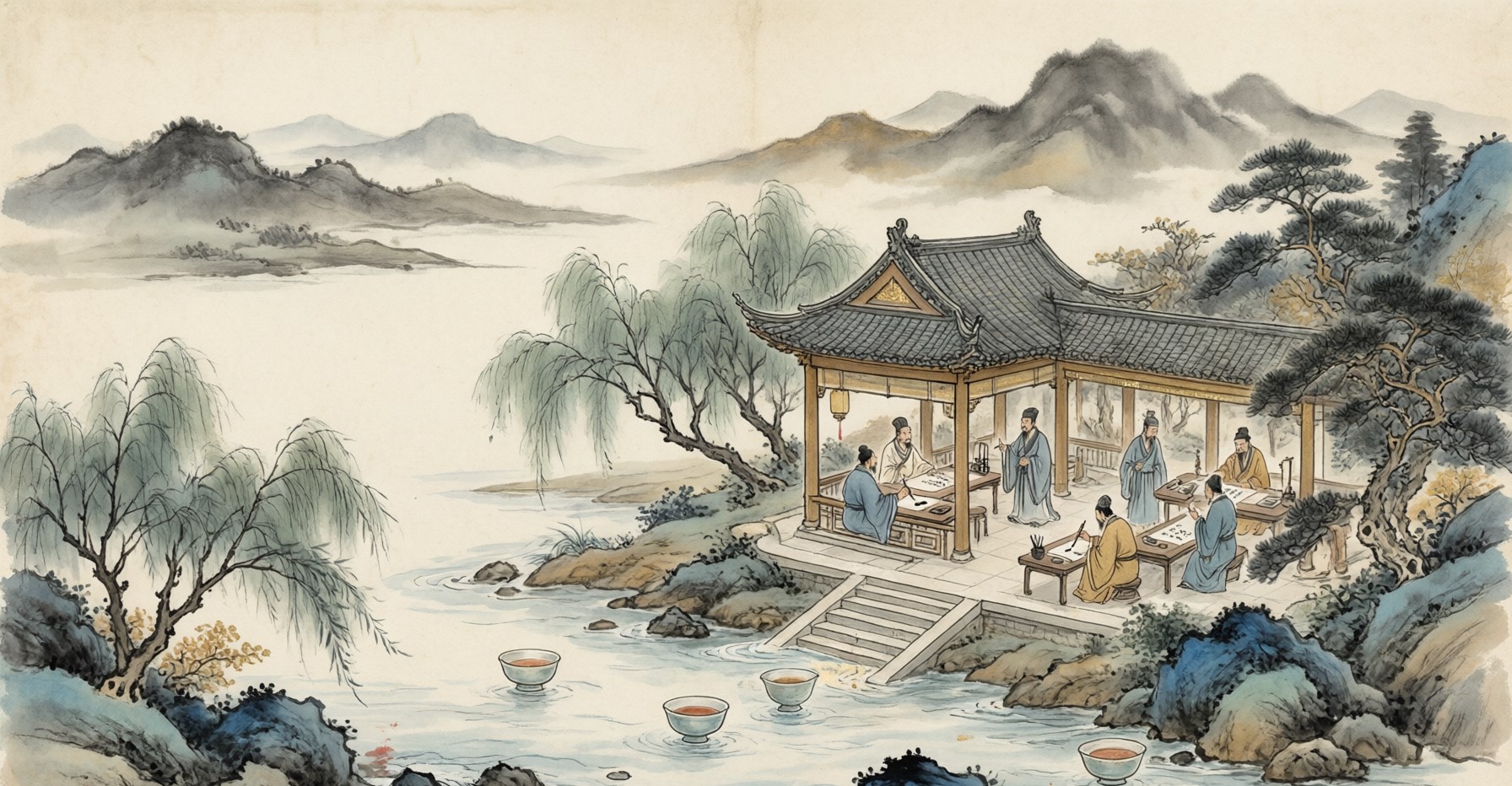
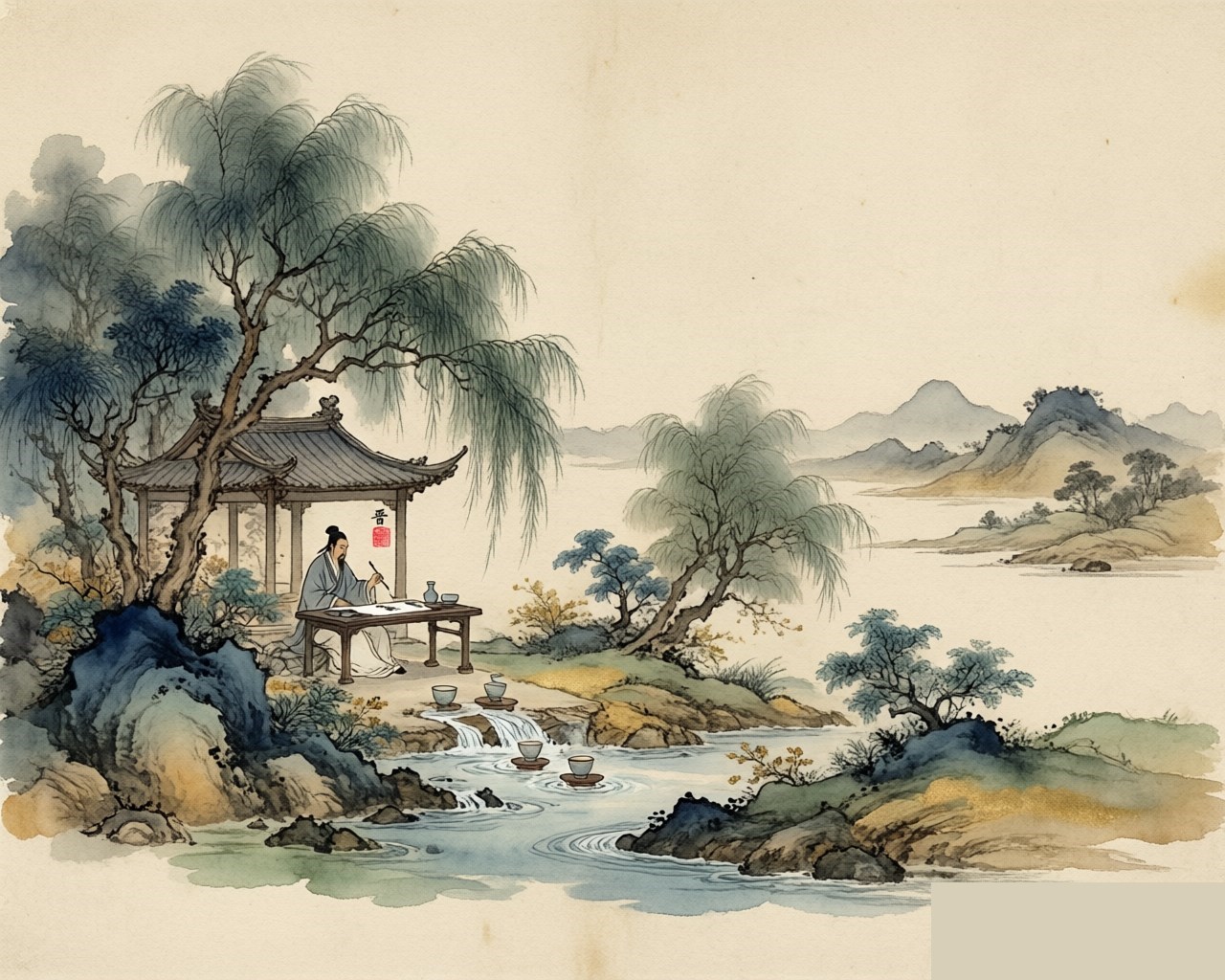
His most celebrated work is the Lanting Xu (兰亭集序), the "Preface to the Poems Composed at the Orchid Pavilion," written in 353 CE. The occasion was a spring gathering of scholars beside a winding stream at Lanting, near modern Shaoxing, where the guests played a drinking game: cups of wine were floated down the water, and whoever a cup stopped before had to compose a poem. Wang Xizhi wrote the preface to the collected verses, and in it he did something more lasting than any of the poems. Reflecting on the beauty of the day and the company, he turned, as the best Chinese writing so often does, to the sorrow beneath it — the certainty that this gathering would end, that the friends would scatter, that all of them would die. The joy of the moment and the grief of its passing are held together in a few lines of heartbreaking clarity. The original manuscript is lost — legend holds that it was buried with an emperor who loved it — but it survives in copies and rubbings that have been treasured and studied for more than a thousand years. It remains, for many, the single most beloved piece of calligraphy in the Chinese tradition.
Poetry of the Fields: Tao Yuanming
If Wang Xizhi gave the age its ideal of the artist, the poet Tao Yuanming (陶渊明) gave it its ideal of the life. Also known as Tao Qian, he was a minor official of the Eastern Jin who, in an act that became legendary, resigned his post rather than bow and scrape for a petty superior, famously declaring that he would not "bend his waist for five pecks of rice a day." He retired to his farm, where he lived in poverty, worked his fields, drank his wine, and wrote poems of such quiet perfection that they created, almost single-handedly, the Chinese tradition of pastoral poetry — the poetry of fields and gardens (田园诗, tianyuan shi).
Tao Yuanming's verse is deceptively simple: plain words about chrysanthemums, about the southern mountain, about the contentment of a cup of wine at dusk. But beneath the simplicity lies a profound philosophy of acceptance — a man who has looked at the ambitions of the world and chosen, with full awareness, the smaller and truer life. He also wrote one of the most enduring fables in the Chinese language, "The Peach Blossom Spring" (桃花源记), the story of a fisherman who stumbles upon a hidden valley where people live in perfect peace, cut off from the centuries of turmoil outside, and who can never find his way back. It became China's defining image of utopia — a paradise not of grandeur but of quiet, and one that, tellingly, can be found only by accident and never again. For a people living through an age of collapse, it was a dream with enormous power.
The Long Twilight and the Legacy of the South
The Eastern Jin lingered for a century after its founding, growing ever more the creature of its great families. It ended, fittingly, not with a foreign conquest but with an internal usurpation. In the early fifth century a general named Liu Yu, a man of humble birth who had risen through military talent, seized power and in 420 CE forced the last Jin emperor to abdicate, founding the Liu Song Dynasty. The Jin was over. But the pattern it had set would define the centuries to come: China divided between a north ruled by non-Han conquerors and a south ruled by a succession of Chinese dynasties — the era historians call the Northern and Southern Dynasties, which would not be reunited until the Sui, nearly two hundred years after the fall of Luoyang.
Yet the Jin's true inheritance was not political but cultural, and it proved far more durable than any border. The flight south had transplanted the heart of Chinese civilization to the Yangtze, and the Eastern Jin and its successor dynasties nurtured that transplanted culture until the south became, permanently, one of the great centers of Chinese life. The aristocratic refinement of the age, its cult of calligraphy, its pastoral poetry, its ideal of the cultivated recluse who finds wisdom in nature — these became the permanent furniture of the Chinese educated mind. Every later scholar who picked up a brush to imitate Wang Xizhi, every poet who wrote of fields and mountains, every painter who prized the empty space on the page as much as the inked, was working inside a tradition the Jin had shaped. The dynasty lost an empire. In its place it built an aesthetic — and that aesthetic outlived every dynasty that followed.
To read the Lanting Xu today, in Wang Xizhi's flowing hand, is to hear across seventeen centuries the voice of a man watching wine cups drift down a spring stream, knowing that the day is already passing into memory. The Jin Dynasty could not hold China together. But it taught China how to be beautiful while falling apart — and in a civilization that has always believed art is the truest form of survival, that may be the greater achievement.