In the Beginning, There Was Only Chaos
Before the first mountain thrust its shoulders above the plains, before the Yellow River carved its ancient path toward the sea, before even the concept of "before" had meaning, there existed only an undifferentiated void. The Chinese called it hundun (混沌) — a word that carries within its syllables the weight of absolute primordial darkness. No light. No sound. No separation between what was above and what was below. The universe was a single, formless mass, coiled upon itself like an embryo sleeping in the womb of eternity.
And within that boundless chaos, something stirred. Not a god in the Western sense — not a being who stood apart from creation and spoke it into existence with divine command. What stirred within the cosmic darkness was something far more intimate, far more embodied. It was Pangu (盘古), the first living thing, the seed of all that would come. He did not create the world from without. He became it from within.
This is the story that the ancient Chinese told themselves about the origin of all things — a story not of a distant architect, but of a sacrifice so total that the creator and the creation became indistinguishable. It is a cosmogony written in flesh and bone, in breath and blood, and it has shaped the Chinese imagination for nearly two millennia.
The Cosmic Egg and Eighteen Thousand Years of Sleep
The earliest written account of Pangu appears in the Sanwu Liji (三五历纪, "Historical Records of the Three Sovereign Divinities and the Five Gods"), compiled by the Three Kingdoms-era scholar Xu Zheng around the third century CE. Yet the myth itself is almost certainly far older, passed down through oral traditions in the southern reaches of China long before any brush touched silk to record it.
Xu Zheng's account begins with an image of startling simplicity: the universe was like a chicken's egg. Within this cosmic egg — this hundan ru ji zi (混沌如鸡子) — Pangu was formed. He grew slowly, imperceptibly, curled in the darkness like a child in the womb. And then he slept.
For eighteen thousand years, Pangu slept.
The number is not arbitrary. In Chinese numerology, eighteen thousand represents a completeness that transcends ordinary counting — a span of time so vast that it renders human history a mere flicker. During those eons of slumber, Pangu grew. His body expanded within the confines of the cosmic egg, pressing against the undifferentiated matter that surrounded him. The chaos, dense and heavy, resisted. But Pangu's growth was inexorable, patient, inevitable.
When at last he opened his eyes — eyes that had never seen light, for no light yet existed — he found himself imprisoned in absolute darkness. There was no sky to gaze upon, no earth to stand upon. There was only the suffocating sameness of undivided chaos pressing in from every direction. And Pangu, the first consciousness in the void, raged against it.
The Splitting of Heaven and Earth
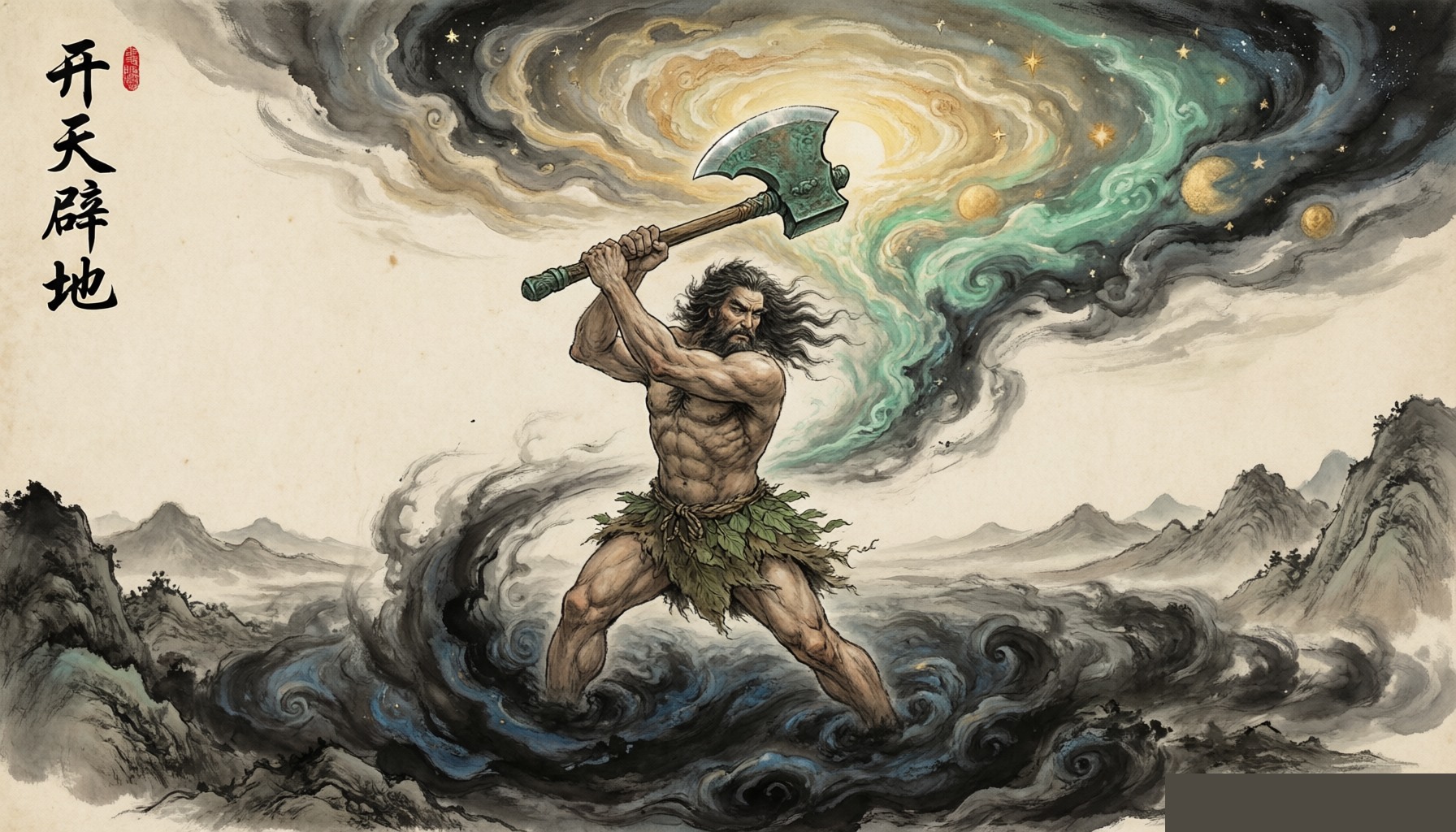
What happened next is one of the most iconic images in all of Chinese mythology. Pangu seized an axe — some traditions say it materialized from his will, others that it was born with him in the egg — and swung it into the darkness. The blow shattered the cosmic egg. The primordial chaos split asunder.
The lighter, purer elements — the yang (阳) — rose upward, luminous and ethereal, to form the heavens. The heavier, turbid elements — the yin (阴) — sank downward, dense and solid, to become the earth. For the first time, there was separation. For the first time, there was space between above and below, between light and dark, between the celestial and the terrestrial.
But the separation was fragile. Heaven and earth, newly born, strained toward each other, threatening to collapse back into the undifferentiated unity from which they had come. And so Pangu placed himself between them. His feet pressed down upon the earth; his head and hands pushed up against the sky. Day by day, the heavens rose ten feet higher, the earth grew ten feet thicker, and Pangu himself grew ten feet taller.
This labor continued for another eighteen thousand years. Pangu stood as the living pillar between heaven and earth, his body the sole guarantee that creation would not unravel. He was not a god who watched from a comfortable distance. He was the architecture itself, bearing the full weight of the cosmos upon his shoulders. Every inch of separation between sky and ground was purchased with his growth, his endurance, his unyielding will.
The Metamorphosis: A Body Becomes a World
When at last heaven and earth were firmly separated, when the distance between them was fixed and irreversible, Pangu's work was done. And Pangu died.
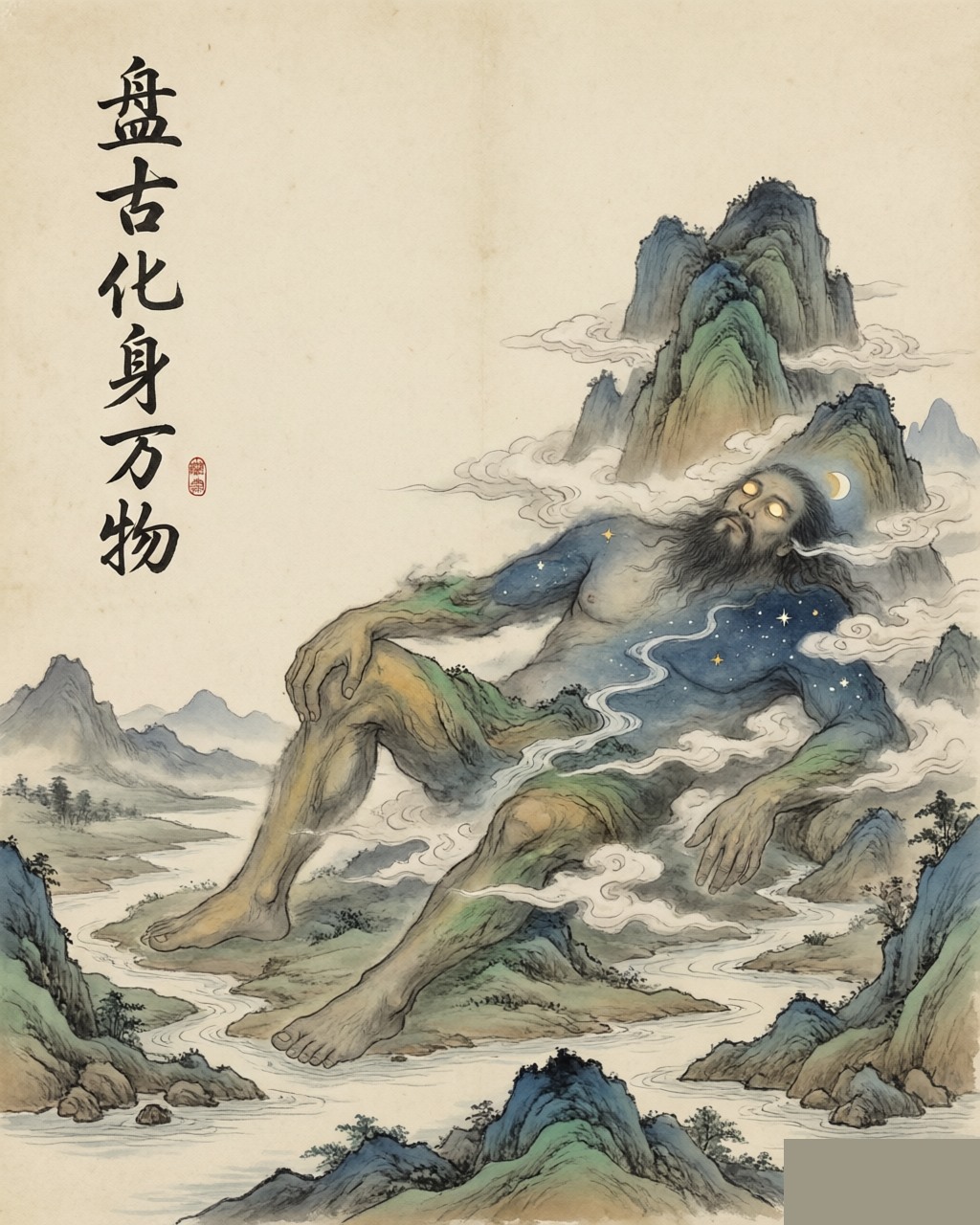
But his death was not an ending. It was the most extraordinary act of creation imaginable — a total self-transformation in which every part of his body became a feature of the natural world. The Wuyun Linian Ji (五运历年纪, "Records of the Five Cycles and Annual Periods") preserves this magnificent catalogue of metamorphosis:
His breath became the wind and the clouds. His voice became the thunder that rolls across the summer sky. His left eye became the sun, blazing with yang fire; his right eye became the moon, cool and luminous with yin radiance. His four limbs became the four pillars that hold up the sky at the cardinal directions. His five bodies became the five great mountains — Taishan, Huashan, Hengshan, Songshan, and Hengshan of the south.
His blood became the rivers that nourish the land. His sinews became the roads and paths that connect all places. His flesh became the fertile soil. His hair and beard became the stars scattered across the night sky. His skin and body hair became the grasses and forests that clothe the earth. His teeth and bones became the metals and minerals hidden in the mountains. His marrow became the pearls and jade buried in the depths. His sweat became the rain that falls upon all living things.
And the parasites that lived upon his body, scattered by the wind, became human beings themselves.
This is not merely a list. It is a theology. It tells us that the world is not a machine built by an external engineer. It is a body. It is alive. Every river is a vein, every mountain a bone, every gust of wind a breath. The Chinese landscape is not scenery — it is anatomy. To walk upon the earth is to walk upon Pangu. To drink from a river is to drink his blood. This understanding permeates Chinese poetry, painting, medicine, and philosophy to this day.
Pangu Among the World's Creation Myths
No creation myth exists in isolation. The story of Pangu invites comparison with the cosmogonies of other civilizations, and these comparisons illuminate what is distinctive about the Chinese vision of origins.
The cosmic egg motif appears across cultures. The Finnish Kalevala begins with a duck laying eggs upon the knee of the water-mother Ilmatar; the cracking of the egg forms sky and earth. Hindu tradition speaks of the Brahmanda, the golden cosmic egg from which Brahma emerges. The Orphic tradition of ancient Greece tells of Phanes hatching from a silver egg laid by Nyx. Yet in these traditions, the being who emerges from the egg typically goes on to create the world through further acts of will or speech. Pangu alone is the world. His creative act is not separate from his physical existence.
The Norse myth of Ymir offers the closest parallel. The primordial giant Ymir is slain by Odin and his brothers, and his body is fashioned into the world — flesh into earth, blood into sea, bones into mountains, skull into sky. The structural resemblance is striking, and some scholars have proposed ancient connections transmitted along the Silk Road or through shared Proto-Indo-European and Sino-Tibetan heritage. Yet the crucial difference lies in agency: Ymir is killed by others and dismembered against his will. Pangu transforms himself. His metamorphosis is voluntary, organic, a completion rather than a destruction. There is no violence in Pangu's death — only the exhaustion of purpose fulfilled.
The Genesis account of the Hebrew Bible presents yet another contrast. God creates through speech — "Let there be light" — and remains entirely separate from the creation. The creator stands outside the created order, transcendent and sovereign. Pangu, by contrast, is radically immanent. He does not speak the world into being. He is the world. The Chinese cosmogony knows no creator-creature distinction, no ontological gap between the divine and the material. This immanence would later find philosophical expression in Daoist concepts of the Dao as both source and substance of all things.
The Southern Origins and Ethnic Dimensions
It is significant that Pangu does not appear in the earliest Chinese texts. The Shijing, the Shujing, the Zuozhuan, even the Zhuangzi — none of them mention Pangu. The myth enters the written record relatively late, and scholars have long noted that its strongest roots lie not in the Central Plains civilization of the Yellow River, but among the Yao, Miao, and Zhuang peoples of southern China.
Among the Yao people of Guangxi and Hunan, Pangu is not merely a cosmic figure but an ancestral hero. Their oral traditions tell of Pangu as a culture-bringer who taught the people to farm, to weave, and to honor the rhythms of the natural world. The Miao people preserve songs of Pangu that are sung during funeral rites, guiding the soul of the deceased back through the layers of creation to its primordial source. The Zhuang people of Guangxi celebrate Pangu with festivals, temples, and elaborate ritual dramas that predate any written Chinese account.
This southern, multi-ethnic origin gives the Pangu myth a particular richness. It is not the exclusive property of Han Chinese civilization but a shared inheritance of the peoples who have inhabited southern China for millennia. When Xu Zheng recorded the myth in the third century, he was likely drawing upon oral traditions that had circulated among non-Han communities for generations. The myth traveled northward, was absorbed into the mainstream literary tradition, and eventually became "Chinese" in the broadest sense — but its roots remain plural, its origins polyphonic.
Pangu in Art, Literature, and Popular Culture
The image of Pangu — a colossal figure, often horned or wild-haired, wielding an axe between heaven and earth — has inspired Chinese artists for centuries. Han Dynasty stone reliefs from Shandong and Sichuan depict Pangu in various stages of his cosmic labor. Ming Dynasty illustrated encyclopedias show him standing between sun and moon, his body already beginning its transformation into landscape. Qing Dynasty paintings render the metamorphosis in exquisite detail, each body part labeled with its worldly counterpart.
In literature, Pangu appears as both subject and metaphor. The Tang Dynasty poet Hu Zeng wrote of "Pangu's axe splitting the primordial dark," using the image to evoke the violence and grandeur of cosmic origins. Later poets invoked Pangu as a symbol of solitary endurance — the figure who bears an impossible burden alone, without witness or reward. In the great Ming novel Journey to the West, the opening lines reference Pangu's separation of heaven and earth as the foundational act that set all subsequent history in motion.
In contemporary China, Pangu remains a living symbol. The Pangu King Temple (盘古王庙) in Huadu, Guangzhou, draws thousands of worshippers and tourists each year. The annual Pangu King Festival, celebrated on the twelfth day of the eighth lunar month, features lion dances, opera performances, and ritual offerings. In popular culture, Pangu appears in video games, animated films, and children's books — his story retold for each new generation with fresh visual imagination while preserving its essential architecture.
Beyond the gallery and the page, Pangu's legacy permeates Chinese philosophical and geomantic traditions. In feng shui practice, the landscape is read as a living body — mountains as vertebrae, waterways as arteries, valleys as the spaces between ribs. This corporeal reading of terrain is a direct inheritance of the Pangu metamorphosis. The practitioner who "reads the dragon veins" (龙脉) of a mountainside is, in mythic terms, tracing the sinews of Pangu's body, seeking the places where his vital energy still flows most strongly. To build a home or site a tomb in harmony with these currents is to nestle oneself into the anatomy of the creator, to find shelter within the body that became the world.
The Theology of Embodied Creation
What does the Pangu myth ultimately tell us about the Chinese understanding of existence? Perhaps this: that creation is not an event but a process, not a command but a transformation, not an imposition of order upon inert matter but the unfolding of potential already latent within chaos.
Pangu does not create the world as a potter creates a vessel — imposing form upon passive clay from without. He creates it as a seed creates a tree — from within, through growth, through the patient expenditure of self. The world is not made by Pangu. The world is made of Pangu. Creator and creation are one substance, one continuum. This vision resonates profoundly with the Daoist understanding of the Dao as both the source from which all things emerge and the medium through which they persist.
It also carries an ethical weight. If the world is a body — if mountains are bones and rivers are blood — then to damage the world is to wound a living being. The ecological implications of this vision, long dormant in an age of industrial extraction, are being rediscovered by contemporary Chinese environmental thinkers who find in Pangu's metamorphosis an ancient warrant for reverence toward the natural world. The earth is not a resource to be exploited. It is a body to be honored. It is Pangu, still breathing, still alive in every stone and stream.
In the end, the myth of Pangu offers something that few other creation stories provide: a vision of creation as total gift. Pangu holds nothing back. He does not reserve a corner of himself, does not ascend to a heavenly realm to enjoy the fruits of his labor. He gives everything — every drop of blood, every strand of hair, every fragment of bone — until nothing remains that is not world. It is, in its own mythic register, a story about love. About the love that holds nothing in reserve. About the creator who disappears into the creation so completely that to find one is to find the other.
And so, when you stand beneath the vast Chinese sky and watch the sun set behind the western mountains, know this: you are watching Pangu's left eye close for the night. And when the rain falls soft upon your face, know that it is his sweat, still falling after eighteen thousand years, still nourishing the world he became.