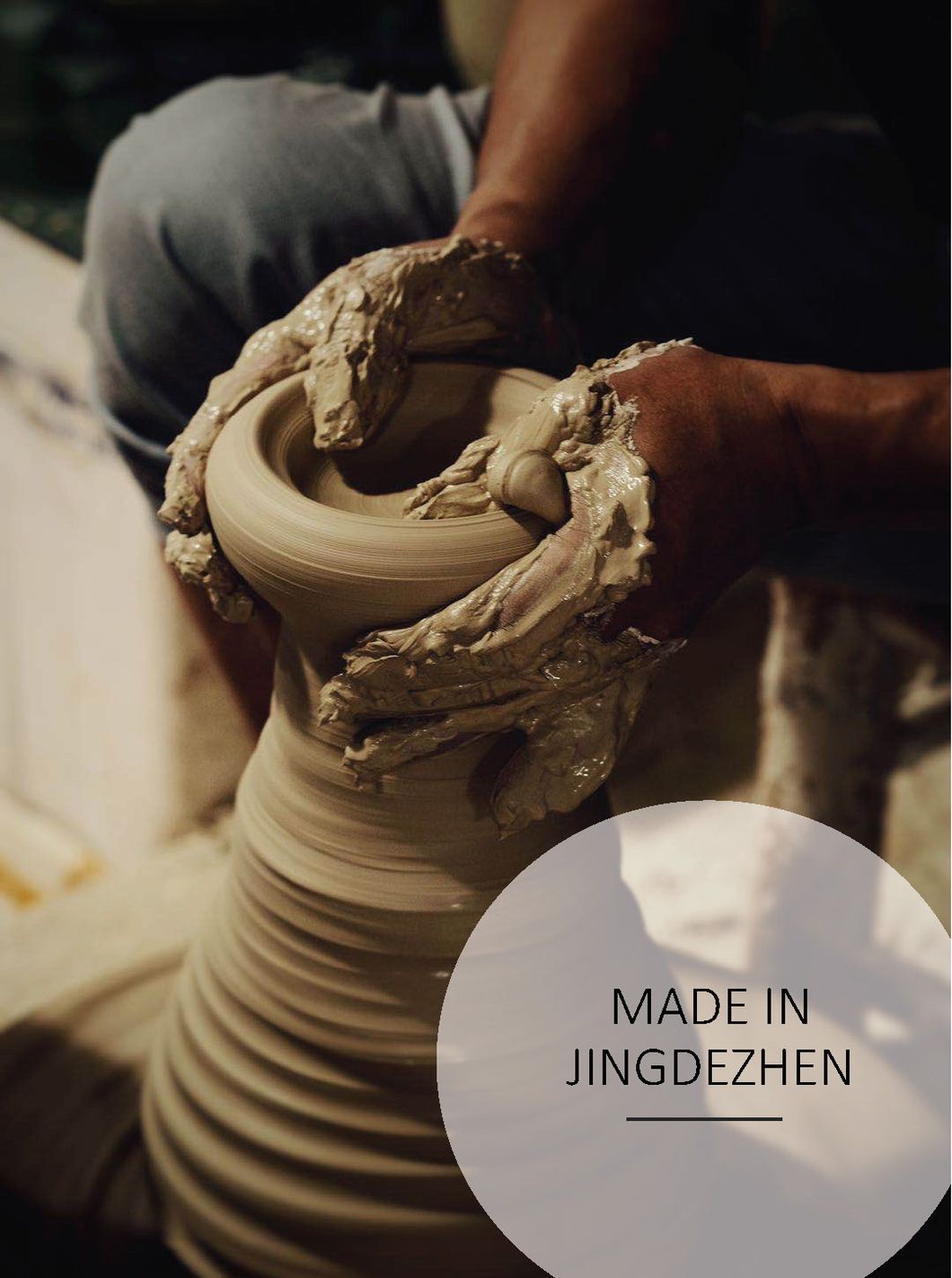
In the misty hills of northeastern Jiangxi province, where the Chang River bends lazily through valleys of pine and bamboo, there exists a town that has shaped the material culture of the entire world. Jingdezhen — named after the Song dynasty emperor Zhenzong, whose reign title "Jingde" graced the town's finest wares — has been producing porcelain for over a thousand years. Its kilns have never gone cold. From the Song dynasty through the Yuan, Ming, and Qing, and into the present day, the fires of Jingdezhen have transformed humble earth into objects of such transcendent beauty that they once commanded prices exceeding their weight in gold.
Among all the treasures born from these kilns, none has achieved greater universal recognition than blue and white porcelain — qinghua ci (青花瓷). Its marriage of cobalt blue and porcelain white is so fundamental to our visual vocabulary that it adorns everything from Dutch Delft tiles to Japanese tea bowls, from Portuguese azulejos to the humble willow-pattern plates found in every Western kitchen. Yet the original — the Jingdezhen original — remains unmatched in its depth, its luminosity, and its quiet perfection.
The Alchemy of Earth and Fire
To understand blue and white porcelain, one must first understand the violence of its creation. The process begins with gaoling tu (高岭土) — kaolin clay, named after the village of Gaoling just outside Jingdezhen where it was first mined. This clay, mixed with petuntse (porcelain stone), is washed, aged, kneaded, and wedged until every air bubble is expelled. The potter then throws the form on a wheel, shaping walls so thin that light passes through them like paper.
But the true magic lies in the painting. Using a brush loaded with cobalt oxide — historically imported from Persia as sumani qing (苏麻离青) — the artist paints directly onto the unfired, unglazed body. There is no erasing, no correction. Every stroke must be decisive, every line committed. The painter works in grey-black, unable to see the final blue that will emerge from the fire. Then the piece is dipped in a transparent feldspar glaze, concealing the painting beneath a milky veil.
Finally, the kiln. Loaded into a dragon kiln or, in later periods, an egg-shaped zhenyao (镇窑), the piece endures temperatures exceeding 1,300 degrees Celsius for over twenty-four hours. In that inferno, the cobalt fuses with the glaze, the body vitrifies into true porcelain, and the grey-black painting erupts into a blue of impossible depth — the blue of a mountain lake seen from a great height, the blue of the sky just before the stars appear.
The Yuan Revolution
While earlier Song dynasty potters had experimented with underglaze cobalt decoration, it was the Yuan dynasty (1271–1368) that transformed blue and white from a curiosity into a revolution. The Mongol empire, stretching from Korea to Hungary, opened trade routes that brought Persian cobalt to Chinese kilns and Chinese porcelain to Islamic courts. The Yuan taste was bold, exuberant, unafraid of density. Where Song aesthetics prized restraint and monochrome subtlety, Yuan blue and white covered entire surfaces with layered registers of decoration — lotus scrolls, cloud bands, geometric borders — framing central panels of dragons, fish, or narrative scenes.
"The kiln fire transforms earth into jade; the painter's brush transforms silence into song."
— Traditional Jingdezhen potter's saying
The most celebrated Yuan pieces are the massive meiping (plum vases) and dahuan (large jars) that survive in collections from Istanbul's Topkapi Palace to the British Museum. Their sheer scale — some exceeding forty centimeters in height — and the confidence of their painting represent a quantum leap in ceramic ambition.
Ming Perfection and Imperial Patronage
The Ming dynasty (1368–1644) elevated blue and white to an imperial art. In 1369, the Hongwu Emperor established the Imperial Kiln Factory (yuyao chang) at Jingdezhen, dedicating the finest potters exclusively to court production. Under the Yongle (1403–1424) and Xuande (1426–1435) reigns, blue and white reached what many consider its absolute zenith. The imported "Sumatra blue" cobalt produced a rich, slightly purple-tinged color with characteristic "heaping and piling" — dark spots where the pigment pooled, giving the painting a three-dimensional, almost tactile quality.
The Chenghua reign (1465–1487) introduced a different sensibility: lighter, more delicate, painted with a finer brush and a paler, more even blue. Chenghua doucai (contrasting colors) pieces, combining underglaze blue with overglaze enamels, are among the rarest and most valuable ceramics ever produced. A single Chenghua "chicken cup" sold at auction in 2014 for over thirty-six million dollars.
A Language of Symbols
Every motif on blue and white porcelain carries meaning. The five-clawed dragon represents the emperor himself; the phoenix (fenghuang) represents the empress. Together, they symbolize the harmony of yin and yang, the union of sovereign powers. The peony — huawang, king of flowers — signifies wealth and honor. The lotus signifies purity, rising unstained from muddy water. Pine, bamboo, and plum together form the "Three Friends of Winter," representing resilience through hardship.
Landscapes on porcelain reference the great tradition of Chinese painting: misty mountains, solitary scholars, fishermen on still waters. Border patterns of ruyi clouds, key-fret (huiwen) bands, and lappet panels frame the central compositions like the borders of a scroll painting. To read a piece of blue and white is to read an entire cosmology encoded in cobalt.
How to Appreciate Porcelain
The connoisseur examines a piece of blue and white with all five senses. The eye reads the quality of the painting — is the brushwork fluid and confident, or hesitant and mechanical? The hand feels the weight, the smoothness of the glaze, the precision of the foot ring. The ear listens: a fine porcelain piece, tapped gently, rings like a bell. A flawed piece sounds dull, cracked, dead.
Hold a piece up to the light. True porcelain is translucent; you should see the shadow of your fingers through the wall. Examine the base: the unglazed foot ring reveals the color and texture of the body, the marks of the potter's tools, sometimes the reign mark written in underglaze blue. These details tell you not just when and where a piece was made, but by whose hand and for whose table.
Jingdezhen Today
Walk through Jingdezhen's Taoxichuan district today and you will find the old and the new in constant dialogue. In converted factory buildings, young ceramicists experiment with contemporary forms while honoring traditional techniques. The ancient kiln sites — the Hutian kilns, the Longquan kilns — are preserved as archaeological parks. The Imperial Kiln Museum, opened in 2022, displays shards excavated from the Ming factory site: pieces that were smashed and buried because they failed to meet imperial standards, yet which today would be considered masterpieces.
The town still produces. Master potters still throw, still paint, still fire. The kaolin hills are diminished but not exhausted. And in workshops along the Chang River, a young painter loads her brush with cobalt, bends over an unfired plate, and begins to paint a dragon. The gesture is a thousand years old. The blue that will emerge from the fire will be the same blue that astonished the courts of the Yuan khans, that filled the treasure ships of Zheng He, that made European monarchs weep with envy. Some things, once perfected, cannot be improved. They can only be continued.