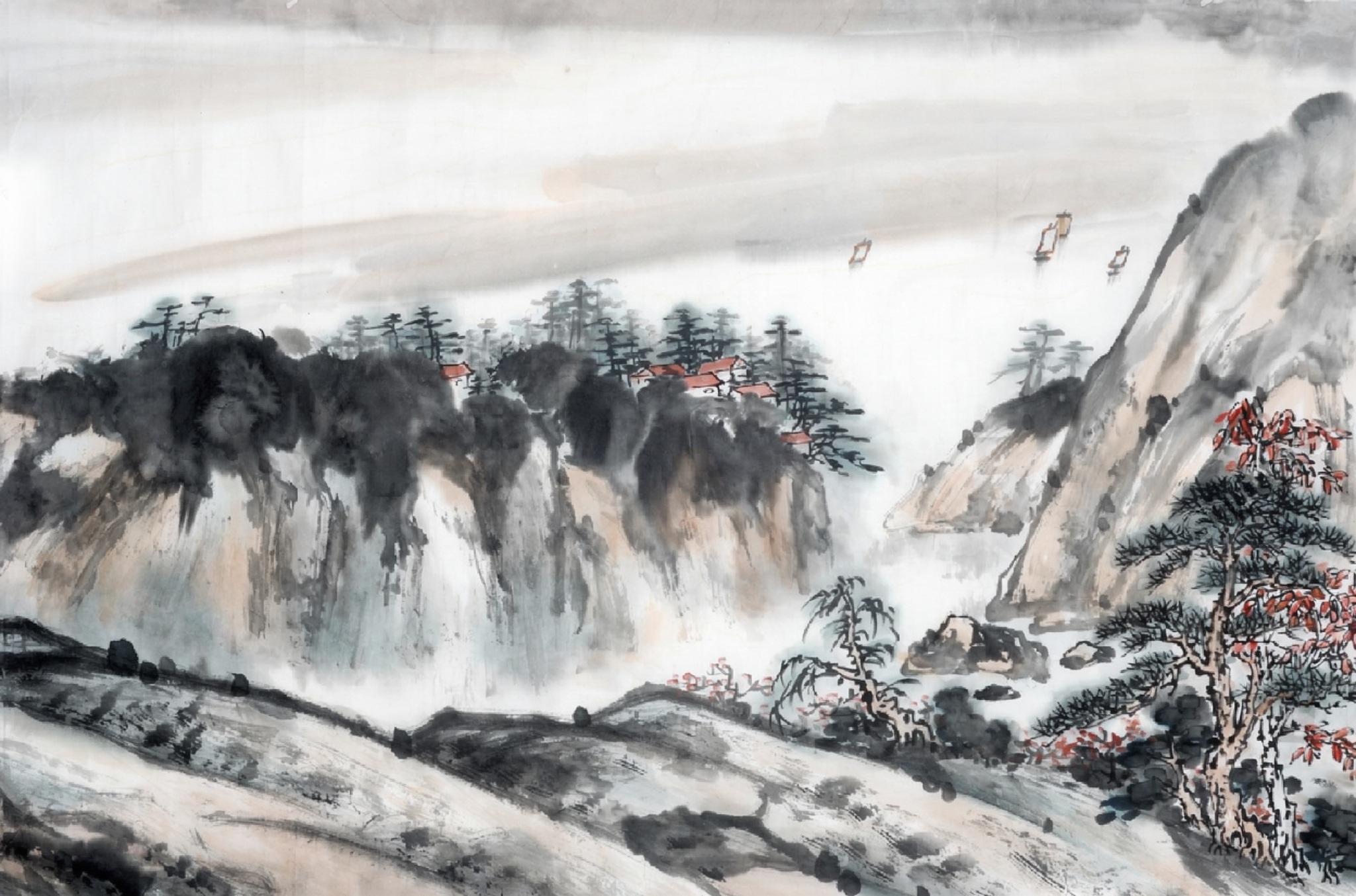
Look at a Chinese landscape painting — a true one, a Song dynasty masterwork — and you will notice something extraordinary. The most powerful element in the composition is not there. It is the white of the paper, the unpainted void, the silence between the mountains. Where a Western painter fills every inch of canvas with pigment, the Chinese master leaves vast expanses of raw silk untouched. And that emptiness is not absence. It is cloud, mist, water, sky, infinity. It is the Dao itself, formless and inexhaustible, from which all form emerges and to which all form returns.
This is 水墨画 (shuǐmò huà), ink wash painting — the art tradition that has defined Chinese visual culture for over a thousand years. It is an art built on paradox: that less is more, that emptiness is fullness, that the most profound statement is the one left unmade. To understand it, one must unlearn nearly everything the Western tradition teaches about what a painting is and what it does.
Shan Shui: Mountains and Waters as Cosmology
The Chinese word for landscape painting is 山水画 (shānshuǐ huà) — literally, "mountain-water painting." This is not a casual compound. In Chinese cosmology, the mountain represents 阳 (yáng): solid, upright, enduring, reaching toward heaven. The water represents 阴 (yīn): yielding, flowing, descending, nourishing all things. Together, they are the fundamental dynamic of the universe — the eternal interplay of complementary forces that generates all life.
A shan shui painting is therefore never a "view" in the Western sense. It is not a record of what a particular place looked like on a particular afternoon. It is a cosmological diagram, a meditation on the structure of reality. The painter who sits before his silk does not ask, "What does this mountain look like?" He asks, "What is the mountain's qi? What is its spirit? How does it breathe?" The resulting image may bear little resemblance to any actual geography, yet it captures something more true than topography: the inner life of the landscape.
"The wise find pleasure in water; the virtuous find pleasure in mountains. The wise are active; the virtuous are tranquil. The wise are joyful; the virtuous are long-lived."
— Confucius, Analerta (Lunyu), Book VI
The Six Principles: Xie He's Ancient Framework
In the fifth century CE, the critic 谢赫 (Xiè Hè) codified six principles by which all painting should be judged. They remain, fifteen centuries later, the foundational framework of Chinese art criticism:
First and supreme is 气韵生动 (qìyùn shēngdòng) — "spirit resonance" or "life-movement." A painting must breathe. It must possess an animating vitality that transcends technical correctness. A technically perfect painting without qi is dead; a rough, imperfect painting with qi is alive. This principle alone explains why Chinese painting values expressiveness over accuracy, why a single inspired brushstroke outweighs a thousand careful ones.
The remaining five principles — bone-method in brushwork (骨法用笔), correspondence to form (应物象形), suitability in coloring (随类赋彩), division and planning of composition (经营位置), and transmission by copying (传移模写) — are all in service of the first. They are means; spirit resonance is the end.
The Viewer Completes the Painting
Perhaps the most radical difference between Chinese and Western painting lies in the role of the viewer. A Western oil painting, particularly after the Renaissance, is a closed system: the artist has rendered everything, filled every space, controlled every detail. The viewer's role is to receive, to admire, to interpret — but not to create.
A Chinese ink painting is an open system. The mist that obscures the middle distance is not painted; it is the white of the paper. The viewer's mind fills it with cloud, with atmosphere, with the memory of every misty morning they have ever witnessed. The painting is not finished until the viewer completes it with their imagination. This is why Chinese paintings are often experienced as scrolls, unrolled slowly, section by section — the viewer literally walks through the landscape in time, discovering each vista as it emerges from the void.
The Southern Song painter Ma Yuan was called "One-Corner Ma" (马一角, Mǎ Yījiǎo) because he composed his paintings with all the visual weight concentrated in a single corner, leaving the rest as luminous emptiness. The viewer's eye is drawn not to what is painted but to what is not — to the infinite suggestion of the blank silk. In this emptiness, the mind wanders freely, projecting its own mountains, its own waters, its own infinite landscape.
Masters of the Void: From Wang Wei to the Four Masters
The tradition credits 王维 (Wáng Wéi, 699–759 CE), the Tang dynasty poet-painter, with founding the "Southern School" of ink painting — the literati tradition that prized spontaneity and spiritual expression over technical polish. Su Shi, the great Song polymath, declared that Wang Wei's paintings contained poetry and his poetry contained paintings, establishing the ideal of the unified artist that would dominate Chinese aesthetics for a millennium.
The Song dynasty produced the monumental landscape tradition: Fan Kuan's 溪山行旅图 (Travelers Among Mountains and Streams), a towering cliff face that dwarfs the tiny human figures below, asserting the sublime indifference of nature. Guo Xi's 早春图 (Early Spring), where the mountains seem to writhe and breathe with organic energy, the ink shifting from dense black to pale grey like weather systems moving across a valley.
The Yuan dynasty's Four Masters — Huang Gongwang, Wu Zhen, Ni Zan, and Wang Meng — transformed landscape painting into an act of personal expression. Ni Zan, the most austere, painted almost nothing: a few bare trees, a low hill, an empty pavilion, and vast stretches of nothing. His paintings are among the most radical statements of emptiness in all of world art. When asked why he painted no human figures, he replied, "There are no people in this world." It was not misanthropy; it was metaphysics.
Ink Against the West: Two Ways of Seeing
The comparison with Western painting illuminates both traditions. European painting, from the Renaissance onward, was built on the geometry of perspective — a fixed viewpoint, a vanishing point, the illusion of three-dimensional space on a flat surface. The Chinese painter rejected this entirely. The shan shui tradition employs what is called "scattered perspective" (散点透视, sǎndiǎn tòushì): the viewer's eye moves through the painting as through actual space, looking up at peaks, down into valleys, across rivers, with no single fixed position.
Where Western painting sought to replicate the optical experience of a single moment, Chinese painting sought to capture the temporal experience of dwelling in a landscape over hours and days. A handscroll may be twenty feet long, containing an entire journey — departure, travel, arrival, rest — experienced over the thirty minutes of unrolling. It is closer to cinema than to photography, closer to music than to architecture.
And where Western painting, until the twentieth century, filled its surfaces completely, Chinese painting always honored the void. The white space is not background; it is the painting's most active element. It is the silence in music that gives the notes their meaning. It is the emptiness of the bowl that makes it useful. It is, in the end, the Dao: the formless source from which all ten thousand things emerge, and to which, in the end, they all return.
To stand before a great ink painting — to let the mist enter you, to feel the mountains breathe, to lose yourself in the white silence between the brushstrokes — is to experience a form of contemplation that the modern world has nearly forgotten. It asks nothing of you except presence. It shows you nothing except everything. And in its emptiness, it is full beyond measure.