There is an art form in China that is considered higher than painting, more expressive than poetry, and more revealing of the soul than any spoken word. It requires no subject matter, tells no story, depicts nothing. It is simply the act of writing — but writing elevated to such a pitch of physical, spiritual, and aesthetic intensity that a single character, brushed in three seconds, can make a viewer weep. This is 书法 (shūfǎ), Chinese calligraphy: the dance frozen in ink.
For over three thousand years, from the oracle bone inscriptions of the Shang dynasty to the contemporary studios of Beijing and Taipei, calligraphy has occupied the supreme position in the Chinese artistic hierarchy. It was the first art a scholar mastered, the skill by which emperors were judged, and the practice through which monks achieved enlightenment. To understand Chinese civilization, one must first understand the brush.
The Four Treasures of the Study
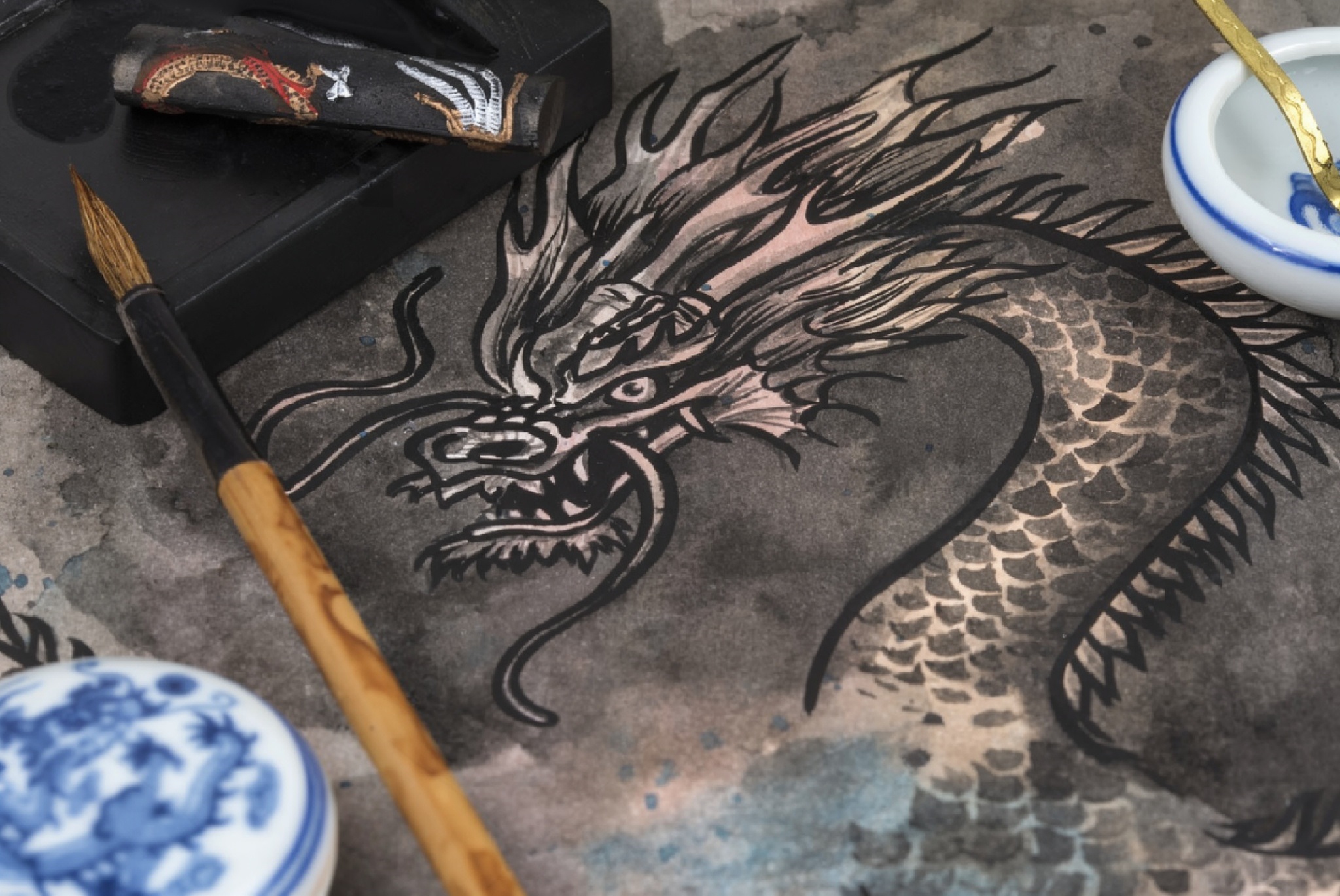
Every calligrapher's practice begins with the 文房四宝 (wénfáng sìbǎo), the Four Treasures of the Study: brush, ink, paper, and inkstone. These are not mere tools; they are collaborators, each with its own character, history, and demands.
The brush (笔, bǐ) is the soul of the art. Made from animal hair — rabbit, goat, wolf, or the legendary "purple hair" of a mountain hare — bound to a bamboo shaft, it is an instrument of extraordinary sensitivity. A skilled calligrapher can produce a line as fine as a spider's silk or as broad as a sword blade, all with the same brush, by varying pressure, speed, and angle. The great brushes of Huzhou, Zhejiang province, have been crafted for over sixteen centuries, each one assembled by hand from hairs selected one by one.
The ink (墨, mò) is traditionally a solid stick, ground with water on an inkstone (砚, yàn) in a slow, meditative circular motion. This grinding is not preparation; it is practice. The calligrapher uses those minutes to calm the breath, focus the mind, and enter the state of concentrated emptiness from which great writing emerges. The finest inkstones — carved from the purple-green stone of Duanxi in Guangdong — are themselves treasures worth more than gold, their surfaces worn smooth by generations of grinding.
The paper (纸, zhǐ) is typically 宣纸 (xuānzhǐ), Xuan paper from Anhui province, made from the bark of the sandalwood tree. Its absorbency is calibrated to capture every nuance of the brush: the dry, rough texture of a "flying white" stroke, the wet bloom of a fully loaded tip, the feathered edge where ink meets fiber. A calligrapher who does not understand his paper is like a pianist who has never listened to his instrument.
Five Scripts, Five Temperaments
Chinese calligraphy evolved through five major script styles, each reflecting the aesthetic sensibility of its era. The oldest is 篆书 (zhuànshū), seal script — the rounded, symmetrical forms carved into bronze vessels and stone steles of the Qin and Han dynasties. It is architectural, monumental, each character a small temple of balanced curves.
From seal script emerged 隶书 (lìshū), clerical script, developed by bureaucratic scribes who needed speed. Its horizontal emphasis and "silkworm head, wild goose tail" strokes gave Chinese writing its characteristic wide stance. Then came 楷书 (kǎishū), regular script — the disciplined, geometric standard that every student learns first, every stroke governed by strict rules of proportion and order.
But it is in the two "running" scripts that calligraphy becomes truly alive. 行书 (xíngshū), running script, loosens the rigid structure of regular script into flowing, connected movement — the characters still legible but breathing, leaning, reaching toward one another. And finally, 草书 (cǎoshū), cursive script, where legibility dissolves entirely into pure gesture. In cursive script, a character may be reduced to a single sweeping line, a whirl of ink that captures not the shape of the word but its energy, its qi.
"In the ancients' calligraphy, one can see the flight of birds, the leap of beasts, the sway of willows, the crash of thunder. All things in heaven and earth find their form in the brush."
— Han Yu, Tang Dynasty essayist
The Sage of Calligraphy: Wang Xizhi
No discussion of Chinese calligraphy can proceed far without arriving at 王羲之 (Wáng Xīzhī, 303–361 CE), the "Sage of Calligraphy" whose Preface to the Poems Composed at the Orchid Pavilion (兰亭集序, Lántíng Jíxù) is revered as the supreme masterpiece of the art. Written in 353 CE during a spring gathering of scholars beside a winding stream, the preface is a work of running script of such natural grace, such effortless variation, that every subsequent generation has studied it and despaired.
The story goes that Wang Xizhi, slightly drunk at the gathering, dashed off the preface in a state of inspired flow. The next morning, sober, he attempted to reproduce it — and failed. Every subsequent attempt fell short of the original's spontaneous perfection. The work's power lay precisely in its unrepeatable immediacy, the brush moving faster than conscious thought could interfere.
Centuries later, the Tang emperor Taizong so coveted the original that he allegedly had it buried with him in his tomb. What survives are copies of copies — yet even these transmit an electricity that makes the hand tremble.
Yan Zhenqing and the Moral Brushstroke
If Wang Xizhi represents calligraphy as natural grace, 颜真卿 (Yán Zhēnqīng, 709–785 CE) represents calligraphy as moral force. His bold, muscular regular script — broad-shouldered, upright, unyielding — became the visual embodiment of Confucian virtue. When Yan was sent to negotiate with a rebel general at age seventy-five and was executed for his refusal to submit, his calligraphy took on an additional dimension: each stroke became an act of loyalty made visible.
His Draft of a Requiem to My Nephew (祭侄文稿, Jì Zhí Wéngǎo), written in anguished cursive upon learning that his young nephew had been killed defending the dynasty, is considered the second-greatest calligraphic work in Chinese history. The ink blots, the crossed-out characters, the places where the brush runs dry and scratches across the paper — these are not flaws but the most honest record of a man's grief. The art transcends beauty into truth.
Calligraphy as Spiritual Cultivation
In the Chan Buddhist tradition, calligraphy is not art but practice — a form of moving meditation indistinguishable from zazen. The monk-painter writes a single character, 空 (kōng, "emptiness"), and in the act of writing, empties himself. The brush becomes an extension of breath; the stroke, a record of presence. There is no revision, no correction. What the brush records is the state of the mind in that irreversible moment.
This is why calligraphy has always been considered the most revealing of arts. A painting can hide behind technique; a poem can hide behind cleverness. But a brushstroke, executed in a fraction of a second, cannot lie. The tremor of anxiety, the confidence of mastery, the looseness of intoxication, the rigidity of fear — all are recorded in ink with forensic precision. The ancient critics claimed they could read a man's character, predict his fate, and diagnose his health from a single page of his writing. They were not entirely wrong.
To practice calligraphy today — to grind the ink, to wet the brush, to breathe, to write — is to enter a stream of continuous practice stretching back three millennia. The characters you write were written by Wang Xizhi, by Yan Zhenqing, by emperors and monks and exiled poets. The brush in your hand is the same brush. The ink is the same ink. And for the duration of the stroke, you are part of the longest unbroken artistic tradition in human history.